Urban Form: Carving from an Overmantel
The Overmantel as Armature: Geometric Integrity and the 2026 Executive Silhouette
The overmantel is not a decorative surface. It is a load-bearing proposition. In the two artifacts under examination—the Udumbara Flowers (Udonge) temple plaque and the Chest for Storing Garments—the architectural logic of the object precedes its ornament. Addison Fashion reads this as a directive for the 2026 executive wardrobe: the garment must first function as structure, then as surface. The silhouette is carved, not draped.
I. The Plaque as Negative Volume
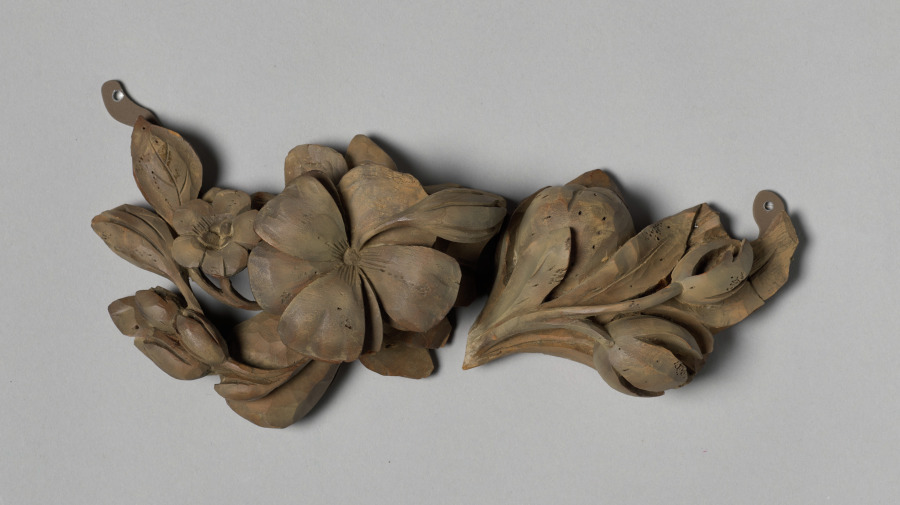
The Udonge plaque operates through subtraction. Its geometry is that of a weathered rectangle—a slab whose proportions are governed by the grain of the wood, not by the symmetry of the flower it names. The udumbara is a flower that cannot be seen; it exists only as a name, a void, a three-thousand-year interval. The plaque does not depict it. The plaque is the interval. This is the first principle of the 2026 silhouette: the garment must not illustrate the body. It must become the temporal space in which the body is suspended.
Note the edge condition. The plaque’s perimeter is not crisp. It is eroded, lichen-stained, gold lacquer flaking into the grain. This is material honesty at the threshold. For Addison’s tailoring, this translates to a shoulder line that is architecturally precise but not aggressive—a seam that acknowledges the body beneath without sealing it. The 2026 executive jacket will feature a collapsed shoulder that retains its structural integrity through internal canvas rather than external padding. The geometry is felt, not seen. Like the plaque’s wood grain, the silhouette reveals its logic only upon sustained scrutiny.
II. The Chest as Positive Container
The Chest for Storing Garments presents the inverse operation. Here, geometry is additive. The chest is a rectilinear volume—a box—whose decoration is contained within a rigid frame. The painted flowers do not break the frame; they inhabit it. This is the second principle: containment as luxury. The 2026 executive silhouette will reject the fluid, unmoored layering of the previous decade. Instead, it will return to the closed form—the coat that encloses, the trouser that terminates cleanly at the ankle, the bag that is a box, not a sack.
The chest’s joinery is invisible. Its corners are mitred. Its surface is lacquered to a high sheen. This is the urban materiality of the future: Onyx as a chromatic register—not black, but the deep, light-absorbing black of aged urushi. The fabric will be a bonded wool-silk with a low sheen, its surface interrupting light only at the fold. The chest’s painted flowers—peonies, chrysanthemums, plum blossoms—are rendered with a precision that borders on the mechanical. Each petal is a discrete unit. This is the logic of the 2026 print: not a repeat, but a modular field, where each motif is placed with the deliberateness of a structural rivet.
III. The Interval Between: Structural Poetics
The two objects share a single aesthetic proposition: how to make the flower a carrier of meaning rather than a mere graphic. The plaque does this through absence; the chest through presence. The 2026 silhouette will operate in the interval between these poles. It will be Minimalist in its refusal of excess, yet Tailored in its insistence on internal architecture. The executive will wear a garment that is simultaneously a plaque and a chest—a surface that names the invisible and contains the visible.
Consider the geometry of the overmantel itself. It is a horizontal band above a fireplace, a transitional zone between the hearth and the wall. It is neither functional nor purely decorative. It is a threshold object. The 2026 silhouette will embrace this threshold condition. The jacket will be cut to the hip, not the knee. The sleeve will end at the wrist bone, not the knuckle. The proportion will be compressed, not elongated. This is the geometry of the plaque: a rectangle that holds its ground.
IV. Urban Materiality: Onyx and the Weathered Surface
The urban environment of 2026 will be denser, quieter, more mineral. The palette will contract. Onyx will dominate—not as a fashion color, but as a material condition. The fabric will be a double-faced cashmere with a matte finish, its reverse side a technical satin. The garment will be reversible in theory but not in practice; the wearer will choose one face and commit. This is the discipline of the chest: a single, resolved surface.
The plaque’s weathering—its cracks, its moss, its flaking gold—will inform the surface treatment of the 2026 collection. Not distress, but patina. A laser-etched micro-pattern on the wool will mimic the grain of aged cedar. A hand-finished seam will reveal the thread’s tension, like the lacquer’s crackle. The garment will not look new. It will look inevitable.
V. The Silhouette as Koan
The udumbara blooms once every three thousand years. The chest’s flowers bloom every spring. The 2026 executive silhouette must accommodate both temporalities. It must be a garment that is worn daily yet feels ceremonial. It must be a structure that is rigid yet breathes. It must be a surface that is opaque yet reveals depth.
This is the final geometric integrity: the silhouette as a koan. The wearer does not resolve the contradiction between the plaque and the chest. The wearer inhabits it. The overmantel is not a decoration. It is a carving. And the 2026 executive will be carved, not dressed.