Urban Form: Enthroned Virgin and Child
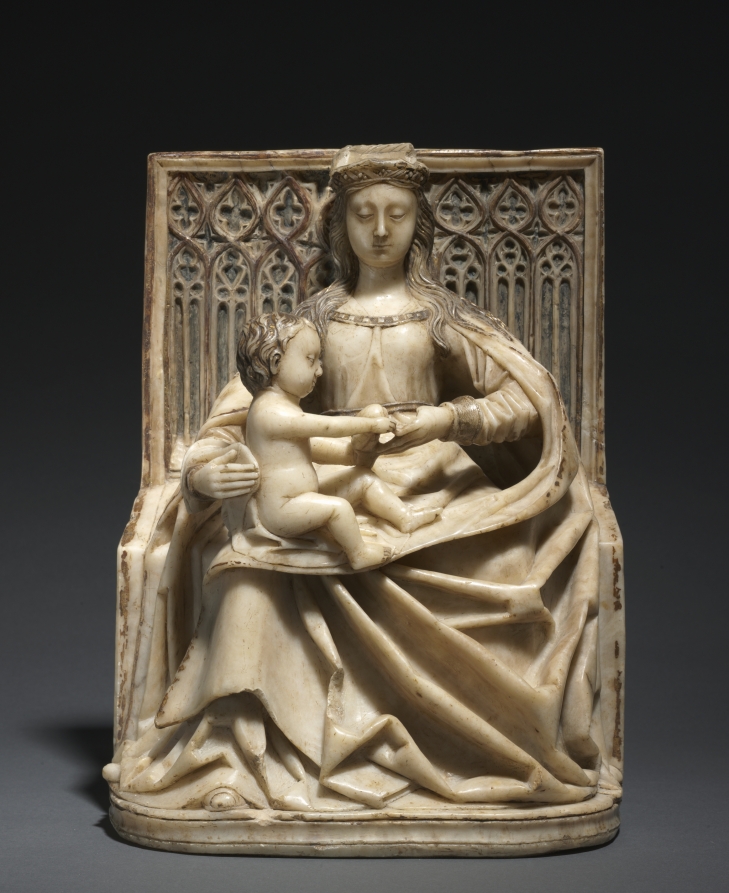
Urban Silhouette Research: The Enthroned Virgin and Child as Structural Archetype
I. Preliminary Taxonomy: The Sedentary Throne as Formal Constraint
The Enthroned Virgin and Child—whether rendered in the Romanesque rigidity of the Auvergne or the Gothic attenuation of the Île-de-France—presents a singular problem in silhouette engineering: the reconciliation of a static, frontal, architecturally anchored mass with a subsidiary figure whose organic asymmetry threatens to destabilize the whole. For the Addison Fashion NYC atelier, this is not a devotional inquiry but a morphological one. The throne is not furniture; it is a load-bearing exoskeleton that dictates the drape, the fall, and the permissible range of the Virgin's mantle. The Child, positioned off-axis and often cradled at the left or right knee, introduces a calculated asymmetry that prevents the composition from collapsing into bureaucratic symmetry.
This is the first principle of the 2026 executive wardrobe: authority must be seated, not merely worn. The modern C-suite silhouette, particularly for women navigating the brutal optics of the Manhattan boardroom, has for too long oscillated between two failed poles—the aggressive shoulder-padded parody of masculine hierarchy and the unstructured fluidity that reads as indecision. The Enthroned Virgin offers a third path. The throne's vertical uprights and horizontal seat create a rectilinear armature against which the textile can fall in controlled, columnar folds. The body is not hidden; it is framed.
II. Chromatic Restraint: The Onyx Principle
The palette of the Enthroned Virgin is, in its most austere Romanesque iterations, a study in chromatic denial. The Virgin's robe is typically a deep, saturated blue—lapis lazuli, the most expensive pigment in the medieval West—but the throne itself is often rendered in gold, ivory, or a muted polychrome that recedes. The Child's flesh tones provide the only warm interruption. This is a hierarchy of chroma: the structural element (throne) is neutralized; the primary figure (Virgin) carries the saturated authority; the subsidiary figure (Child) provides the accent.
For Addison's 2026 Onyx collection, we translate this into a three-tier chromatic architecture. The base layer—trousers, column skirts, and the new "throne-cut" blazer with its extended, squared shoulder line—is executed in matte onyx wool crepe. It is the armature: invisible in its neutrality, indispensable in its structure. The secondary layer—the silk charmeuse blouse or the bias-cut midi dress—carries the saturated depth: a midnight teal, a bruised aubergine, a deep oxblood. This is the Virgin's lapis: the point of visual gravity. The accent layer—a single gold-tone cuff, a bone-colored leather glove, a silver pin at the throat—is the Child: small, warm, asymmetrically placed, and absolutely essential to preventing the composition from reading as funereal.
III. The Udumbara Dialectic: Emptiness as Structural Device
The DNA source invokes the Udumbara flower—the Buddhist fig that blooms once every three thousand years—as a counterpoint to the Han dynasty mirror's crowded cosmology. The Udumbara plaque is a study in subtractive aesthetics: the wood grain is preserved as a natural texture, the petals are carved with the staccato rhythm of Zen brushwork, and the negative space is not empty but pregnant. The mirror, by contrast, is additive: four deities, a chariot, a white tiger, all compressed into a centrifugal composition that leaves no surface unmarked.
The Enthroned Virgin occupies a middle position. It is neither as reductive as the Udumbara plaque nor as saturated as the Han mirror. The throne provides architectural negative space—the void between the uprights, the shadow beneath the seat—while the Virgin's mantle provides textural density. This is the dialectic that informs the 2026 Addison silhouette: the void must be engineered as deliberately as the volume.
In practical terms, this means the executive wardrobe must incorporate what we term "structural omission"—the deliberate removal of fabric where a lesser house would add a seam, a dart, a decorative flourish. A blazer with no lapel, closed with a single concealed hook. A trouser with no front crease, its line established purely by the bias of the cut. A coat with no visible closure, its volume held by the tension of the weave alone. These are not minimalist gestures; they are load-bearing absences, as essential to the silhouette as the throne's uprights are to the Virgin's drape.
IV. The White Tiger's Velocity: Dynamic Tension in Static Form
The Han mirror's white tiger is a study in compressed motion—the beast's tail curls like flame, its muscles are cast in bronze tension, its open mouth suggests a roar frozen at the moment of emission. This is the dao of the mirror: the eternal return, the cosmic circuit, the animal that never stops running even as it is fixed in metal.
The Enthroned Virgin, by contrast, is static authority. She does not move; she is seated. But the Child in her lap introduces a subtle kinetic counterpoint—a reaching hand, a turned head, a leg that dangles rather than rests. This is the micro-dynamic that prevents the throne from becoming a tomb.
For the 2026 executive wardrobe, this translates into controlled asymmetry. A blazer whose right shoulder is subtly extended, its left shoulder cropped. A skirt whose hem is sliced on the bias, creating a diagonal that suggests motion without sacrificing the columnar line. A sleeve that is full at the wrist and fitted at the elbow, or vice versa. These are not decorative gestures; they are kinetic inscriptions—the white tiger's velocity encoded in the fall of a hem, the turn of a cuff, the angle of a lapel.
V. Conclusion: The Throne as Wardrobe, the Wardrobe as Throne
The Enthroned Virgin and Child is not a painting of a woman and a baby. It is a diagram of authority—a structural system in which the throne, the body, and the subsidiary figure negotiate a stable but dynamic equilibrium. The Udumbara plaque and the Han mirror provide the chromatic and kinetic poles: the one reductive, silent, and empty; the other additive, centrifugal, and dense. The Virgin occupies the center: seated, saturated, and still.
For Addison Fashion NYC's 2026 Onyx collection, this is the mandate. The executive wardrobe must be architectural without being rigid, chromatically restrained without being colorless, and asymmetrically dynamic without being unstable. The throne is not a piece of furniture. It is a silhouette. And the silhouette is not a shape. It is a system of load-bearing decisions—each seam, each omission, each accent a structural member in the edifice of modern authority.
The Udumbara blooms once every three thousand years. The white tiger runs forever. The Virgin sits at the center, and the Child reaches out. The wardrobe must do all three.