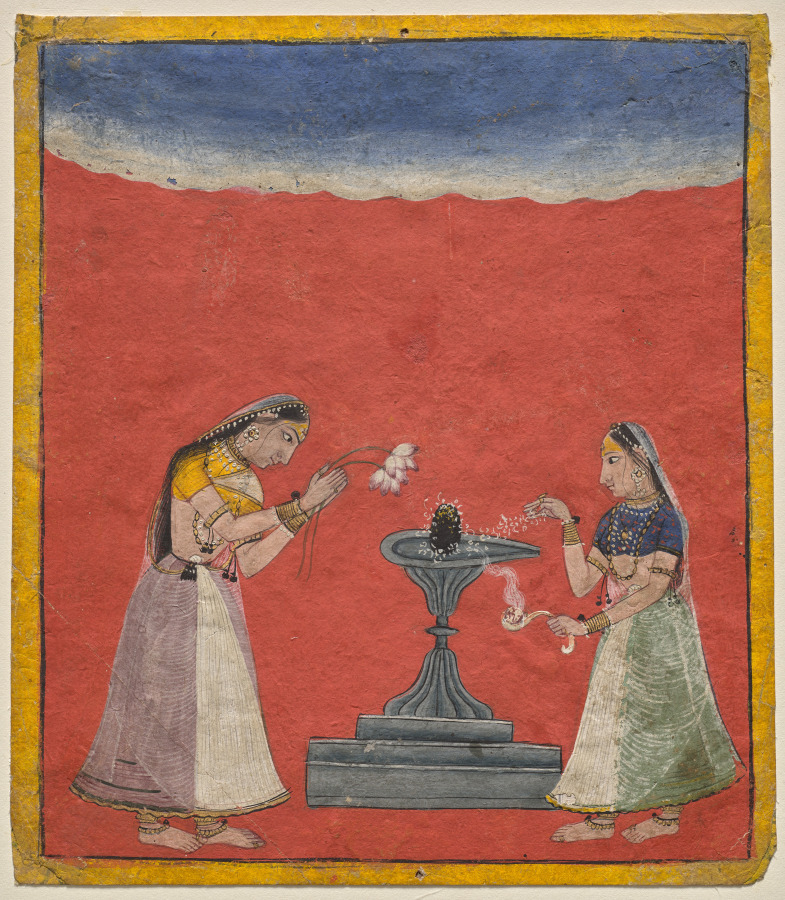
Urban Form: Women worshiping a Shiva linga: Devagandhari Ragini of Hindol Raga, from a Ragamala
Urban Silhouette Research: Devagandhari Ragini and the Architecture of Devotional Form
Preliminary Observations on Source Material
The Devagandhari Ragini folio—a woman or women in devotional posture before a Shiva linga—presents a compositional problem of considerable formal interest. The linga functions as a vertical axis, a monolith of compressed spiritual capital, while the female figures arrange themselves in subordinate horizontal registers. This tension between the phallic vertical and the supplicant horizontal generates the image's structural energy. The palette is restrained: mineral pigments yielding ochre, terre verte, slate-grey, and a muted vermilion that operates as chromatic punctuation rather than atmospheric field. The women's bodies are rendered as continuous contour—no chiaroscuro, no anatomical excavation—reducing the figure to a silhouette event against the architectural ground. This is not portraiture. It is typological form.
Formal Deconstruction: The Linga as Silhouette Anchor
The Shiva linga occupies the central vertical third of the composition. Its silhouette is cylindrical with a domed terminus—a form that resists both figuration and ornament. In Ragamala convention, the linga is often draped with a thin textile or floral garland, introducing a secondary silhouette layer that softens the monolith's severity. This is a critical formal maneuver: the hard edge of the sacred object is mediated by a soft, organic overlay. The women's bodies echo this logic. Their saris and odhnis create fluid, uninterrupted contours from shoulder to ankle, while their hands and faces—the only exposed skin—function as focal apertures within an otherwise continuous textile field. The composition thus operates on a binary of containment and exposure: the linga is contained by its drapery, the women are contained by their garments, and the negative space between them is activated by gestural asymmetry—one figure leans forward, another kneels, a third stands with hands folded. This is choreographed imbalance, not static symmetry.
Color Logic: Muted Saturation and Hierarchical Chroma
The Devagandhari Ragini's palette is deliberately desaturated. The ground is a warm sand or pale ochre, the architecture a cool slate-grey, and the figures' textiles a restrained range of ivory, muted indigo, and faded madder. The linga itself is often rendered in dark stone or deep charcoal, making it the chromatic anchor—the darkest value in the composition. This is a hierarchical color system: the sacred object absorbs light, the human figures reflect it, and the architectural ground recedes into atmospheric neutrality. The vermilion accents—a tilaka mark, a flower, a border detail—function as semiotic triggers, directing the eye to points of ritual significance. For the 2026 executive wardrobe, this translates into a Slate-dominant palette with Ivory and Sand as secondary fields, punctuated by controlled vermilion or oxblood accents at the collar, cuff, or closure. The logic is chromatic restraint as authority—not absence of color, but strategic deployment of saturation.
Silhouette Translation: The Devotional Contour as Executive Armor
The women's silhouettes in the Ragini are defined by continuous, unbroken lines from shoulder to hem. There is no waist cinching, no peplum, no structural interruption. The textile drapes rather than sculpts. This is a fluid silhouette—but not in the contemporary sense of loose or oversized. It is fluid because it follows the body's natural architecture without imposing a secondary geometry. For the 2026 NYC executive wardrobe, this suggests a return to the column: long, unbroken outerwear—a duster coat, a sleeveless vest, a tunic-length blazer—that skims rather than grips. The linga's verticality informs the proportion system: a single, dominant vertical line (a center-front placket, a column of buttons, a scarf worn long) should anchor the look, while horizontal gestures (a wide belt, a cropped jacket, a folded collar) remain subordinate and asymmetrical. The garland overlay on the linga translates into textural layering: a fine-gauge knit beneath a structured wool, a silk scarf over a matte crepe, a sheer organza panel over a solid base. The principle is soft over hard, organic over geometric.
Materiality and the Tactile Register
The Ragini's material world is paper, pigment, and cloth—all matte, absorbent surfaces. There is no gloss, no metallic sheen, no reflective finish. The linga's stone is unpolished; the textiles are handwoven and slightly irregular. For the executive wardrobe, this argues for matte wool, brushed cotton, raw silk, and felted cashmere—fabrics that absorb light rather than deflect it. Slate as the primary color should be rendered in textured weaves: herringbone, birdseye, flannel, and heavy crepe. Ivory should appear as undyed or minimally processed—raw silk, unbleached linen, ecru wool. Silver hardware—buttons, zipper pulls, cufflinks—should be brushed or oxidized, never polished. The vermilion accent should be matte: a silk pocket square, a leather trim, a lacquered button. The overall tactile impression is recessive luxury—quality that whispers rather than announces.
Compositional Strategy for the 2026 Executive
The Devagandhari Ragini's compositional intelligence lies in its asymmetric balance. The linga is centered, but the women are distributed unevenly—two on the left, one on the right, or vice versa. The visual weight is counterbalanced by gesture and gaze, not by mirroring. For the executive wardrobe, this translates into proportion play: a long, columnar coat balanced by a cropped, structured shoulder; a voluminous trouser offset by a fitted, high-necked top; a monolithic bag (the linga) paired with delicate, minimal jewelry (the supplicant figures). The negative space between garments—the gap at the wrist, the open collar, the unbuttoned hem—should be deliberate and architectural. This is not about revealing skin; it is about revealing structure. The 2026 executive does not dress to be seen. She dresses to be read—as a composition of vertical authority, muted chroma, and tactile restraint. The Devagandhari Ragini, with its linga-anchored verticality and supplicant horizontality, provides the formal grammar. The translation is Slate, Ivory, Sand, and a whisper of vermilion—a wardrobe that functions as secular devotion to form.