Urban Form: Architecture of the Middle Ages: Staircase, St. Maclou, Rouen
The Architecture of Ascent: St. Maclou and the 2026 Executive Silhouette
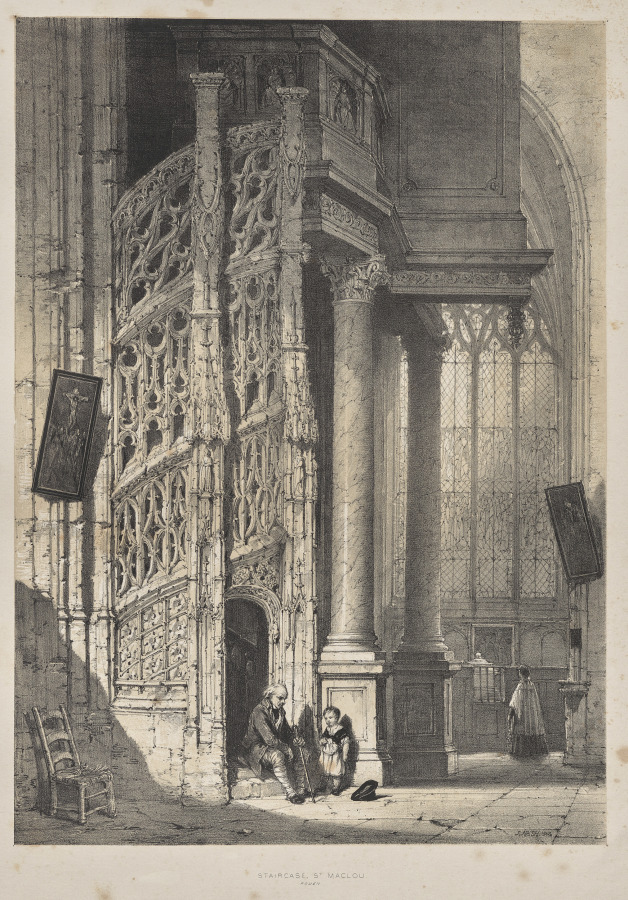
The staircase of St. Maclou in Rouen is not merely an architectural appendage. It is a manifesto carved in stone, a declaration that ascent itself can be monumental. For Addison Fashion's 2026 Urban Silhouette Research, this Flamboyant Gothic structure—with its spiraling helix, its pierced balustrades, its vertical insistence—offers a precise vocabulary for the executive wardrobe. The staircase does not decorate; it organizes space around a principle of controlled upward motion. This is the essence of the coming season's tailoring.
Geometric Integrity: The Spiral as Structural Logic
Examine the staircase's geometry with clinical detachment. The central newel—a single, unbroken column—anchors the entire composition. Around it, the steps rotate with mathematical inevitability, each tread a repetition of the last, yet each rotation introducing subtle variation in light and shadow. This is not ornamentation for its own sake. It is structural recursion: a system where the part reflects the whole, where every element serves the integrity of the ascending line.
Translated to the body, this logic demands a silhouette that spirals around the wearer's axis. The 2026 Addison executive does not dress in flat planes. She dresses in helical volumes—garments that wrap, that turn, that create a continuous line from shoulder to hem without interruption. A double-faced wool coat with a single asymmetric seam that travels from the left clavicle to the right hip. A column dress in bonded crepe, its side seams displaced forward, creating a subtle torque that mimics the staircase's rotation. The geometry is severe, but it is not rigid. It breathes because it moves.
The Pierced Balustrade: Transparency and Defense
St. Maclou's balustrade is a paradox. It protects, yet it is perforated. It defines a boundary, yet it allows vision to pass through. The stone is carved into tracery so fine that solidity becomes lace. This is the architectural equivalent of armor that reveals rather than conceals.
For 2026, this translates into urban materiality that negotiates between exposure and protection. Consider a tailored jacket in double-faced cashmere, its lapels cut away in a geometric lattice—not a print, but actual negative space, revealing the silk charmeuse beneath. Consider trousers in bonded wool with laser-cut perforations along the outer seam, creating a rhythm of opacity and transparency that echoes the balustrade's cadence. The executive silhouette is not a fortress. It is a filter—a structure that admits light, air, and scrutiny while maintaining absolute composure.
The palette must follow. Onyx dominates, but it is not flat. It is a black that absorbs and reflects, that shifts from matte to sheen depending on the angle of approach. This is the color of carved stone at dusk—dense, authoritative, yet alive with subtle variation.
Verticality and the Executive Gaze
The staircase ascends. It does not meander. Every element—the newel, the treads, the handrail, the lancet windows above—reinforces a single vector: upward. This vertical insistence is the defining characteristic of the 2026 Addison silhouette. Hemlines drop, but not to the floor. Shoulders are pronounced, but not exaggerated. The waist is defined, but not cinched. The result is a line that draws the eye from the shoe to the crown of the head in one uninterrupted sweep.
This is achieved through construction, not corsetry. A shoulder pad that extends slightly beyond the natural shoulder, tapering to nothing at the sleeve head. A trouser with a high rise and a single pleat that releases into a straight leg, creating a column from waist to ankle. A coat with a collar that stands away from the neck, framing the face like a Gothic arch frames a rose window. The body is not confined; it is architecturally amplified.
Urban Materiality: Stone, Steel, and Silk
Rouen's staircase is limestone—weathered, porous, marked by centuries of use. But its form is precise, its edges still sharp where the carvers' chisels finished their work. The 2026 collection must capture this duality: materials that age with dignity, but structures that retain their edge.
Think of a trench coat in waxed cotton with a bonded leather collar, the wax creating a patina that deepens with each wearing. Think of a knit dress in fine-gauge merino, its surface interrupted by a single architectural seam that runs from the neck to the hem, a line as deliberate as the newel of St. Maclou. Think of accessories—a bag with a handle that spirals, a belt with a buckle that echoes the staircase's ironwork—that extend the architectural language without becoming costume.
The urban environment demands resilience. The executive moves through streets, through lobbies, through negotiations. Her clothing must be as structurally sound as the staircase that inspired it—capable of bearing weight, of facilitating ascent, of remaining beautiful under pressure. This is not fashion as decoration. This is fashion as infrastructure.
Conclusion: The Ascent as Silhouette
The staircase of St. Maclou is a machine for rising. The 2026 Addison silhouette is a machine for being seen while rising. It is minimalist not in its lack of detail, but in its refusal to include anything that does not serve the ascending line. It is Onyx not as a color, but as a condition—dense, authoritative, and endlessly deep. The executive who wears it does not simply occupy space. She organizes it, step by step, rotation by rotation, until the eye reaches the top and finds her there, already looking down.
This is the architecture of power. This is the Addison standard.