Urban Form: Christ Carrying the Cross with Saints Simon and Veronica
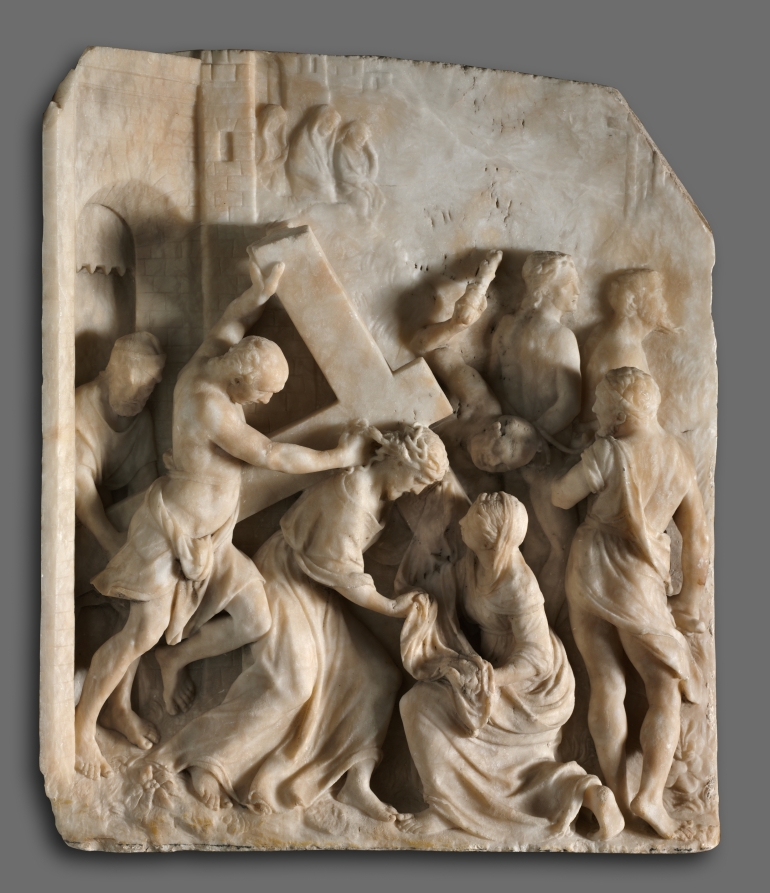
Urban Silhouette Research: Christ Carrying the Cross with Saints Simon and Veronica
I. Geometric Integrity: The Diagonal as Structural Doctrine
The composition operates on a single, ruthless axis: the diagonal of the Cross. This is not a decorative inclination but a load-bearing vector. It bisects the pictorial field with the indifference of a structural beam, converting narrative space into an architectural section. Christ’s body, compressed beneath this diagonal, becomes a study in compressive stress—the torso folds, the knees buckle, yet the spine retains a vertical ambition. This tension between the descending timber and the ascending will defines the artwork’s geometric integrity: a countervailing force held in permanent suspension.
For the 2026 executive silhouette, this translates into a doctrine of asymmetric load-bearing. The Addison wardrobe will not drape; it will support. Shoulders are engineered as cantilevers, extended beyond the natural line to suggest the Cross’s horizontal reach. The waist is suppressed—not cinched, but compressed, as Christ’s ribcage is compressed against the wood. The result is a silhouette that reads as both burdened and indomitable: a vertical monolith interrupted by a single, decisive diagonal seam.
II. The Saints as Peripheral Architecture
Simon and Veronica function as flanking buttresses. They do not participate in the central drama; they stabilize it. Simon’s grip on the Cross is a compression joint—fingers locked, forearm angled to redirect force. Veronica’s veil is a tensile membrane, stretched between her hands and Christ’s face, capturing the imprint not of a face but of a pressure differential. These figures are not characters; they are structural nodes, distributing the visual weight of the composition outward from the diagonal’s apex.
In urban materiality, this suggests modular layering. The 2026 executive will wear garments that function as peripheral architecture: a detachable collar that acts as a compression ring, a sleeve that extends the shoulder line into a tensile arc. The body is the central span; the clothing is the scaffolding that prevents collapse. Addison’s design language will favor exposed seams—not as ornament, but as visible load paths, the sartorial equivalent of Simon’s gripping hand.
III. Materiality: The Weight of Representation
The painting’s surface is a negotiation between opacity and abrasion. The Cross is rendered in a dense, unyielding brown—a material that absorbs light rather than reflecting it. Christ’s flesh is pallid, almost translucent, as if the body is being erased by the weight it bears. The saints’ garments are matte, their folds carved with the economy of a woodblock print. There is no sheen, no luxury of surface. This is materiality as moral condition: the heavier the load, the coarser the texture.
For Addison’s 2026 collection, this demands a rejection of polished finishes. The palette will be Onyx—not glossy, but matte black with a granular hand, akin to compressed charcoal or oxidized iron. Fabrics will be dense wool crepe, bonded cotton, resin-treated linen—materials that hold a crease like a scar holds memory. The silhouette will not float; it will settle, the way the Cross settles into Christ’s shoulder. Weight is not a flaw; it is the proof of structural honesty.
IV. The Urban Context: Compression and Release
The painting depicts a procession—a movement through space that is also a movement through time. The diagonal of the Cross is a trajectory, not a static form. It implies destination, exhaustion, and the inevitability of arrival. In the urban grid, this translates into kinetic tailoring: garments designed for the transit between power and exposure, between the boardroom and the street. The 2026 executive does not sit; she moves under load.
The silhouette must therefore accommodate compression and release. A jacket that is fitted at the ribcage but flared at the hem mimics the Cross’s diagonal: narrow where the weight is greatest, expansive where the burden lifts. Trousers will be high-waisted and tapered, the fabric pooling minimally at the ankle—a gesture toward Veronica’s veil, which catches what falls and holds it in suspension.
V. Conclusion: The Silhouette as Moral Geometry
Christ Carrying the Cross with Saints Simon and Veronica is not a painting of suffering. It is a diagram of endurance. Its geometric integrity lies in the refusal to resolve the diagonal—the Cross never reaches the ground, the body never fully collapses. The 2026 Addison silhouette must inherit this unresolved tension. It must be Minimalist not in its austerity, but in its structural necessity: every seam a load path, every fold a compression, every hem a release. The executive who wears it does not adorn herself; she assumes a geometry. She carries the weight. She does not break.