Urban Form: Architecture of the Middle Ages: At Senlis
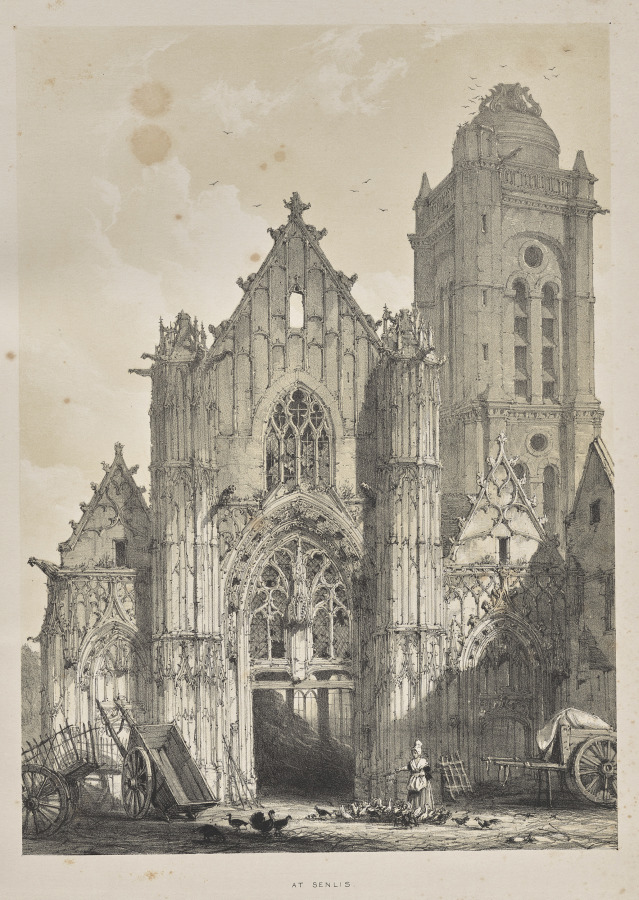
The Senlis Protocol: Structural Poetics of the Medieval Plane
The architectural vocabulary of Senlis—its truncated nave, the taut verticality of its flying buttresses, the disciplined geometry of the transept crossing—constitutes a primary source for the 2026 executive silhouette. This is not a nostalgic quotation of the Gothic. It is a rigorous extraction of load-bearing logic, transposed into the grammar of urban tailoring. The Addison position is unambiguous: the medieval wall, stripped of ornament, is the most honest structural document in the Western canon, and its translation into cloth must proceed with the same cold precision with which the mason set stone upon stone.
Geometric Integrity: The Bay System as Pattern Architecture
The defining unit at Senlis is the bay—a repeated module of vertical pier, pointed arch, and clerestory aperture. This tripartite division operates as a proportional algorithm, not a decorative motif. Each bay resolves the conflict between lateral thrust and vertical aspiration through a calculated distribution of mass. In the 2026 silhouette, this logic manifests as a three-zone construction: the shoulder line as pier (fixed, load-bearing, uncompromising), the waist as arch (the point of dynamic transfer), and the hem as clerestory (the release of visual weight into air). The integrity of the garment depends on the refusal to soften these transitions. Where the medieval mason allowed no ambiguity between structure and infill, the Addison pattern allows no ambiguity between tailored plane and fluid drape. The seam is a structural joint. It must read as such.
The pointed arch deserves specific attention. Its geometry—two intersecting arcs whose centers lie outside the span—produces a form that is simultaneously compressive and ascending. Translated to the shoulder and lapel, this yields the 2026 ogival shoulder: a line that rises from the armhole with controlled tension, neither padded into aggression nor collapsed into softness. The apex of the arch corresponds to the cervical point; the springing line to the deltoid. This is measurable, repeatable, and therefore executable at production scale.
Structural Poetics: The Flying Buttress as Counterweight Tailoring
The flying buttress is the most sophisticated engineering proposition of the Middle Ages: an external armature that permits the interior wall to dissolve into glass. Its poetics lie in visible support—the admission that stability is achieved through counterforce, not mass alone. For the 2026 executive silhouette, this principle governs the relationship between the garment and the body beneath it. The Addison construction introduces an externalized counterweight system: a discrete rear yoke and side-panel architecture that carries the garment's structural load away from the front plane, allowing the chest and torso to present as a clean, uninterrupted surface. The result is a silhouette that appears weightless at the front precisely because the weight has been relocated, visibly and honestly, to the back and sides.
This is the antithesis of the concealed-construction tradition. The Addison method does not hide its armature; it choreographs it. The counterweight panel becomes a design element—a slate-grey structural ribbon, a disciplined seam line—that announces its function. Urban materiality demands this honesty. The executive who wears the garment is not seeking the illusion of effortlessness; she is seeking the evidence of engineering.
Urban Materiality: Stone, Glass, and the Weight of Light
Senlis is a study in material contrast: the dense limestone of the pier against the translucent glass of the clerestory. The 2026 silhouette must reproduce this tonal and textural opposition within a single garment. The Addison specification pairs a dense, matte wool-silk suiting—onyx in tone, with a dry, stone-like hand—against knife-pleated organza or technical mesh at the underarm gusset and hem release. The dense fabric carries the architectural load; the translucent fabric admits light and motion. The boundary between them is a hard edge, not a gradient. This is the medieval wall logic: mass and aperture in direct, unmediated contact.
The color discipline is equally structural. Onyx as the primary field absorbs light and reinforces the silhouette's authority. Slate appears only at the counterweight seams and the ogival shoulder binding—a functional accent, not a decorative one. No color is permitted to migrate across a structural boundary. The palette is a load diagram.
Conclusion: The 2026 Executive Silhouette as Load-Bearing Form
The Senlis research yields a definitive proposition: the 2026 executive silhouette is a compressive system in tension. It derives its authority not from volume or ornament but from the legible distribution of structural force—pier, arch, and clerestory; counterweight and release; mass and aperture. The geometric integrity of the medieval bay, translated through the Addison pattern architecture, produces a garment that is at once monastic in its discipline and urban in its material intelligence. This is the Addison position for 2026: architecture as tailoring, tailoring as architecture, and no seam without a reason.