Urban Form: Two Standing Apostles (probably Saint John the Evangelist and St. Paul)
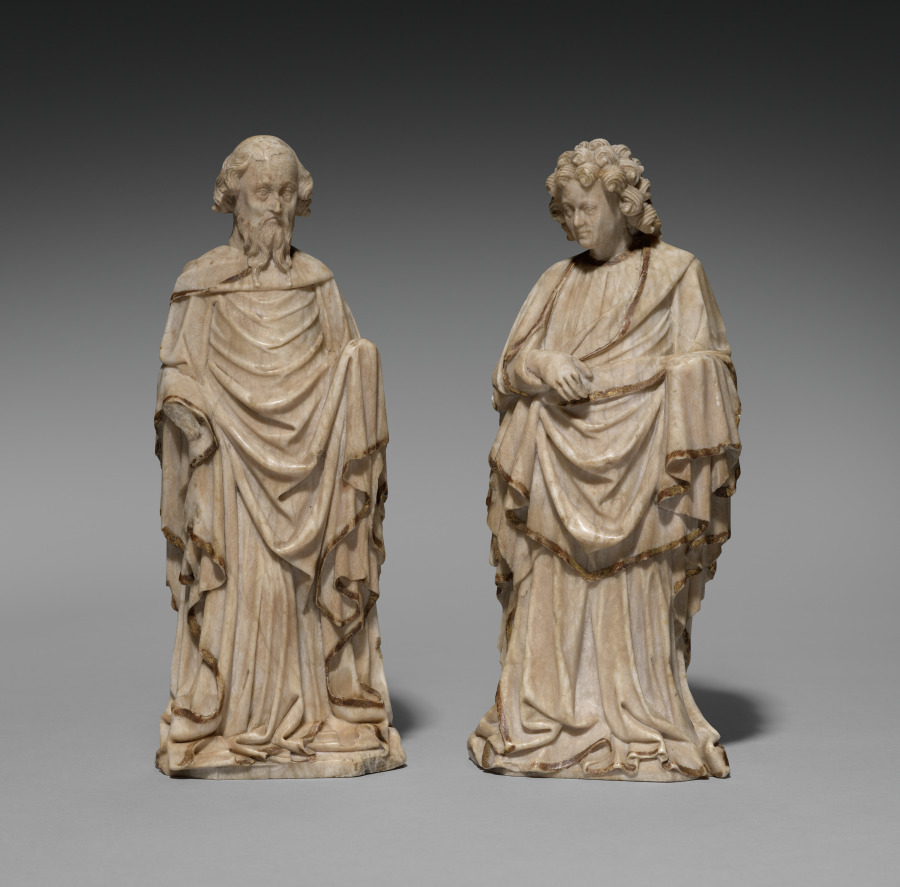
Urban Silhouette Research: The Standing Apostle as Structural Prototype
I. The Vertical Axis and the Architecture of Stillness
The Two Standing Apostles—read here as probable Saint John the Evangelist and Saint Paul—operate not as devotional figures but as load-bearing columns in the Addison anatomical lexicon. The composition is governed by a single, unbroken vertical: the spine of each figure functions as a plumb line, a datum against which every fold, hem, and shoulder is measured. This is the first principle of the 2026 executive silhouette—the body as a structural system, not an organic mass. The drapery does not soften the form; it articulates it, carving negative space with the precision of a chisel. Where the Udumbara plaque subtracts to suggest the infinite, these figures add only what the column requires: a shoulder plane, a sleeve volume, a hem that meets the floor with the finality of a plinth.
II. Drapery as Load Distribution
The garment logic here is architectural, not sartorial. The folds of the apostles' robes behave as compression folds—each crease registers the weight of the fabric against gravity, mapping the body's internal armature. For Addison, this translates into a tailoring philosophy of controlled volume: the shoulder is set, the waist is suppressed, and the skirt or trouser falls in a single, uninterrupted plane. The 2026 executive does not wear cloth that clings; she wears cloth that holds its own geometry. The apostle's mantle, thrown over one shoulder and pinned at the sternum, is the ancestor of the asymmetric closure—a single diagonal that breaks the bilateral symmetry and introduces tension into an otherwise stable field. This is the poetics of the off-axis seam: a line that appears accidental but is, in fact, the precise point where structure meets gesture.
III. Materiality: Stone, Wool, and the Urban Surface
The apostles are rendered in a material that reads as weathered stone—matte, granular, light-absorbing. This is the tonal register Addison adopts for the Slate palette: a mineral grey that refuses reflection, that holds shadow in its weave. The urban equivalent is a dense, dry-handled wool—a flannel or a heavy crepe—that drapes with the weight of carved cloth. The surface must be non-negotiable: no sheen, no stretch, no concession to the body's softness. The apostle's hem, which breaks at the ankle in a series of stacked horizontal folds, becomes the cropped, wide-leg trouser or the column skirt with a single inverted pleat—a detail that introduces rhythm without compromising the vertical. The hands, hidden in the drapery, are the concealed pockets of the 2026 silhouette: utility without display, function absorbed into form.
IV. The Head as Capital: Proportion and Restraint
Note the proportion of head to body—approximately one to seven and a half, a classical ratio that reads as elongated and authoritative. The 2026 executive silhouette adopts this extended vertical through a high, narrow lapel and a shoulder line that sits precisely at the acromion, neither padded nor dropped. The hair and beard of the apostles are tightly contained, carved in shallow relief—a lesson in grooming as architecture: the head is a capital, and it must not compete with the column. The collar, therefore, is stand-up and minimal, a single band of self-fabric that frames the jaw without ornament. This is the monastic severity that Addison translates into the band-collar coat and the crew-neck column dress—garments that begin at the throat and end at the floor, with no interruption.
V. The Dialectic of Void and Mass: From Udumbara to Apostle
The internal DNA of this research is the dialogue between the Udumbara plaque's subtractive emptiness and the bronze mirror's additive fullness. The apostles occupy the median position: they are figures of mass, but their mass is organized by void—the negative space between the two bodies, the gap beneath the hem, the shadowed fold that reads as a cut. For Addison, this is the 2026 proposition: a silhouette that is simultaneously monumental and porous, that holds the body in a stable, legible geometry while allowing the eye to pass through. The apostle's cloak, falling in a single unbroken plane from shoulder to floor, is the definitive urban form: a minimalist carapace that shields the executive from the noise of the city while asserting her presence as a fixed point in a fluid field. The白虎's motion is the city; the apostle's stillness is the self. Addison dresses the stillness.
VI. Conclusion: The Standing Figure as Executive Typology
The Two Standing Apostles are not relics; they are prototypes. Their geometric integrity—the plumb-line spine, the load-bearing drapery, the mineral surface, the contained capital—defines a silhouette of cold authority for 2026. The executive does not move through the urban landscape as a soft body; she moves as a carved column, her garments registering weight, resisting decoration, and holding space. This is the Addison contract: structure over surface, poetics over ornament, and a silhouette that stands.