Urban Form: Two Angels and Cherubs Bearing an Icon of Christ
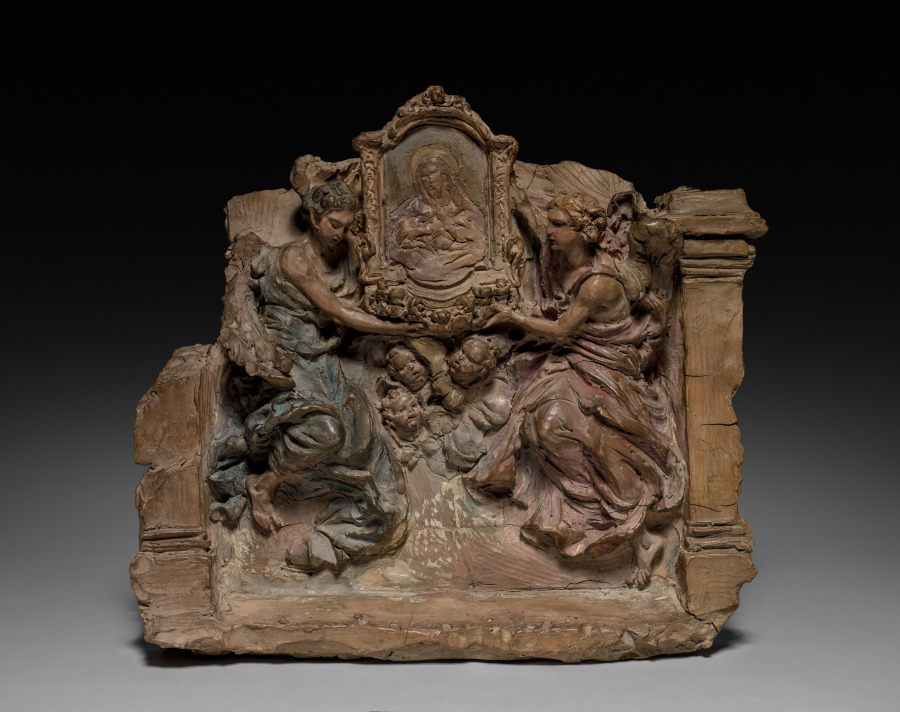
Urban Silhouette Research: Two Angels and Cherubs Bearing an Icon of Christ — A Technical Deconstruction of Form and Chromatic Restraint
I. Preliminary Structural Assessment: The Icon as Silhouette Archive
The subject under examination—Two Angels and Cherubs Bearing an Icon of Christ—presents a compositional architecture that is, at first read, deceptively devotional. Our mandate is not theological but morphological. We are extracting the silhouette logic embedded in this work and translating it into the 2026 executive wardrobe for the Addison client operating within the compressed geometries of Manhattan's commercial grid. The painting's formal grammar—bilateral symmetry, tiered verticality, and the deliberate tension between supporting figures and supported object—offers a precise blueprint for garments that must perform structural authority without ornamental excess.
The icon itself functions as the compositional apex: a framed, rectilinear mass held aloft by two winged figures whose bodies describe opposing arcs. This is, in tailoring terms, a suspension system. The angels are not decorative appendages; they are load-bearing elements. Their drapery—rendered in cool, desaturated tones—folds along diagonal vectors that converge at the icon's lower edge. The cherubs, positioned at the base, provide counterweight. The entire composition reads as a tripartite column: base, shaft, capital. This is the same vertical logic we deploy in a Minimalist column dress or a Slate-toned tailored coat with a defined shoulder and a controlled sweep at the hem.
II. Form Analysis: The Suspension Principle and Its Tailoring Applications
The most transferable formal device is what I term the suspension principle: two symmetrical agents maintaining a central mass in equilibrium. In the painting, the angels' wings extend outward and upward, creating a negative space between them that frames the icon. This negative space is as structurally significant as the figures themselves. For 2026, we translate this into garments where the void is the design—open backs, architectural cutaways at the waist, and shoulder seams that float rather than anchor. The Addison executive does not require volume; she requires controlled emptiness.
The drapery folds demand close reading. They are not chaotic; they are systematic. Each fold follows a gravitational logic, cascading from the shoulder or hip in parallel channels. This is the pleat as infrastructure. In our Slate palette, we execute this through knife pleats on a wool-crepe midi skirt and accordion pleating at the sleeve cap of a structured blouse. The pleats must be permanent—heat-set, not merely pressed—because the painting's folds are not transient; they are ontological. They describe how the fabric is, not how it momentarily falls.
The cherubs at the base introduce a compression dynamic. Their bodies are foreshortened, dense, and low to the ground. In silhouette terms, this is the weighted hem. For the 2026 wardrobe, we interpret this as a dropped waistline on a column dress or a substantial cuff on a tapered trouser—a deliberate accumulation of visual mass at the terminal point that stabilizes the entire vertical read. The executive silhouette must not float; it must land.
III. Chromatic Analysis: Slate as the Operational Neutral
The painting's palette is a study in chromatic suppression. The angels' robes occupy a narrow band between cool grey and muted blue-grey; the icon's frame is a darker, almost onyx-adjacent tone; the flesh tones are desaturated to the point of near-monochrome. This is not poverty of color—it is discipline of color. The work understands that authority in visual communication derives from tonal control, not chromatic variety.
Slate is the logical extraction. It is the color of the painting's dominant drapery, the color of Manhattan's winter sky at 7:45 AM, and the color of executive neutrality. In our 2026 palette, Slate functions as a chromatic substrate—a base layer that absorbs and reflects light without asserting hue. We deploy it in three registers: matte (wool suiting, heavy crepe), satin (bias-cut slips, lining flashes), and textured (brushed cashmere, compact knit). The interplay of these finishes within a single Slate family creates depth without color—precisely the effect achieved by the painting's subtle tonal shifts across the angels' wings.
The icon's frame introduces a darker accent—a near-black that we translate as Onyx hardware: matte gunmetal buttons, a blackened zipper tape, a narrow leather belt. This accent must be sparse. The painting uses darkness only at the structural edges—the frame, the shadow beneath the cherubs. In the wardrobe, Onyx appears at closure points and seam terminations, never as a field color.
IV. Synthesis: The 2026 Executive Silhouette
The final garment derived from this analysis is a Slate wool-crepe column coat with a suspension shoulder—a seam that floats 2cm off the natural shoulder line, creating a negative-space channel between body and fabric. The coat features knife pleats released from the yoke, cascading to a weighted hem that hits mid-calf. Closure is a single Onyx hook-and-eye at the throat, leaving the remainder open—a deliberate void. Underneath, a matte Slate column dress in compact knit, with a satin Slate bias panel at the side seam that catches light only in motion.
This is not a garment of ornament. It is a garment of structural legibility. The painting teaches us that authority resides in the relationship between support and supported—between the angels and the icon, between the pleat and the hem, between the Slate field and the Onyx point. The Addison executive does not dress to be seen. She dresses to be read—quickly, accurately, and without ambiguity. The silhouette must resolve at a glance. The color must recede. The form must hold.
In the painting, the angels bear the icon upward. In the wardrobe, the garment bears the executive forward. The mechanism is identical: symmetrical tension, tonal restraint, and the refusal of excess. This is the Addison standard for 2026—a standard derived not from trend forecasting but from the formal DNA of the Western image, read with cold precision and executed in Slate.