Urban Form: Architecture of the Middle Ages: St. Etienne, Rouen
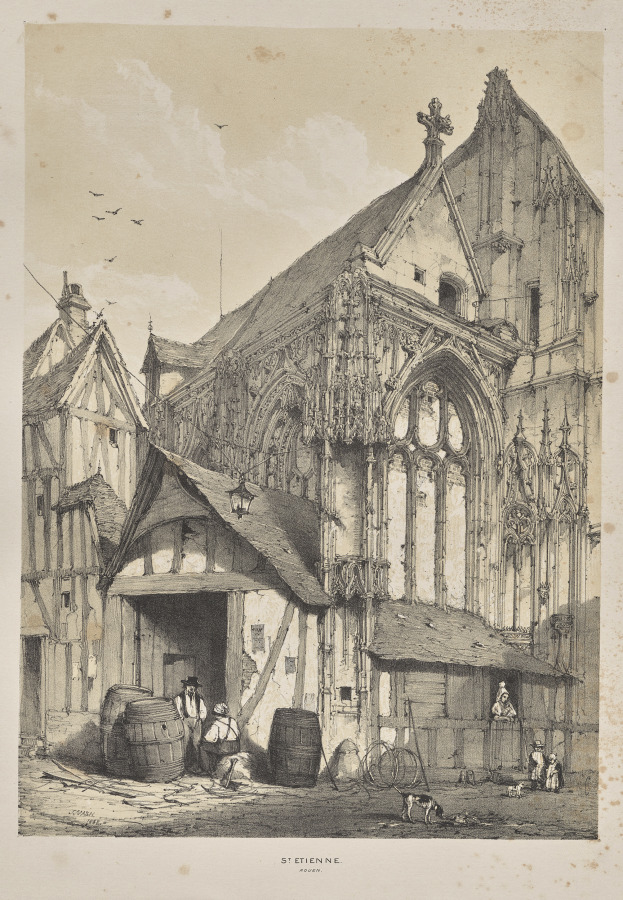
Urban Silhouette Research: The Architecture of the Middle Ages — St. Etienne, Rouen
I. The Vertical Imperative: Geometric Integrity as Executive Armature
The façade of St. Etienne, Rouen, is not ornament; it is structural argument. Its verticality is relentless, a buttressed ascent that refuses the horizontal drift of the eye. The tower rises through three distinct registers — base, lantern, spire — each a discrete geometric proposition yet bound into a single columnar thrust. This is the first principle of the 2026 executive silhouette: the body as a load-bearing column. The Addison tailored line for the coming season abandons the softened shoulder and the draped torso in favor of a spine that reads as a plumb line. The shoulder is squared not by padding but by pattern — a seam that travels from clavicle to scapula in a single unbroken arc, echoing the buttress that transfers weight without visible strain. The waist is suppressed, not cinched; the garment falls from the shoulder in a controlled descent, its volume calibrated to the millimeter. The result is a silhouette that does not follow the body but replaces it with an architectural proposition — a vertical plane that commands the room without gesture.
II. The Lantern Register: Transparency, Restraint, and the Poetics of the Void
The lantern tower of St. Etienne is a study in controlled permeability. Its lancet openings are not windows in the domestic sense; they are apertures that admit light as a structural material, carving the mass into a rhythm of solid and void. The 2026 executive wardrobe absorbs this logic as a discipline of negative space. The Addison minimalist coat for the season is cut from a single length of bonded wool, its front closure offset by three centimeters to create an asymmetric placket — a vertical void that reads as a lantern slit against the body's mass. Sleeves are set into a dropped armhole, allowing the fabric to fall in a clean, unbroken line from the shoulder cap to the wrist, eliminating the visual noise of a set-in seam. Pockets are welted and invisible, their placement determined by the golden ratio of the torso rather than the convenience of the hand. This is urban materiality as asceticism: the garment's power derives from what it refuses to show. The executive who wears it does not accessorize; the silhouette is the statement, and the void is its grammar.
III. Stone and Shadow: The Materiality of Restraint
The limestone of Rouen is not white; it is a weathered slate-grey, its surface pitted by centuries of rain and industrial exhaust. This is the palette of the 2026 Addison executive: not the pristine ivory of the atelier but the patinated neutral of the urban fabric. The season's fabric research centers on a double-faced wool-cashmere in a slate tone that shifts between graphite and ash depending on the light — a textile that behaves like stone, absorbing and reflecting in equal measure. The surface is milled, not pressed, giving it a faintly granular hand that catches the light without sheen. Linings are omitted; the interior is finished with bound seams in a contrasting onyx thread, a detail visible only to the wearer. This is the poetics of the hidden structure — the buttress behind the façade, the seam beneath the surface. The executive silhouette of 2026 is not a display of wealth but a demonstration of load-bearing confidence: a garment that holds its shape because its geometry is correct, not because its fabric is heavy.
IV. The Spire and the Street: Proportional Discipline in the Urban Field
The spire of St. Etienne is a tapered octagon, its faces narrowing as it rises, a geometry that converts mass into aspiration. The 2026 Addison trouser applies this principle to the lower body: a high-rise waist that sits at the natural fulcrum of the torso, a leg that tapers from thigh to ankle in a continuous line, and a hem that breaks precisely at the instep — no pooling, no crop. The proportion is eight-to-one: eight units of leg to one unit of shoe, a ratio that elongates the figure without the artifice of a platform. The fabric is a high-twist wool in slate, woven tightly enough to resist creasing during the commute yet fluid enough to move with the stride. This is the urban field as runway: the executive does not walk; she processes, her silhouette a vertical argument against the horizontal noise of the street. The coat, the trouser, the columnar knit — each is a register of the same architectural proposition, a secular cathedral of the self.
V. Conclusion: The Silhouette as Moral Geometry
St. Etienne, Rouen, is a medieval structure, but its logic is eternally modern: mass organized by line, light admitted by discipline, ornament subordinated to structure. The 2026 Addison executive silhouette is its sartorial translation — a wardrobe of slate, onyx, and ivory that treats the body as a site of architectural integrity. The geometric armature is not a constraint but a liberation: when the silhouette is correct, the wearer is free to act. This is the final lesson of the Gothic façade: the most powerful statement is the one that appears inevitable. The executive of 2026 does not dress to be seen; she dresses to stand — a vertical plane in a horizontal city, a column of slate against the grey light, a structure that holds.