Urban Form: Adoration of the Magi
Urban Silhouette Research: The Adoration of the Magi as Structural Prophecy
I. Geometric Integrity and the Architecture of Devotion
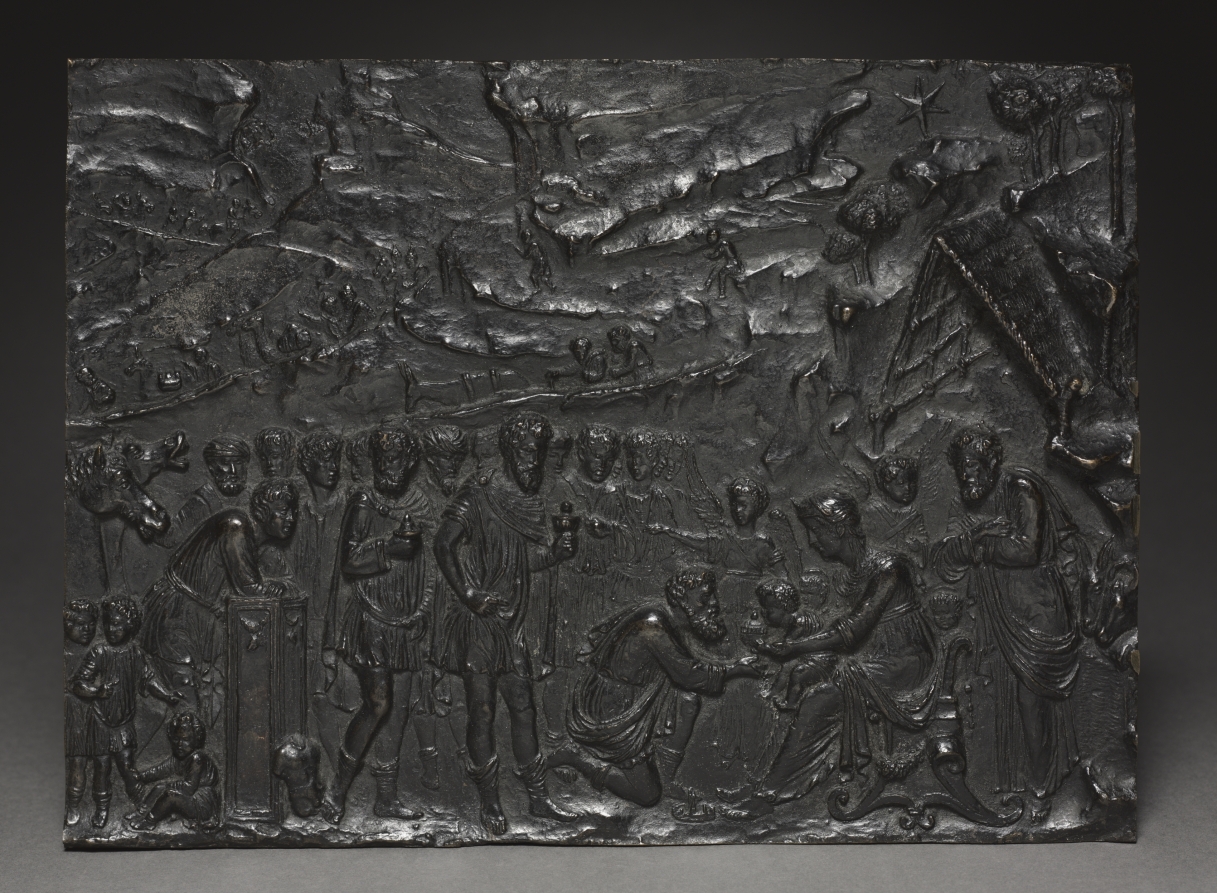
The compositional armature of the Adoration of the Magi operates as a closed geometric system—a triangulated hierarchy in which every figure functions as a load-bearing element. The Virgin and Child occupy the apex, not as sentimental center but as structural keystone; the Magi descend in graduated obliquity, their postures forming a descending spiral that resolves into the horizontal register of the gifts. This is not narrative painting. This is load distribution. The eye is conducted along vectors of reverence that are, in fact, vectors of force: the incline of the eldest king's spine, the counterweight of the kneeling figure's drapery, the vertical insistence of the architectural fragment at the right margin. The composition holds because it is built, not because it is felt.
For the 2026 executive silhouette, this geometry translates into a doctrine of contained triangulation. The shoulder line must read as the apex—elevated, deliberate, unapologetic in its width. From this apex, the garment descends in controlled obliquity: a lapel that angles rather than curves, a waist suppressed but not cinched, a hem that resolves the spiral into a clean horizontal. The silhouette does not drape; it distributes. It is the difference between a garment that hangs from the body and a garment that is held by the body's own structural logic.
II. The Vessel as Load-Bearing Metaphor
The Magi's gifts—gold, frankincense, myrrh—arrive in vessels. These containers are the painting's most underread structural elements. They are small, dense, and geometrically absolute: the casket's rectilinear severity, the pyx's cylindrical compression, the reliquary's faceted precision. They anchor the lower register of the composition with the same finality that Morandi's jars anchor his tabletops. They are not accessories. They are gravitational centers—objects whose formal integrity resists the narrative pressure of the scene around them.
This is the materiality the 2026 executive wardrobe must absorb. The urban executive does not carry objects; she carries vessels—the structured bag, the architectural shoe, the belt whose buckle functions as a clasp rather than an ornament. Each must possess the same density as the Magi's offerings: small, absolute, resistant to the decorative impulse. In slate-toned calfskin and brushed hardware, these elements operate as the garment's counterweight, preventing the silhouette from dissolving into the fluidity that has dominated the previous cycle. The vessel does not adorn the body. It completes its physics.
III. Drapery as Structural Skin
The painting's drapery is not cloth. It is architectural skin—folded, pleated, and tensioned to reveal the body beneath as a system of planes rather than volumes. The Virgin's mantle falls in cascading diagonals that echo the load paths of a vaulted ceiling. The Magi's robes gather at the knee in compressed horizontals that function as visual plinths. Every fold is a decision; every crease is a calculation. The drapery does not soften the figure. It specifies it.
For 2026, this demands a fabric language of engineered fall. Wool crepe with sufficient weight to hold a pleat without pressing. Double-faced cashmere whose reverse side reveals a contrasting slate tone at the cuff and hem—a private structural truth. The garment must drape with the deliberateness of carved stone, not the surrender of silk. The urban environment is abrasive; the silhouette must answer with materiality that resists without rigidity. The fold is the interface between body and city, and it must be engineered as such.
IV. The Negative Space of Authority
Between the figures of the Adoration, the painter has left intervals—chambers of unpainted ground that function as structural voids. These are not absences. They are compression chambers, the negative space that allows the composition to breathe without collapsing. The gap between the kneeling king and the standing attendant is as deliberate as the gap between two load-bearing columns. Remove it, and the structure fails.
The 2026 executive silhouette must reclaim this negative space as a garment principle. The interval between shoulder and sleeve cap. The pause between lapel and collar. The clearance at the wrist where the cuff does not touch the hand. These are not fit issues; they are structural voids that grant the wearer authority through restraint. The minimalist executive does not fill space. She edits it. The silhouette is defined as much by what it refuses to occupy as by what it claims.
V. Conclusion: The Silhouette as Secular Reliquary
The Adoration of the Magi proposes a body that is simultaneously vessel and architecture—a figure that receives devotion and distributes weight with equal composure. The 2026 Addison executive inherits this dual mandate. She is not adorned; she is constructed. Her silhouette is a secular reliquary: slate-toned, geometrically absolute, and structurally honest. It carries meaning without displaying it. It holds the body as the painting holds its figures—with the cold clarity of load paths and the quiet authority of negative space. The city is her nave. The silhouette is her offering.