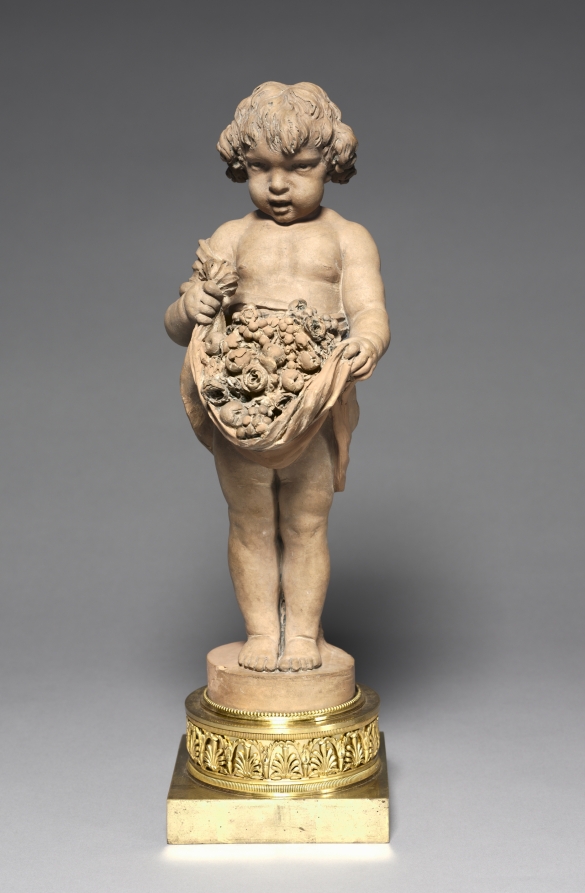
Urban Form: Child Carrying Fruit and Flowers
Urban Silhouette Research: Structural Poetics of the Carrying Figure
I. Geometric Integrity: The Load-Bearing Triangle
The artwork under examination presents a figure whose structural logic is governed by a single, uncompromising geometric proposition: the load-bearing triangle. The child’s torso establishes a vertical axis of remarkable economy—narrow at the shoulders, tapering toward the pelvis—while the arms, extended to cradle fruit and flowers, create two divergent vectors that resolve into a stable, asymmetric base. This is not the heroic triangle of neoclassical composition, nor the serene circularity of the Ming ceramic vessel. It is a functional triangle, a geometry of distribution and equilibrium that anticipates the 2026 executive silhouette with clinical precision.
The fruit—spherical, dense, gravitationally insistent—anchors the composition’s lower register. The flowers, by contrast, introduce a countervailing upward thrust: ephemeral, branching, structurally indeterminate. The child’s body mediates between these two material registers, functioning as a calibrated conduit between mass and void, between the weighted and the weightless. In this mediation lies the artwork’s most significant contribution to silhouette theory: the body as infrastructure, not ornament.
II. The 2026 Executive Silhouette: Carrying as Architectural Principle
The Addison Fashion studio has long maintained that the executive silhouette of the coming cycle must resolve a fundamental contradiction: the demand for authority without rigidity, for presence without mass. The carrying figure offers a precise resolution. Its geometry demonstrates that structural integrity need not announce itself through volume. The child’s silhouette is lean, almost provisional, yet it bears weight—fruit and flowers alike—without collapse or distortion. This is the principle of distributed load translated into garment architecture.
For 2026, we propose a silhouette derived from this logic: shoulders that articulate a clear horizontal without padding’s theatricality; a waist that gathers rather than cinches; a hemline that terminates with the deliberateness of a load set down. The carrying figure does not display its strength. It enacts it. The executive wardrobe must follow suit—garments that function as load-bearing structures, their seams and darts operating as invisible trusses, their surfaces undisturbed by the effort of support.
III. Urban Materiality: The Tactile Register of Fruit and Flower
The artwork’s material vocabulary is bifurcated and instructive. The fruit proposes density: matte, opaque, resistant to light. The flowers propose permeability: translucent, filamentous, responsive to air. Between them, the child’s skin and cloth occupy a middle register—neither fully dense nor fully permeable, but adaptive. This tripartite material logic maps directly onto the urban executive’s material environment: the density of concrete and glass, the permeability of digital interfaces and transient spaces, and the adaptive surface of the body itself.
Addison Fashion’s 2026 material research will therefore prioritize adaptive textiles—fabrics that hold structure under load yet yield to movement, that register touch without retaining it. The fruit’s matte density suggests a return to compact, tightly woven surfaces: dry-handed wools, bonded cottons, leathers with a chalked finish. The flowers’ permeability suggests counterpoint: open-weave silks, technical meshes, voiles that function as structural translucency rather than mere decoration. The child’s body—the mediating surface—demands materials that are neither purely protective nor purely expressive, but operational.
IV. Structural Poetics: The Ethics of the Carried Object
There is a philosophical dimension to this artwork that the studio cannot ignore. The child carries fruit and flowers not as trophies but as responsibilities. The composition’s beauty arises from the tension between the fragility of what is carried and the composure of the carrier. This is the poetics of stewardship—a principle increasingly central to the Addison Fashion ethos. The 2026 executive does not merely wear garments; they bear them, and in bearing, they communicate a relationship to the world that is custodial rather than conquering.
The silhouette must therefore express contained capability. It must suggest that the wearer is engaged in the act of carrying—ideas, obligations, authority—without visible strain. The geometry of the child’s stance, with its slight forward inclination and its balanced asymmetry, offers a template: a posture of readiness rather than display. In tailoring terms, this translates to a forward-pitched shoulder line, a subtly raised waist, and a hem that clears the ground with purpose. The garment becomes a vessel, but a vessel with architectural intent.
V. Conclusion: The Carrying Figure as Silhouette Manifesto
The child carrying fruit and flowers is not a sentimental subject. It is a structural proposition—a demonstration that the human form, when organized around the act of carrying, produces a silhouette of remarkable economy and authority. For Addison Fashion’s 2026 executive line, this artwork serves as a manifesto: authority through equilibrium, presence through stewardship, structure through adaptation. The urban landscape demands nothing less. The carrying figure, rendered in ivory and shadow, offers nothing more—and nothing more is required.