Urban Form: Firefighter's Suit (Kaji shōzoku)
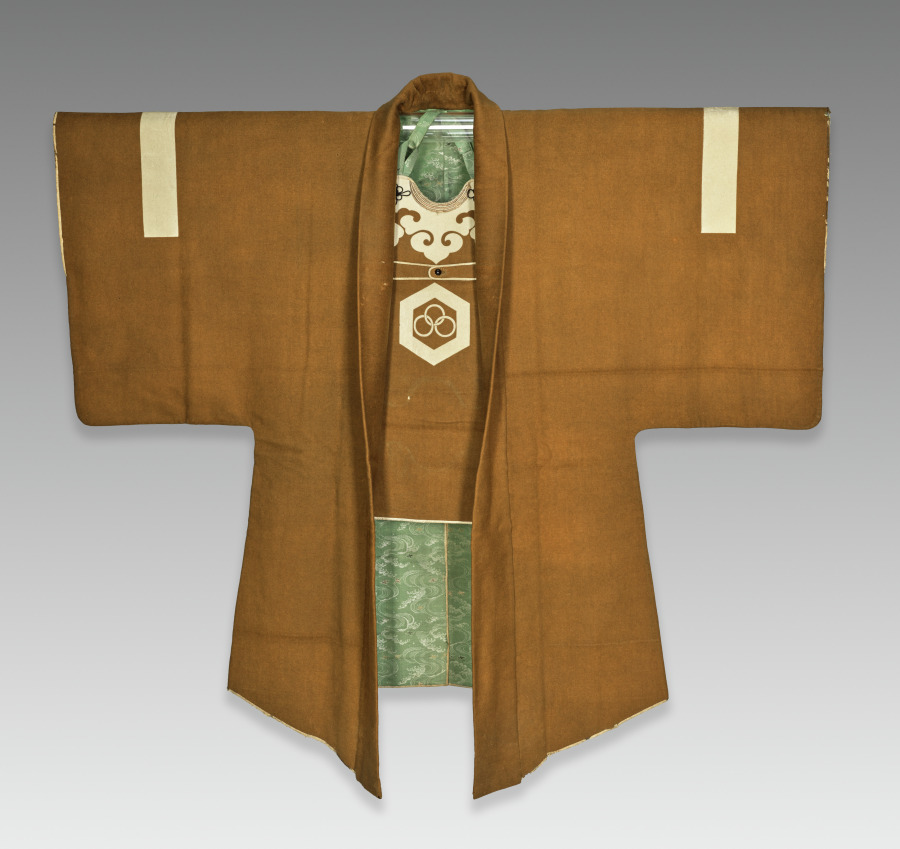
Urban Silhouette Research: The Firefighter's Suit as Structural Palimpsest
I. The Geometry of Containment
The Kaji shōzoku—the Japanese firefighter's suit—presents a geometric proposition that is, at its core, a study in defensive architecture for the human body. Unlike the tailored suit, which seeks to articulate the torso through suppression and darting, the firefighter's garment operates on a principle of deliberate volumetric excess. Its silhouette is not carved; it is constructed as a protective envelope, a series of planar shields that hang from the shoulder line with an almost liturgical gravity. The shoulders are broad, squared, and unapologetically horizontal—a load-bearing beam from which the entire structure suspends. The sleeves, cut wide and cropped at the wrist, create a cylindrical void that speaks to the body's vulnerability rather than its vanity. This is not a garment that follows the figure; it is a garment that precedes and protects it, establishing a perimeter of safety that the 2026 executive silhouette will reinterpret as a perimeter of authority.
II. Materiality as Temporal Witness
The textile language of the Kaji shōzoku is one of layered resilience. Heavy cotton, often treated with persimmon tannin, creates a surface that is at once supple and intractable—a material that records the body's movement through creases and folds that deepen with use. This is the antithesis of the pristine, seasonally replaced fabric of conventional luxury. The firefighter's suit ages into its identity; its value is cumulative, not instantaneous. For Addison Fashion's 2026 executive, this translates into a material philosophy of patinated permanence: fabrics that hold memory, that develop a personal topography of wear. The slate-grey palette we propose for this research is not a color applied to cloth but a condition of the cloth itself—a mineral, urban neutrality that absorbs light rather than reflecting it, aligning the wearer with the infrastructure of the city rather than its spectacle.
III. The Poetics of the Unfinished Edge
Here we encounter the critical resonance with the Mold Fragment with Musicians. The firefighter's suit, in its traditional form, is never truly finished. Its seams are reinforced with visible stitching; its closures are functional cords and loops rather than concealed fastenings. The garment exposes its own construction as a form of honesty—a refusal to disguise the labor that holds it together. This is the aesthetic of the fragment, transposed from the archaeological to the sartorial. The 2026 executive silhouette will embrace this exposed interiority: raw-edge hems, visible bar-tacks, and structural seams that read as architectural drawing rather than decorative flourish. The garment becomes a document of its own making, and the wearer becomes the custodian of that document—a figure whose authority derives not from the concealment of process but from its unflinching display.
IV. The Silence of the Void
The Bird on Lotus offers the countervailing principle: the eloquence of emptiness. The firefighter's suit, for all its protective volume, is defined as much by what it does not enclose as by what it does. The wide sleeve opening, the gap between the cropped jacket and the trouser, the negative space at the neck where the hood is folded back—these are apertures of vulnerability that the garment acknowledges rather than eliminates. In the 2026 executive silhouette, this translates into strategic omission: the unfinished sleeve, the open back panel, the trouser that stops short of the ankle. These are not errors of tailoring but deliberate caesuras—moments where the garment invites the urban environment to complete it. The wearer becomes a participant in the silhouette's ongoing composition, their movement through the city the brushstroke that fills the void.
V. Conclusion: The Executive as Urban Guardian
The Kaji shōzoku is not a costume of nostalgia but a template for a new urban poetics. Its geometry—broad-shouldered, volumetric, architecturally suspended—offers the 2026 executive a silhouette that is defensive without being aggressive, protective without being hermetic. Its materiality—patinated, honest, cumulative—aligns with a luxury that values time over novelty. Its unfinished edges and strategic voids resonate with the fragmentary beauty of the Mold Fragment and the meditative emptiness of the Bird on Lotus. The Addison Fashion executive of 2026 does not dress to dominate the room; they dress to hold the room—a structural presence, a slate-grey sentinel whose silhouette is at once a shield, a shelter, and a statement of intent. The firefighter's suit, in this reading, is not a uniform of emergency but a uniform of permanence—and permanence, in the urban landscape, is the ultimate luxury.