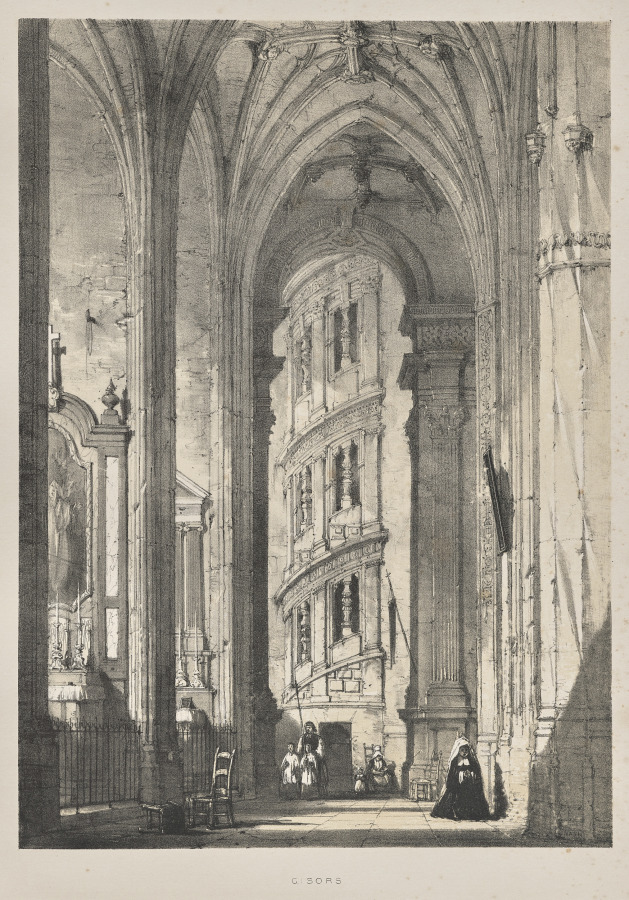
Urban Form: Architecture of the Middle Ages: Church of St. Gisors, Interior
Urban Silhouette Research: The Medieval Interior as Structural Protocol
I. The Gisors Interior as Geometric Proposition
The interior of the Church of St. Gisors, in its Norman Gothic articulation, presents a geometry that is not decorative but constitutive. The ribbed vault, the clustered pier, the lancet aperture—each operates as a load-bearing proposition rather than an ornament. For the 2026 executive silhouette, this distinction is decisive. The Addison wardrobe does not quote the medieval; it inherits its logic. The pointed arch is read here not as a symbol but as a stress diagram made visible: two curves resolving a vertical thrust into a lateral one, distributing weight across a plane that appears, to the untrained eye, to float. This is the first principle of the season—structure disguised as ease.
The interior’s elevation is governed by a tripartite rhythm: arcade, triforium, clerestory. Each register performs a distinct structural duty while remaining legible as a single vertical argument. Translated to the body, this becomes the three-tier tailoring system that anchors the Addison 2026 executive line: a base layer of compressed jersey (the arcade, bearing load), a mid-layer of structured wool (the triforium, transmitting force), and an outer shell of bonded technical cloth (the clerestory, admitting light while resisting weather). The silhouette is not built; it is engineered.
II. The Rib Vault and the Disappearance of the Seam
The rib vault at Gisors achieves what modern pattern-cutting still struggles to articulate: the convergence of disparate forces at a single, silent node. The ribs gather at the boss without visible friction; the stone appears to have consented to its own compression. In the 2026 executive silhouette, this translates to the suppressed shoulder seam—a construction in which the armhole is rotated forward and the sleeve head is bonded rather than stitched, so that the shoulder line reads as a continuous curve rather than an assembly. The result is a jacket that appears to have grown from the wearer rather than been fitted to them: architectural, not tailored.
The vault’s diagonal ribs also inform the season’s asymmetric closure. Where the medieval mason allowed the rib to cross the bay at an angle, the Addison coat allows its placket to travel off-axis, resolving at the hip rather than the throat. This is not whimsy; it is a load-path decision. The off-center closure redistributes tension across the torso, permitting a closer fit at the waist without restricting the shoulder—precisely the problem the rib vault solved for stone.
III. Materiality: Stone, Light, and the Urban Surface
The Gisors interior is a study in material contrast under a single light source. The limestone is cool, matte, and slightly absorbent; the glass is thin, saturated, and refractive. The eye reads the difference not as decoration but as information—each material announcing its structural role. The 2026 Addison palette applies this principle to urban cloth: slate-bonded wool against silver-coated membrane, matte against sheen, absorbent against reflective. The executive silhouette is thus legible at a distance, its material hierarchy readable before a single word is spoken.
Crucially, the medieval interior admits light only through controlled apertures. The clerestory is not a window but a calibrated instrument. The Addison outerwear for 2026 adopts the same discipline: venting is concealed within seam allowances, reflective tape is bonded beneath the storm flap rather than applied to the surface, and the hood, when deployed, reveals a silver interior that functions as a light well for the face. The garment does not display its technology; it meters it.
IV. The Silhouette as Processional Space
Finally, the Gisors interior is not a room but a procession—a sequence of thresholds that compresses and releases the body in rhythm. The 2026 executive silhouette must be understood in the same terms: not a static shape but a choreography of volumes. The Addison coat opens at the hem to permit stride; the jacket shortens at the waist to clear the desk; the trouser breaks at the ankle to signal motion without excess. Each decision is a threshold, calibrated to the pace of the urban day.
The medieval mason built for permanence; the Addison executive dresses for continuity. The silhouette is not a statement but a system—Slate, Minimalist, structurally resolved, and silent in its authority. This is the architecture of the 2026 executive: weight borne invisibly, light admitted deliberately, and the body permitted to move.