Urban Form: Landscape with Two Monks
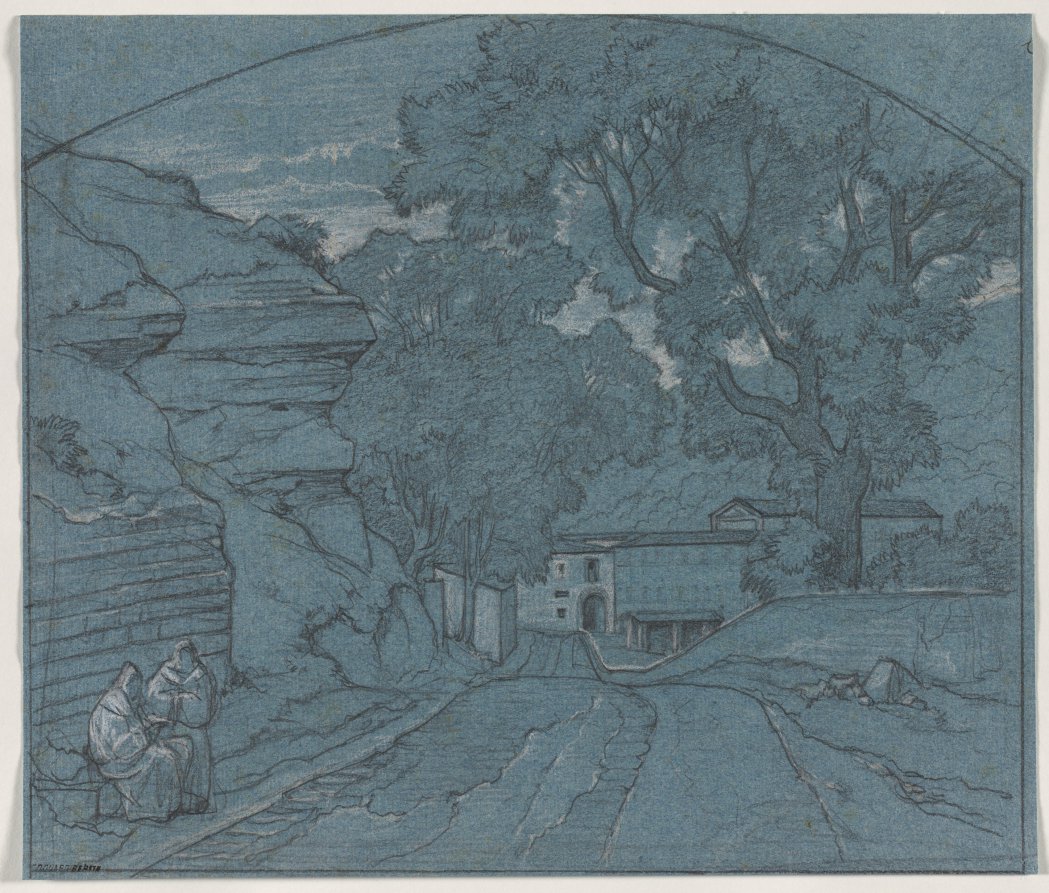
Urban Silhouette Research: Landscape with Two Monks — Form, Color, and the Dialectics of Stillness
The following document constitutes a technical deconstruction of form and chromatic discipline derived from the paired aesthetic objects designated Landscape with Two Monks. The reference corpus juxtaposes the Western narrative canvas — The Death of Socrates — against the Eastern ceramic vessel — the meiping with waves. Our mandate is not art-historical exegesis but structural extraction: to isolate the formal logic of each object and translate that logic into a coherent proposition for the 2026 executive wardrobe. The analysis proceeds from silhouette architecture to chromatic strategy, terminating in a specification of wearability for the Addison client operating within the compression and velocity of the New York corporate environment.
I. Silhouette Architecture: The Convergent Vessel
The meiping presents a closed formal system: a constricted aperture, an expansive shoulder, a tapering base. This is a silhouette of containment and release — energy gathered at the neck, distributed through the body, resolved at the foot. The wave motif does not decorate this form; it articulates it, tracing the vessel's own curvature in continuous, non-repeating arcs. There is no seam, no interruption, no narrative incident. The form is total.
Contrast this with the Socrates canvas, where the silhouette is radial and centrifugal — every figure, every gesture, every fold of drapery vectors toward the central cup. The composition is an argument made visible: a single point of convergence, a dramatic apex, a terminal gesture toward the heavens. The Western silhouette is a sentence with a subject and a predicate; the Eastern silhouette is a clause without punctuation.
For 2026, Addison proposes the convergent silhouette: a garment that borrows the meiping's closed-system logic — narrow at the shoulder line, generous through the torso, disciplined at the hem — while permitting a single, controlled narrative gesture. This manifests as a tailored overcoat with a raised, compact collar; a shoulder seam set inward by 1.5 centimeters; a body that releases into a straight, unbroken fall from the scapula to the mid-calf. The gesture — the "Socratic vector" — is confined to a single detail: a diagonal closure, an asymmetric placket, a seam that travels from the sternum to the hip. One incident. One argument. No more.
II. Chromatic Strategy: The Slate Discipline
The meiping's glaze operates in the register of depth without contrast — celadon upon celadon, wave upon wave, differentiated not by hue but by line and light. The Socrates canvas, by contrast, is a study in chiaroscuro as moral argument: the lit body of the philosopher against the dark surround, the cup catching a single highlight, the drapery absorbing and reflecting in equal measure. Light here is judgment; in the vessel, light is merely weather.
Addison's chromatic prescription for the 2026 executive wardrobe is Slate: a blue-grey of low saturation and high tonal range, capable of registering both the vessel's monochromatic continuity and the canvas's dramatic focal illumination. Slate is not a neutral; it is a disciplined chromatic field that permits a single point of luminance — a silver hardware, an ivory cuff, a polished onyx button — to function as the compositional apex. The wardrobe thus operates as a closed system: the slate ground provides continuity, the single accent provides the Socratic gesture, the absence of additional color preserves the meiping's restraint.
This is not minimalism as absence but minimalism as compression — the reduction of the palette to its load-bearing elements. The executive who wears slate head-to-toe, interrupted by a single silver line at the wrist or a single onyx point at the throat, is wearing an argument about focus. She is not decorated; she is composed.
III. Material and the Tactile Register
The meiping demands touch — the hand warms the glaze, the eye follows the wave in raking light. The Socrates canvas demands distance — the viewer stands apart, receives the image as a completed statement. Addison's 2026 fabrication strategy reconciles these imperatives through double-faced wool in a slate melange, a material that reads as monolithic at three meters and reveals tonal variation at thirty centimeters. The garment is legible at boardroom distance and intimate at handshake proximity. The wave is in the weave; the drama is in the cut.
IV. Specification for the 2026 Executive Wardrobe
The resulting capsule comprises: a slate double-faced wool overcoat with convergent shoulder and single diagonal closure; a slate crepe column dress with a raised neckline and a seam that traces the meiping's shoulder-to-hem arc; a silver-tone bar pin positioned at the sternum — the single point of luminance, the cup in the composition. Trousers are straight, uncuffed, hemmed to the instep. Footwear is onyx leather, unadorned. No print. No logo. No secondary color.
The wardrobe is a closed system. It contains its own weather. It does not argue; it states. In the compressed geography of the New York executive day — the elevator, the conference room, the evening reception — the Addison client moves as the vessel moves through light: continuous, self-possessed, and sufficient unto herself. The wave is in the fabric. The stillness is in the cut. The argument is complete.