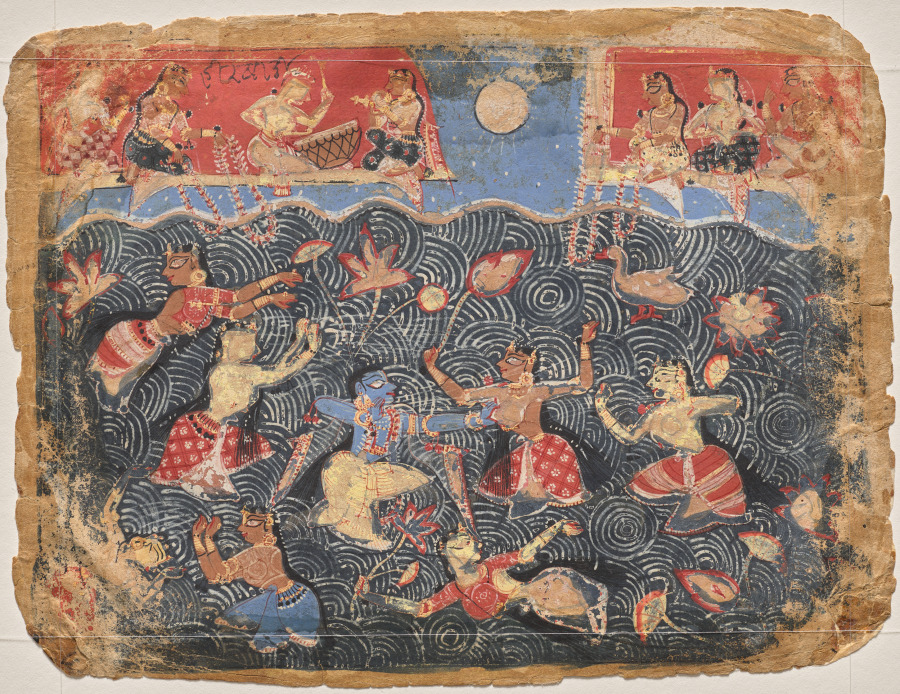
Urban Form: Krishna sporting with the gopis in the Jumna River, from a Bhagavata Purana
Urban Silhouette Research: The Suspended Interval — Form, Chromatic Restraint, and the Executive Body in Motion
I. Source Artifact Analysis: The Bhagavata Purana Folio as Structural Proposition
The subject folio — Krishna sporting with the gopis in the Jumna River — presents a compositional logic that is, at first inspection, deceptively ornamental and, at second inspection, rigorously architectural. The narrative action is aquatic: bodies submerged, bodies emergent, bodies suspended at the waterline. This is not a scene of arrival or departure but of interstitial occupancy — figures held between two states, neither fully clothed by the river nor fully exposed to air. For the purposes of Addison Fashion's 2026 development cycle, this interstitial condition is the operative formal principle. The silhouette we are engineering is not a garment worn upon the body but a garment that negotiates the body's transitions — seated to standing, interior to street, daylight to evening.
The folio's spatial organization rewards close reading. The Jumna is rendered not as a perspectival depth field but as a stacked horizontal register — bands of pigment that compress the river into a shallow, legible plane. Figures overlap without occlusion; the eye reads sequence rather than distance. This is a deliberate flattening, and it produces a specific sartorial consequence: the garment must function as a readable surface at close range, with information distributed across the horizontal axis rather than concentrated at a single focal point. Translated to tailoring, this argues for the elimination of the singular lapel statement in favor of distributed detailing — a seam line here, a suppressed dart there — that rewards the viewer who stands within conversational distance.
II. Chromatic Deconstruction: Pigment Logic and the Slate Register
The folio's palette operates on a principle of chromatic containment. The river blues are not saturated; they are mineral, chalked, held in check by warm earth grounds and the disciplined white of textile. Color functions as differentiation, not decoration — each figure is legible against the water precisely because the water refuses to compete. This is the discipline we are importing into the Slate register for 2026. Slate is not gray; it is a blue-black held in suspension, a color that reads as neutral at three meters and as cool mineral at thirty centimeters. It is the chromatic equivalent of the folio's river: present, structural, and deliberately recessive.
The critical technical decision is value stratification within a single hue family. The folio achieves depth through tonal steps — deep indigo at the water's edge, mid-tone mineral blue at the surface, pale wash where light strikes. We replicate this through fabric selection rather than print: a Slate wool crepe for the shell, a Slate-and-Onyx micro-check for the underlayer, a Slate silk habotai for the lining that flashes only in motion. The result is a garment that changes value with the wearer's movement — a kinetic chromatic system that mirrors the folio's layered water. No print, no pattern, no applied ornament. The color is the structure.
III. Form Translation: The Suspended Interval as Garment Architecture
The folio's most transferable formal insight is the suspension of the figure at the waterline — the point at which the body is neither fully supported nor fully free. In garment terms, this is the transition zone: the waist, the shoulder, the hem. Conventional tailoring resolves these zones with hard boundaries — a waistband, a set-in sleeve, a finished hem. The Addison 2026 proposition is to suspend the resolution, to hold the transition in a state of controlled ambiguity.
Technically, this manifests in three moves. First, the extended shoulder: a soft, unstructured shoulder line that extends 2–3 cm beyond the natural acromion, creating a horizontal register that echoes the folio's stacked bands. Second, the suspended waist: a waistline that is indicated rather than cinched, achieved through a bias-cut panel that drapes from the ribcage to the hip without a defined seam. Third, the fluid hem: a hem that is weighted but not stiffened, falling in a controlled column that responds to gait rather than resisting it. The aggregate silhouette is columnar with lateral release — a vertical proposition that permits horizontal motion, exactly as the folio's figures are vertically composed but laterally engaged.
IV. Executive Wardrobe Application: The 2026 NYC Context
The NYC executive wardrobe of 2026 operates under a specific constraint: the compression of the day. The same garment must survive a 7:00 a.m. transit, a 10:00 a.m. board presentation, a 1:00 p.m. working lunch, and a 6:00 p.m. cultural engagement — without a change of clothes and without visible degradation. This is the suspension requirement in commercial terms: the garment must hold its form across contexts without resolving into any single one.
The Slate Fluid program addresses this through fabric engineering. The shell is a 340-gram wool-silk blend with a 2/2 twill construction — sufficient body to hold the extended shoulder, sufficient drape to permit the suspended waist. The underlayer is a 19-momme silk crepe de chine in Slate-Onyx, providing a chromatic step that reads as depth rather than contrast. The lining is a 12-momme habotai, chosen for its low-friction hand — the garment slides over the body rather than gripping it, which is the physical correlate of the folio's water: supportive, not restrictive. Seams are French-finished and pressed open, eliminating bulk at the transition zones and preserving the suspended line.
The commercial logic is straightforward. The executive client is not purchasing a garment; she is purchasing a system of intervals — the minutes between meetings, the transitions between rooms, the states between formal and informal. The Addison 2026 Slate Fluid program is engineered for exactly this: a silhouette that does not resolve, a color that does not announce, and a construction that holds the body in a state of productive suspension. The folio's gopis are held at the waterline; our client is held at the threshold. The garment is the river.