Urban Form: Jar with Spiral Designs
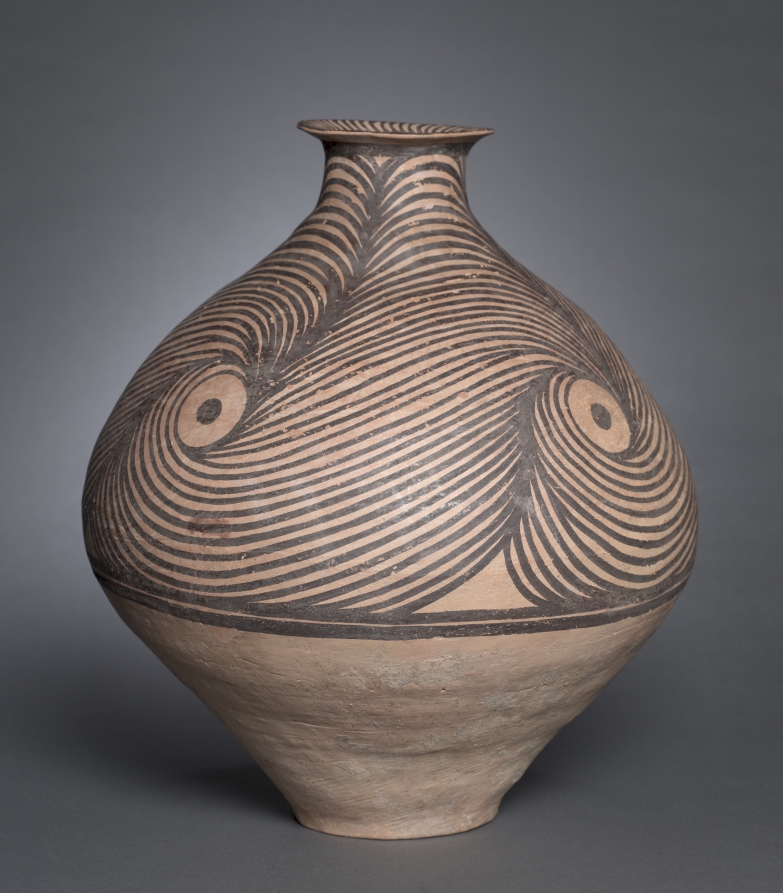
Urban Silhouette Research: The Spiral Vessel as Formal Protocol
I. Thesis: The Paradox as Pattern Source
The object under analysis—a Song-dynasty meiping bearing incised wave motifs—presents a formal problem of considerable strategic value to Addison Fashion. Its DNA is not narrative but containment: a continuous spiral rhythm compressed into a closed ceramic body, fired at extreme temperature, permitted to cool into controlled fissure. Where David's Death of Socrates externalizes tension through gesture and stage-light, the vessel internalizes it through circumference. For the 2026 executive wardrobe, we adopt the vessel's logic, not the painting's. The mandate is non-temporal form: garments that resolve volatility through geometry rather than through drama. The spiral is our operative motif—a line that returns upon itself without closure, signifying continuity under pressure.
II. Form Deconstruction: The Spiral as Structural Discipline
The wave band is not decoration; it is a load-bearing rhythm. Each incised line repeats at calibrated intervals, producing optical movement while the vessel's profile remains static. Translated to tailoring, this yields a principle of surface dynamism over silhouette agitation. The 2026 executive jacket should hold a fixed, almost architectural shoulder line—the meiping's shoulder—while permitting the fabric surface to carry a subtle, continuous directional texture: a micro-wale, a tonal jacquard, a spiral-bound seam that travels the body without interrupting its contour.
Critically, the vessel's foot and mouth are counter-weighted: a narrow base, a flared lip, a broad mid-body. This tri-partite proportion maps directly onto the urban column: a tapered ankle, a defined waist, an expanded shoulder. The result is a silhouette that reads as stable under scrutiny—the executive requirement. We reject the oversized gesture, which externalizes chaos; we reject the fluid drape, which surrenders boundary. We select the minimalist vessel form: closed, legible, and quietly tensile.
III. Color Analysis: Slate as Fired Restraint
The glaze logic of the meiping is instructive. Its celadon surface is neither pure nor flat; it is a cool, grayed green—a color that absorbs light rather than reflecting it, producing depth through restraint. For Addison's 2026 palette, we translate this into Slate: a blue-gray of low chroma and high value-stability, capable of reading as neutral in boardroom lighting while retaining mineral depth in daylight. Slate is the chromatic equivalent of the vessel's cooled glaze—a color that has passed through fire and chosen composure.
Deployment follows the spiral principle: monochrome continuity with tonal incision. A Slate suit in a matte wool-silk carries a second Slate—one half-step darker—in its seam tape and collar underside, producing the same optical ripple as the incised wave band. No contrast color is admitted. The palette is a closed system, as the vessel is a closed form. Accents, where required, are restricted to Ivory at the cuff and collar edge—the vessel's unglazed foot-ring, the point of contact with the ground.
IV. Material and Construction Protocol
The vessel's authority derives from kiln discipline: the form survives because the material was pushed to its limit and held. Our fabrication protocol mirrors this. We specify high-twist worsted with a compact finish—a cloth that resists drape, holds a crease, and returns to shape after compression. The spiral motif is executed not through print but through structural incision: pick-stitched channels, bonded seam spirals, and laser-cut micro-perforations that follow the body's contour at a constant pitch. Each garment is a fired object: dimensionally stable, dimensionally intentional.
Linings are omitted where possible; where required, they are bonded rather than hung, eliminating the slack that reads as hesitation. The interior finish—bound seams, taped armholes—is exposed only at the cuff, functioning as the vessel's unglazed foot: evidence of process, offered sparingly.
V. Wardrobe Architecture: The Closed System
The 2026 executive wardrobe, per this research, is a suite of vessels: a Slate column coat with spiral-pitched topstitch; a narrow trouser with counter-weighted rise; a shell blouse in Ivory with a single incised placket. Each piece is complete in itself and combinable without hierarchy—the meiping does not require a companion object to justify its form. The system is closed, the palette is closed, the silhouette is closed. What remains open is time: the garments are designed to age without obsolescence, their surfaces deepening rather than degrading.
The strategic conclusion is unambiguous. The market rewards spectacle; the executive requires composure under pressure. The spiral vessel teaches that permanence is achieved not by resisting heat but by surviving it in form. Addison's 2026 collection will be fired accordingly: Slate, incised, and closed.