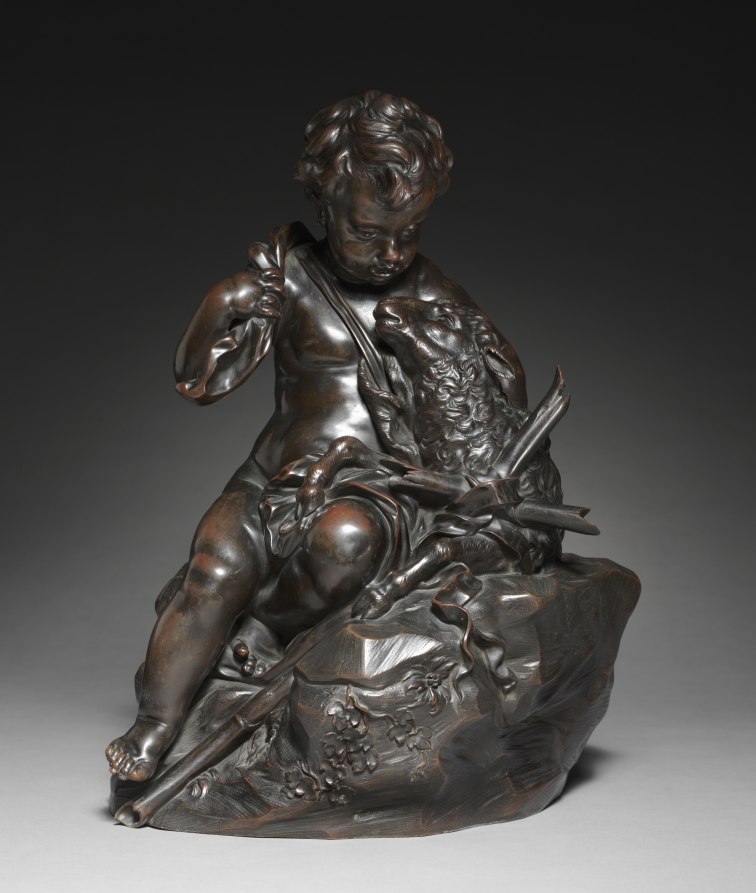
Urban Form: Young Saint John and the Lamb
Urban Silhouette Research: The Udumbara–White Tiger Dialectic as Form Language for the 2026 Executive Wardrobe
Premise: Two Ontologies of Surface
The subject under examination—Young Saint John and the Lamb—arrives not as a devotional reference but as a structural cipher. Its DNA source juxtaposes two East Asian artifacts whose formal logics are antithetical yet mutually constitutive: the Udumbara Flowers wooden plaque, a Japanese temple relief governed by subtraction and the aesthetics of wabi-sabi, and the Han-dynasty Mirror with Deities, Chariot, and the White Tiger, a bronze surface saturated with cosmological density. For Addison Fashion NYC, the analytical value lies in translating this dialectic—void generating form versus form approaching void—into a disciplined vocabulary of silhouette, material, and chromatic restraint. The 2026 executive wardrobe must operate at precisely this intersection: legible authority without ornamental surplus.
Form Analysis I: The Plaque as Negative-Space Tailoring
The plaque’s carving logic is subtractive. The artist removes material to simulate brushwork; the wood grain is retained as "natural respiration"; the flower is rendered not through botanical fidelity but through the topology of the uncarved. Every incised stroke is a decision not to decorate. Translated to tailoring, this yields a silhouette defined by the integrity of the unbroken plane: a single-shoulder seam, a collarless neckline, a sleeve set without visible armhole disruption. The garment’s authority derives from what it refuses to articulate. In the 2026 executive context—where hybrid presence and screen-mediated scrutiny reward clean read-lines—this translates into monolithic column dressing: elongated torsos, dropped waistlines, and closures concealed within the seam architecture. The "three-thousand-year bloom" is not an emblem to be appliquéd; it is the rarity of the uninterrupted surface.
Form Analysis II: The Mirror as Saturated Structural Density
The bronze mirror inverts the proposition. Its man-gong (full-work) layout compresses four deities, a celestial chariot, and the White Tiger into a rotational cosmos. The tiger’s tension—open jaw, flame-coiled tail, muscular torsion—is cast as permanent kinetic rhythm. Formally, this is density without chaos: every motif is subordinate to a rotational order that mirrors celestial procession. For tailoring, the lesson is controlled structural saturation—garments where multiple engineered elements (articulated shoulder, bias-cut panel, sculpted cuff) coexist under a single governing axis. The 2026 executive blazer, accordingly, may carry a rotated seam line or an asymmetric lapel, but only where the rotation is systemic, never incidental. Density must read as order, not accumulation.
The Dialectic: Subtraction and Saturation in One Wardrobe
The critical insight is that these are not opposing styles but two registers of the same discipline. The plaque is introspective—it points toward the unsayable; the mirror is extroverted—it asserts that the visible image is the Dao. The executive wardrobe of 2026 requires both registers simultaneously: the boardroom demands the mirror’s declarative density (structured shoulder, precise lapel, confident volume), while the negotiation, the keynote, the private meeting demand the plaque’s recessive calm (matte surface, tonal continuity, absence of hardware). Addison’s proposition is a modular system in which a single Slate-toned foundation—trouser, column dress, unlined coat—accepts either a saturated structural overlay (the mirror register) or a subtractive minimal shell (the plaque register). The wearer shifts registers without changing palette.
Color: Slate as the Mediating Ground
Slate is selected precisely because it occupies the chromatic midpoint between the plaque’s bleached, desaturated wood and the mirror’s oxidized bronze-green. It is neither the void nor the saturation; it is the substrate on which both logics become legible. In worsted wool and bonded crepe, Slate absorbs light without flattening—retaining the tonal depth that signals executive material literacy. Against Ivory it reads as shadow; against Onyx it reads as atmosphere. The 2026 palette therefore treats Slate as infrastructure, not accent.
Material and Construction Implications
The plaque’s wood grain suggests tonal, matte-finish textiles—dry-handed wool, brushed cashmere, sand-washed silk—where surface variation substitutes for ornament. The mirror’s cast bronze suggests engineered structure: bonded seams, heat-fused interlinings, sculpted shoulder pads that hold form without visible stitching. Both demand concealed construction: the plaque conceals its cuts within natural grain; the mirror conceals its casting logic within rotational symmetry. Addison’s atelier protocol for 2026 specifies invisible seam allowances, bound internal edges, and hardware reduced to a single functional point per garment.
Conclusion: The Executive Silhouette as Artifact
The Young Saint John and the Lamb cipher resolves into a single directive: the garment must function as a vessel for time. The Udumbara blooms once in three thousand years; the White Tiger runs an eternal circuit. The 2026 executive moves between the singular moment and the recurring cycle—the decisive meeting and the quarterly rhythm. Addison Fashion NYC’s Urban Silhouette for 2026 is therefore neither minimal nor maximal in isolation, but dialectically disciplined: Slate-grounded, structurally saturated where authority is required, subtractively silent where judgment is required. Form is not decoration; form is the argument.