Urban Form: Virgin and Child Enthroned with Saints Francis and Giovanni Gualberto
Urban Silhouette Research: The Enthroned Geometry of Sacred Stillness
Preliminary Observation: The Altarpiece as Architectural Proposition
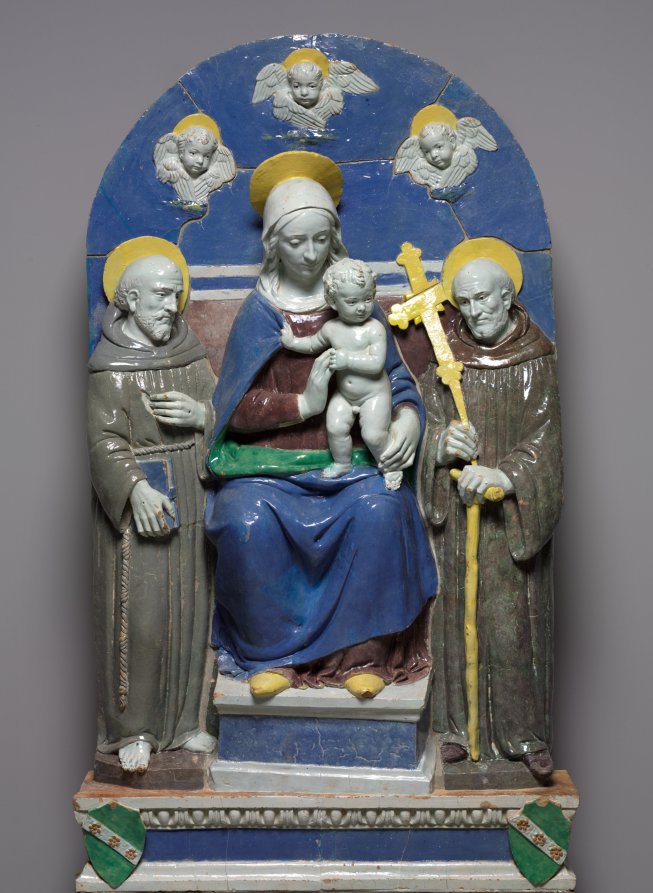
The Virgin and Child Enthroned with Saints Francis and Giovanni Gualberto presents itself not as a narrative tableau but as a structural manifesto. The composition operates through a rigorous vertical hierarchy, wherein the enthroned Virgin occupies the central axis as a load-bearing column, flanked by the two saints who function as buttressing elements—symmetrical, subordinate, yet essential to the tensile balance of the whole. This is not merely devotional iconography; it is architectural poetics rendered in pigment. The throne itself, with its rigid back and geometric armrests, prefigures the executive silhouette of 2026: a framework that contains, elevates, and disciplines the body within.
The Throne as Structural Prototype
Examine the throne's geometry. Its vertical uprights establish a strict parallel to the picture plane, refusing diagonal recession. The seat is a horizontal plane of absolute stability. The Virgin's body, draped in heavy fabric, does not soften this geometry but rather amplifies it through contrast—the folds of her mantle cascade in controlled, almost architectural pleats, each crease a decision, each shadow a deliberate structural joint. The Christ child, held at the precise center of this composition, functions as the keystone: small, dense, and load-bearing. He is the point of maximum compression within the visual field, the weight that the entire edifice is designed to support.
For the 2026 executive silhouette, this translates into a tailored discipline of the shoulder line—not the aggressive padding of prior decades, but a quiet, structural authority. The throne's back becomes the jacket's back: a clean, uninterrupted plane. The armrests become the precise set of the sleeve, terminating in a cuff that is neither ornamental nor casual but definitive. The fabric must possess weight—not heaviness, but gravitas—draping with the same controlled fall as the Virgin's mantle, each fold a testament to material intelligence.
Saints as Flanking Volumes: The Symmetry of Restraint
Francis and Giovanni Gualberto are not incidental. They are counterweights. Their positioning—kneeling, gazing upward, hands clasped or gesturing—creates a triangular compositional armature that stabilizes the central mass. Their robes, darker and less articulated than the Virgin's, function as negative space made positive: they are the shadow that defines the light, the silence that frames the utterance. In silhouette terms, they represent the supporting garments of the executive wardrobe—the understated trouser, the precise boot, the unadorned accessory. They do not compete; they complete.
The 2026 silhouette demands this same hierarchy of volumes. The primary garment—the coat, the jacket—must command the central axis. Secondary elements must recede with intention, their geometry simplified, their color muted to slate and shadow. The result is not minimalism as absence but minimalism as compression: every element reduced to its structural essence, every surface accountable.
Materiality: The Weight of Light and Stone
The painting's surface reveals a material intelligence that speaks directly to urban fabric. The throne's stone—cold, veined, unyielding—contrasts with the softness of wool and linen. The Virgin's blue mantle, deepened by shadow, suggests a dense, matte textile—perhaps a heavy crepe or a bonded wool—that absorbs light rather than reflecting it. The saints' robes, in earth tones, evoke brushed flannel or dry-finished cotton: surfaces that resist sheen, that hold their shape without stiffness.
For Addison Fashion's 2026 executive, this translates into a palette of controlled materiality: slate as the dominant tone, onyx for structural accents, ivory for the occasional plane of relief. Fabrics must possess tactile authority—a hand that communicates density without weight, a drape that holds a line without rigidity. The urban environment demands resilience; the silhouette demands composure under pressure.
The Geometry of Stillness: A Conclusion
The Virgin and Child Enthroned is, ultimately, a study in stillness as power. Its geometry does not move; it holds. The central axis is unbroken. The flanking volumes are balanced. The material contrasts are resolved within a unified field of shadow and light. This is the architectural integrity that the 2026 executive silhouette must embody: a presence that does not shout but stands, a structure that contains the body without constraining it, a minimalism that is not empty but compressed to its essential load-bearing form.
The urban poetics of Addison Fashion reside in this translation—from sacred stone to city pavement, from painted mantle to tailored wool, from the stillness of devotion to the composure of command. The silhouette is not a costume. It is a structure. And like the throne in the altarpiece, it must bear weight with grace, hold form with intention, and endure.