Urban Form: Winter Trees Reflected in a Pond
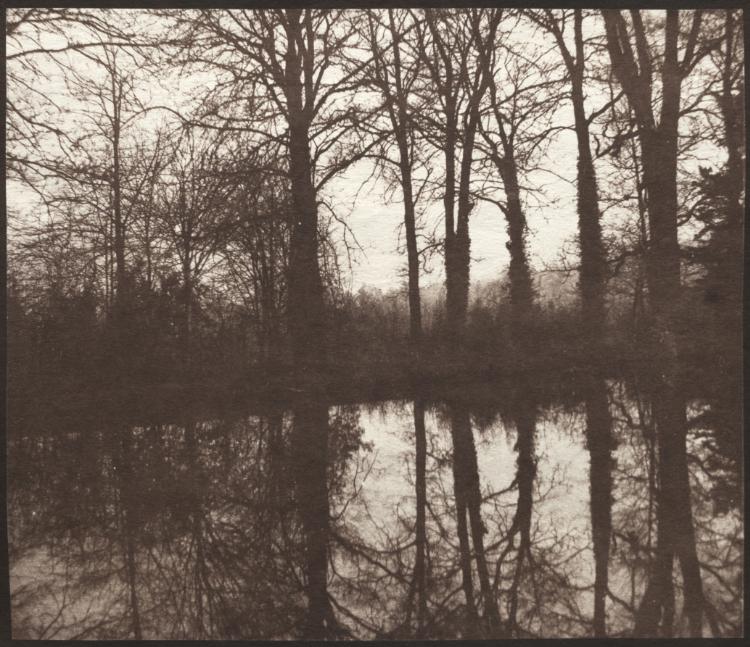
Urban Silhouette Research: Winter Trees Reflected in a Pond — Structural Poetics of the 2026 Executive Silhouette
I. The Geometry of Stillness: Verticality Against the Horizontal Plane
The artwork presents a binary architecture: the vertical insistence of bare trunks against the horizontal, reflective plane of the pond. This is not a landscape; it is a diagram of structural tension. For Addison Fashion, the winter tree functions as a load-bearing column — a slender, unadorned vertical that refuses ornamentation yet commands spatial authority. The reflection below is not a copy but a specular negotiation, a doubled silhouette that softens the original's severity through optical dissolution. The 2026 executive silhouette must internalize this duality: a tailored verticality above, a fluid, almost liquid drape below. The geometry is severe but not rigid — the branches fork and taper with the precision of a cantilever, suggesting that structural integrity in tailoring is achieved not through stiffness but through calculated asymmetry.
II. Negative Space as Tailoring Discipline
The pond's surface occupies the lower register as a field of negative space — a slate-grey void that mirrors and mutates. In the Addison vocabulary, this translates to the discipline of the unlined: the absence of visible construction, the erasure of dart and seam, the garment that holds its shape through fabric memory rather than interlining. The reflection's blurred edges are the couture equivalent of a raw-cut hem or a bias-finished seam — intentional imperfection as a marker of sophistication. The winter trees themselves are pure line: no foliage, no texture, only the essential stroke. This is the minimalist mandate for 2026 — the elimination of the decorative in favor of the architectural. A coat sleeve that follows the arm's axis without excess, a shoulder that is set rather than padded, a lapel that is a single fold rather than a constructed roll.
III. Materiality: The Pond as Fabric Surface
The water's surface is the artwork's most complex material proposition. It is reflective yet absorptive, smooth yet rippled, transparent yet opaque. This is the textile brief for the 2026 season: fabrics that perform multiple optical functions. Consider a slate-grey double-faced wool with a matte face and a subtle luster on the reverse — the garment's interior becomes the pond's hidden depth. Or a bonded silk-cotton that holds a crease like frozen water yet drapes with the fluidity of reflection. The trees' bark — rough, vertical, unyielding — suggests dry-handle wool crepe or heavy linen canvas for the structural elements: the trouser, the overcoat, the column dress. The contrast between bark and water is the contrast between tailoring and drape, and the 2026 silhouette lives precisely at this seam.
IV. The Reflected Silhouette: Doubling and Dissolution
The reflection is not a mirror image; it is a distortion. The trees bend, elongate, and dissolve at the waterline. This is the poetics of the urban executive who moves between the rigidity of the boardroom and the fluidity of the street. The Addison silhouette for 2026 proposes a doubled garment: a tailored shell that, when unbuttoned or unbelted, reveals a second, softer layer — a silk underlayer, a bias-cut slip, a fluid trouser beneath a structured tunic. The waterline itself is the waist seam, the point of transition where structure gives way to flow. The reflection's vertical striations — the elongated trunks — become pleats, tucks, knife folds that run the length of a skirt or a wide-leg trouser, creating a linear rhythm that echoes the artwork's compositional grid.
V. Color and Atmosphere: The Slate Register
The palette is monochromatic and severe: slate grey, charcoal, bone white, and the black of deep water. There is no warmth, no accent. This is the urban winter palette — a rejection of seasonal color in favor of tonal depth. The 2026 executive wardrobe will be built on value contrast rather than hue: a slate coat over an ivory trouser, an onyx knit beneath a silver-grey jacket. The artwork's atmosphere is one of cold clarity — the air is sharp, the light is flat, the mood is contemplative. This is the emotional register of the Addison client: composed, analytical, and quietly authoritative. The silhouette must reflect this — no superfluous gesture, no decorative flourish, only the essential line.
VI. Conclusion: The 2026 Executive Silhouette as Reflected Architecture
The winter trees reflected in a pond are not a scene; they are a proposition. The proposition is that structure and fluidity are not opposites but reflections of each other. The 2026 Addison silhouette is built on this principle: a tailored vertical that meets a fluid horizontal, a matte surface that conceals a luminous interior, a severe geometry that dissolves into specular softness. The executive who wears this silhouette is not dressed for display but for presence — a presence defined by architectural integrity, material intelligence, and the quiet authority of the unadorned. The pond does not shout; it reflects. The trees do not plead; they stand. This is the Addison posture for 2026: still, structural, and inexorably modern.