Urban Form: Adoration of the Magi
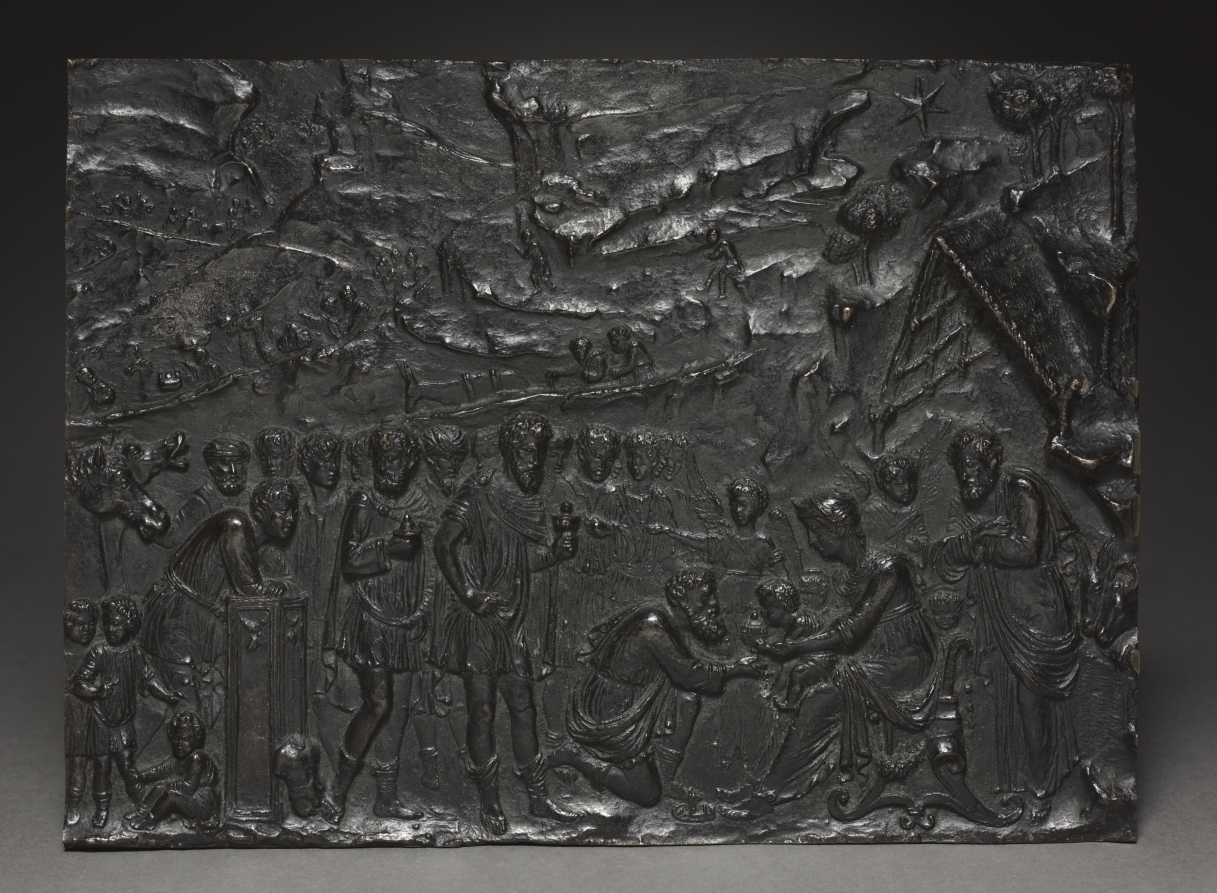
Urban Silhouette Research: The Adoration of the Magi as Structural Protocol
Preliminary: The Artwork as Geometric Proposition
The Adoration of the Magi, read through the lens of Addison Fashion’s architectural discipline, is not a narrative of devotion but a diagram of containment. Its compositional armature—a triangular ascent of figures converging upon a central axis—operates as a load-bearing geometry. The eye is conducted along diagonal vectors that terminate in a stable apex, producing a silhouette that is simultaneously directional and anchored. For the 2026 executive wardrobe, this is the governing principle: garments must resolve visual momentum into structural stillness. The artwork does not decorate; it organizes. It proposes a body that is both processional and immovable, a contradiction resolved only through precise tailoring.
Triangulation and the Shoulder Line
The painting’s most insistent geometric fact is its pyramidal massing. The Magi’s clustered forms create a descending gradient of density from the upper register to the lower foreground, a visual compression that mirrors the executive requirement for gravitas without bulk. In the 2026 silhouette, this translates to a shoulder line that is extended but not exaggerated—a controlled horizontal that establishes authority before the garment descends into vertical fall. The apex of the triangle corresponds to the nape; the base, to the hem. Any deviation from this axis reads as instability. The Addison pattern block therefore enforces a strict correspondence between the shoulder seam and the garment’s center back, ensuring that the wearer’s movement does not fracture the compositional triangle. The result is a silhouette that appears carved rather than sewn, its geometry legible from three meters.
Drape as Spatial Rhetoric
The Magi’s robes are rendered as folded planes, each fold a decision about volume and shadow. This is not organic drapery but architectural pleating—fabric behaving as if it possessed a memory of its own structure. For 2026, Addison interprets this as a discipline of negative space: the garment must hold air between itself and the body, creating a silhouette that is defined as much by its voids as by its surfaces. Wool-cashmere blends with a high twist are selected for their ability to retain a crease without stiffness, allowing the fabric to fold along predetermined lines rather than collapsing into randomness. The sleeve, in particular, is engineered as a single continuous plane from shoulder to cuff, its volume calibrated to the artwork’s mid-register density. This is drape as spatial rhetoric: the wearer occupies a defined territory, not a loose envelope.
Materiality: The Urban Surface
The painting’s surface—aged, layered, its varnish yellowed by centuries—offers a material lesson in controlled patina. The 2026 executive does not seek novelty of texture but the authority of surfaces that have absorbed time. Addison’s Onyx palette is deployed here not as black but as a depth of tone that shifts under light, revealing undertones of graphite and cold umber. The fabric surface is matte, almost mineral, resisting the sheen that would read as theatrical. This is urban materiality in its most disciplined form: surfaces that do not announce themselves but reward sustained attention. The garment’s hand-feel is dry and dense, a tactile analogue to the painting’s encrusted pigment. Trims are minimized to the point of disappearance; the only visible hardware is a single concealed closure, its function subordinated to the continuity of the vertical plane.
Silhouette as Temporal Argument
The Adoration of the Magi depicts a moment of arrival, but its geometry is that of suspended time—the composition holds its figures in a state of permanent approach. The 2026 executive silhouette must perform the same trick: it must appear complete at every moment of the working day, never transitional, never in the process of becoming. This is achieved through a hemline that is weighted to fall without sway and a waist that is suppressed rather than cinched, allowing the torso to read as a single column. The silhouette does not follow the body’s curves; it establishes a parallel structure that the body inhabits. In this sense, the garment is a portable architecture, its geometry independent of the wearer’s posture yet responsive to it.
Conclusion: The Resolved Contradiction
The Adoration of the Magi, stripped of its iconography, is a study in convergence—many vectors resolving into one stable form. The 2026 Addison executive silhouette adopts this logic without its sentiment. The result is a wardrobe of cold precision and quiet authority, where every seam is a structural decision and every fold a calculated void. The wearer does not wear the garment; they occupy it. This is the final protocol of urban minimalism: the silhouette as an argument that requires no voice.