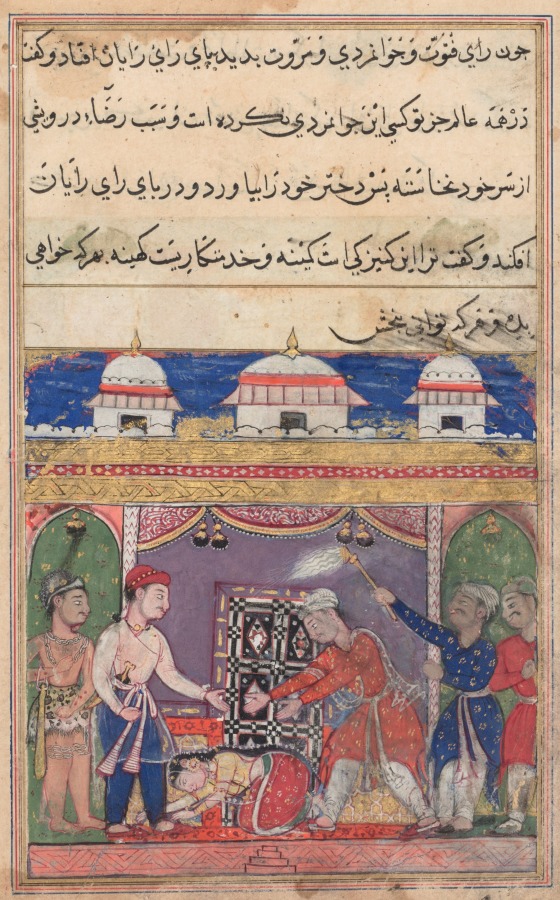
Urban Form: The king of Bahilistan offers his daughter to the King of Kings, from a Tuti-nama (Tales of a Parrot): Seventh Night
Urban Silhouette Research: The Bahilistan Court as Structural Prototype for the 2026 Executive Wardrobe
I. The Court as Grid: Geometric Integrity of the Composition
The Tuti-nama folio depicting the King of Bahilistan’s offering of his daughter to the King of Kings operates, first and foremost, as an exercise in compressed architectural logic. The manuscript page is not a window but a plan—a flattened elevation in which every figure is a load-bearing element. The composition resolves into a rigorous bilateral symmetry: the enthroned King of Kings anchors the rightward mass, the Bahilistan delegation counterweights the left, and the offered daughter occupies the precise fulcrum of the visual axis. This is not decorative balance; it is structural equilibrium, the same principle that governs a tailored shoulder line meeting a suppressed waist. The vertical registers—canopy, figures, ground plane—read as stacked strata, each with its own density and opacity. For the 2026 executive silhouette, the lesson is unambiguous: hierarchy is achieved through placement, not ornament. The garment must behave as the page behaves—every seam a ruling line, every panel a registered block.
II. The Offered Figure as Negative Space: The Poetics of Suppression
The daughter is rendered with deliberate restraint—her form is narrower, her gesture contained, her silhouette a tapered column against the broader masses of the male courtiers. She is the composition’s negative space made flesh: the interval that gives the surrounding volumes their legibility. This is the central poetics of the Addison executive wardrobe. The 2026 silhouette does not shout its authority through volume; it withholds. The daughter’s posture—upright, frontal, hands composed—is a study in minimalist verticality, the spine as the single unbroken line from hem to collar. Translate this to cut: a columnar coat with a suppressed waist, a shoulder that extends without padding excess, a hem that falls with the gravity of a plumb line. The figure’s containment is not weakness; it is editorial control. She occupies the least area and commands the most attention—the definition of a well-edited silhouette.
III. Materiality of the Folio: Pigment, Paper, and Urban Surface
The folio’s material logic is as instructive as its geometry. Opaque mineral pigments—lapis, ochre, verdigris—sit on a sized paper ground with matte absorption, not gloss. The surface refuses reflection; it holds light in a low, even register. This is the materiality of the 2026 urban executive: matte wool, brushed flannel, bonded cotton—surfaces that absorb the city’s glare rather than return it. The gold leaf accents, applied sparingly at the canopy and regalia, function as punctuating hardware: a single metallic closure, a restrained buckle, nothing more. The folio teaches that luxury is a matter of controlled reflectance—ninety percent matte, ten percent gleam. The color story is equally disciplined: a slate-dominant ground with ivory figure-ground separation and onyx anchoring the throne. This is the palette of the Addison executive—cool, mineral, and unremittingly urban.
IV. Narrative Compression and the Tailored Gesture
The scene depicts a transaction—an offering, a transfer of value—yet the painting refuses theatricality. There is no swirling drapery, no diagonal frenzy. The drama is compressed into gesture: the incline of a torso, the precise angle of a presenting hand. This is narrative economy, and it is the governing principle of the tailored gesture in 2026. A jacket does not narrate through embellishment; it narrates through the angle of a lapel, the set of a sleeve head, the break of a trouser. Each is a compressed event, legible only to the trained eye. The Bahilistan courtiers’ layered robes—each fold a registered plane—demonstrate that complexity is achieved through stratification, not accumulation. The executive wardrobe follows: a base layer of ivory silk, a mid-layer of slate wool, an outer shell of onyx bonded cotton—three strata, each with a defined edge, none competing for dominance.
V. Conclusion: The Silhouette as Ruling Line
The Tuti-nama folio is, finally, a document of governance—of bodies arranged according to law, of space allocated by rank, of surfaces disciplined by pigment. The 2026 Addison silhouette inherits this jurisprudence. It is a wardrobe of ruling lines: the vertical of the spine, the horizontal of the shoulder, the diagonal of the lapel. It is minimalist not by subtraction but by jurisdiction—every element admitted only after proving its structural necessity. The King of Kings sits because the composition requires an anchor; the daughter stands because the axis requires a fulcrum. The executive dress, likewise, is a court of seams—each one summoned, each one accountable. In slate and onyx, in matte and mineral, the Addison silhouette does not decorate the body. It legislates it.