Urban Form: Mourner from the Tomb of Philip the Bold, Duke of Burgundy (1364–1404)
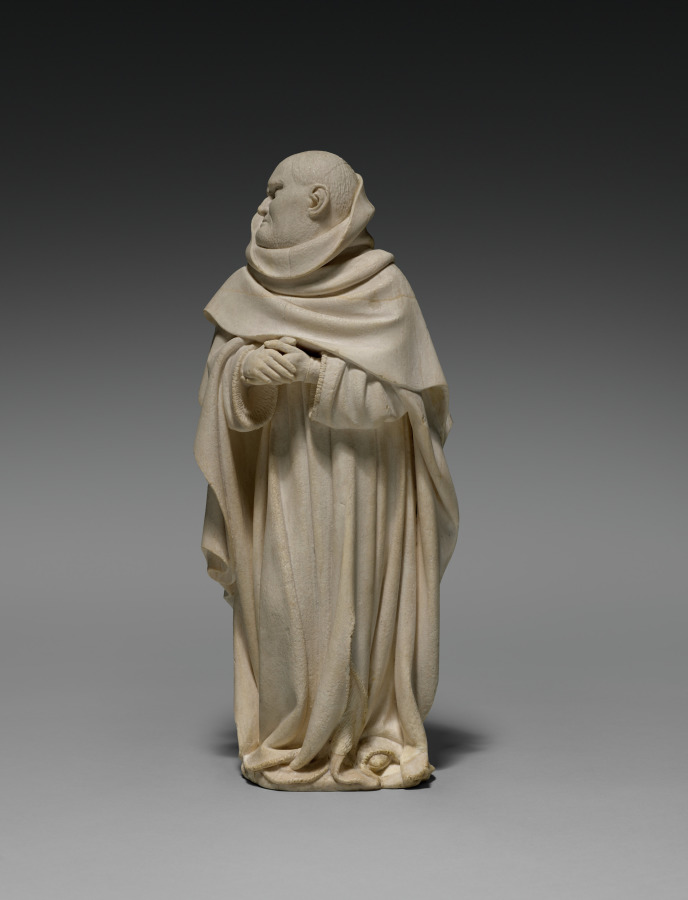
Urban Silhouette Research: The Mourner of Burgundy as Formal Precedent for the 2026 Executive Wardrobe
I. The Mourner as Structural Artifact: A Thesis on Displaced Volume
The Mourner from the Tomb of Philip the Bold, Duke of Burgundy (1364–1404), is not, at first inspection, a garment study. It is a funerary sculpture—one of the celebrated pleurants that populate the ducal tomb at Champmol, carved under the direction of Claus Sluter and his workshop in the late fourteenth century. Yet for the purposes of Addison Fashion's 2026 executive wardrobe, the Mourner functions as a primary source of structural intelligence: a compressed treatise on how volume, drapery, and concealment can be engineered into a single vertical silhouette. The figure is cloaked in a houppelande-derived mourning mantle, its hood drawn forward, its hands clasped, its face recessed into shadow. The body is present but withheld. This is the operative principle.
The Mourner's silhouette is governed by a deliberate asymmetry of information. The mantle falls in unbroken vertical folds from shoulder to hem, suppressing the waist, the hip, and the knee. What remains legible is the column—a continuous, slightly tapered mass that reads as a single gesture rather than a sequence of anatomical events. The hood creates a second, nested volume at the crown, producing a stepped profile that draws the eye upward and inward. This is not ornament; it is architectural logic. The garment is designed to be read at distance, in procession, under diffuse light—conditions that anticipate the executive's movement through a lobby, a boardroom, a terminal.
II. Form Deconstruction: The Mechanics of Withheld Volume
Three formal operations distinguish the Mourner and translate directly into our 2026 tailoring program.
First, the suppression of the waistline. The mantle does not cinch; it replaces the waist with a continuous fall of cloth. In contemporary terms, this is the argument for the unbelted long coat and the column dress—garments that establish authority through uninterrupted verticality rather than through the conventional hourglass. For the executive wardrobe, we translate this into a slate wool-cashmere overcoat cut with a dropped shoulder and a straight, floor-adjacent hem, worn open over a narrow underlayer. The coat becomes the silhouette; the body becomes the subtext.
Second, the nested hood. The Mourner's hood is a study in concentric framing: an outer mantle, an inner cowl, a recessed face. This layering produces depth without bulk—a critical distinction for the urban executive, who requires warmth and presence without the penalty of visual mass. Our interpretation is the double-collar construction: a high, structured stand collar beneath a broader, softer outer collar, both in slate, both matte. The face is framed, not swallowed.
Third, the clasped-hand gesture as closure. The Mourner's hands are bound into the cloth, eliminating the disruption of a sleeve opening. The garment reads as sealed. In tailoring, this suggests the value of the closed cuff, the concealed placket, and the integrated glove or gauntlet—details that remove the incidental and preserve the line. For 2026, we propose a slate wool houppelande-influenced coat with a concealed asymmetric closure and a cuff that extends to the knuckle, eliminating the visual noise of a visible wrist.
III. Color Analysis: Slate as the Mourner's Register
The Mourner's palette is monochrome by necessity—the limestone of Champmol has weathered into a cool, grey-green patina, and the original polychromy, where it survives, is muted. But the chromatic intelligence of the figure lies in its refusal of contrast. There is no accent, no trim, no break in value. The garment is a single tonal field, and its authority derives precisely from this tonal discipline.
Slate is the correct register for this translation. It is not black—black is declarative, and the Mourner is not declarative. Slate is recessive and mineral, a color that absorbs light rather than reflecting it, that reads as depth rather than surface. In the executive context, slate functions as a neutral of consequence: it signals seriousness without the funereal finality of onyx, and it holds a matte finish without the fragility of ivory. For 2026, we specify slate across a tonal triad—a deep slate for the outer coat, a mid-slate for the underlayer, a pale slate for the shirt—producing a graded monochrome that echoes the Mourner's weathered stone while remaining legible under artificial light.
IV. Application: The 2026 Executive Wardrobe
The Mourner's lesson for Addison Fashion is not historicist quotation but structural transfer. The 2026 executive does not require a mourning mantle; she requires its logic: the column silhouette, the nested collar, the sealed closure, the tonal field. These are the elements that convert a garment from clothing into presence—the capacity to occupy a room without announcing arrival.
We therefore propose a three-piece slate capsule: a floor-adjacent unbelted overcoat with a dropped shoulder and concealed closure; a column underlayer in mid-slate with a high stand collar; and a pale slate shirt with a closed cuff. The ensemble is designed to be read as a single vertical event, its volumes nested, its color graded, its details suppressed. It is, in effect, a pleurant for the boardroom—a silhouette that withholds the body in order to project the institution.
The Mourner was carved to accompany a duke into eternity. The 2026 executive requires a garment that accompanies her into the quarterly review. The formal grammar is identical: volume, concealment, tonal discipline. Addison Fashion's Urban Silhouette Research treats the Mourner not as a relic but as a specification—a precise, cold, and enduring instruction in how cloth becomes authority.