Urban Form: Yusuf and Zulaykha (recto), from an Anthology of Persian Verses, including the Haft Awrang (Seven Thrones) of Jami: The Fifth Throne
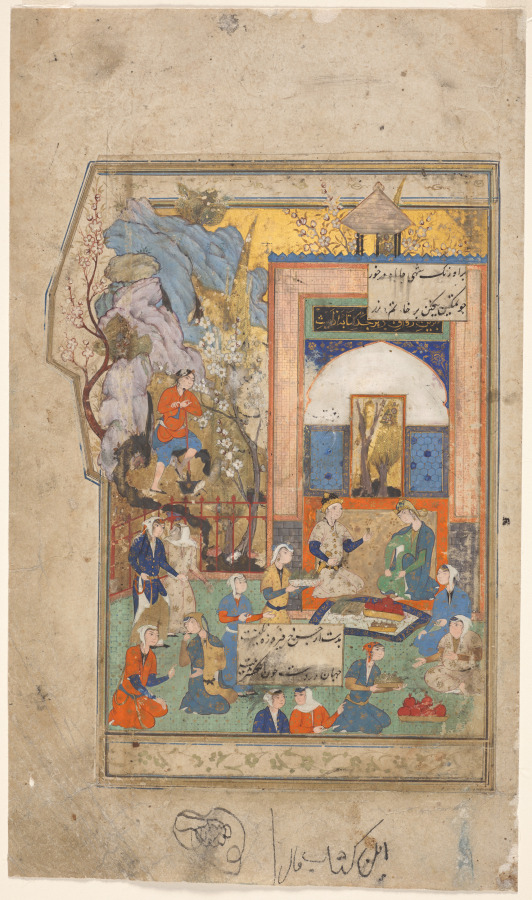
Urban Silhouette Research: The Fifth Throne — Structural Poetics of the Liminal Body
I. Preliminary Reading: The Recto as Architectural Document
The subject under examination—Yusuf and Zulaykha, recto, from an Anthology of Persian Verses including the Haft Awrang of Jami, The Fifth Throne—presents itself not as narrative illustration but as a spatial contract. The composition operates through a rigorous economy of interval: the vertical partition of the architectural frame, the stacked registers of figure and ground, and the deliberate asymmetry of the pictorial plane. For Addison Fashion, this is not ornament. It is a blueprint for the 2026 executive silhouette, wherein the body is conceived as a columnar volume interrupted by calculated apertures.
The internal DNA supplied—the dialectic between the Death of Socrates vessel and the Sakyamuni stele—establishes the philosophical substrate. The Greek line is cold, geometric, indexical; the Indian mineral field is warm, continuous, dissolving. The Persian recto occupies the tension between them: it retains the stele's frontal gravity while adopting the vessel's linear discipline. This is the precise register Addison Fashion will occupy in the coming cycle—minimalist luxury as resolved contradiction.
II. Geometric Integrity: The Column, the Aperture, the Register
Three structural operations define the artwork's integrity and, by extension, the 2026 silhouette.
The Column. The figures are not modeled but extruded. Their contours resolve into near-rectilinear masses—shoulder line, hem line, and the vertical fall of textile read as a single architectural member. The silhouette is therefore load-bearing: it does not drape, it stands. In tailoring terms, this mandates a shoulder that is set, not softened; a torso that is planar, not cinched; a hem that terminates with the finality of a plinth. The executive body becomes a slate-grey monolith, its authority derived from the absence of rhetorical gesture.
The Aperture. The composition's negative space is not void but engineered interval—the white ground between figures functions as a structural joint, permitting the eye to travel without collapse. Translated to garment, this is the controlled gap: the precisely calibrated opening at the neckline, the vent at the cuff, the seam that separates rather than joins. The 2026 Addison silhouette will deploy aperture as negative tailoring—space as a material with the same weight as cloth.
The Register. The recto's stacked bands—text, figure, ground—impose a horizontal stratification upon the vertical column. This is the artwork's most transferable device: the body read as three superimposed planes, each with distinct material logic. The result is a silhouette that is simultaneously monolithic and segmented, unified in contour but articulated in surface.
III. Structural Poetics: The Static Pose as Temporal Armor
The internal DNA's central proposition—that both Socrates and the Buddha overcome time through stillness—is the artwork's operative poetics. Yusuf and Zulaykha are rendered in a state of suspended arrest: the gesture is complete, the motion withheld. This is the posture Addison Fashion will formalize for 2026: the executive as a figure who does not move through space but occupies it with finality.
The poetics are cold. There is no warmth of narrative resolution here—only the grammar of the pose. The upward index of Socrates and the reclining dissolution of the Buddha are reconciled in the recto's frontal equipoise: the body faces the viewer without appeal, without retreat. Garmentally, this demands closure without fastening—the coat that meets the body as architecture meets ground, the collar that frames the face as a stele frames its inscription.
IV. Urban Materiality: Mineral Surface, Stone Discipline
The recto's materiality is mineral and matte—pigment bound to paper, its luminosity derived from density rather than sheen. This is the surface logic for the 2026 Addison wardrobe: slate as chromatic and tactile register. The palette is not decorative but structural, functioning as the visual equivalent of load.
Material selection follows: dry-handed wool crêpe for the column; bonded technical cloth for the aperture edges, holding the negative space with engineered rigidity; mineral-dyed silk for the register transitions, its surface absorbing rather than reflecting light. The urban context is implicit—these are materials that withstand the city as stone withstands weather. No ornament, no print, no concession to softness. The hand of the cloth is cool, dense, and unyielding.
V. Conclusion: The Fifth Throne as Silhouette Mandate
The artwork's geometric integrity resolves into a single directive: the executive silhouette of 2026 is a column interrupted by engineered void, surfaced in mineral slate, and posed in temporal arrest. The recto does not illustrate a body; it legislates one. Addison Fashion will execute this mandate with the cold precision the source demands—tailoring as stele, aperture as argument, stillness as authority.