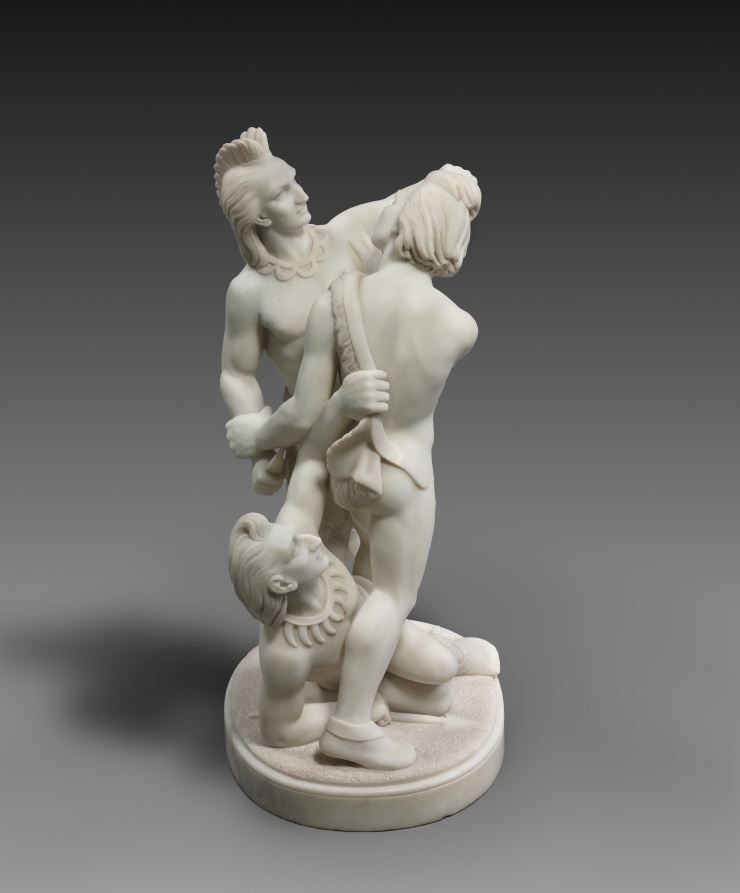
Urban Form: Indian Combat
The Addison Fashion Urban Silhouette Research: Structural Poetics of the Rational and the Continuous
I. The Vertical Axis: Death as Architectural Tension
The David composition presents a closed geometric system: bodies compressed into a shallow foreground plane, light descending from a single upper-left source, and a central figure whose gesture—the raised hand, the pointing finger—establishes an uncompromising vertical axis. This axis is not decorative; it is structural. It divides the canvas into a left field of grief (the clustered, collapsing bodies) and a right field of absence (the receding arch and empty corridor). The geometric integrity of the work resides in this asymmetry: a dense mass counterweighted by void, a body in repose counterweighted by a gesture of ascent.
For the 2026 executive silhouette, this vertical axis translates directly into the columnar line. The Addison tailleur of the coming season will abandon the nipped waist and the softened shoulder in favor of a single, uninterrupted descent from clavicle to hem. The shoulder is squared but not padded—a clean right angle that recalls the philosopher's upright torso. The lapel is narrow, almost knife-edged, and the closure is concealed. The garment does not ornament the body; it constructs a proposition about the body's relationship to gravity. The executive who wears it occupies space with the same deliberate stillness as the condemned man: composed, declarative, and entirely aware of the gaze upon him.
II. The Horizontal Wave: Continuity as Material Logic
The Meiping vase operates on an opposing geometric principle. Its form is a continuous curve—no hard angle, no terminal gesture. The wave motif, rendered in underglaze cobalt, is not a representation of water but a rhythmic system: arcs that repeat without origin or terminus, their spacing calibrated to the vessel's taper. The geometry here is not compositional but topological. The wave does not sit on the surface; it belongs to the surface, absorbed into the glaze, inseparable from the clay's curvature.
This principle governs the Addison approach to urban materiality for 2026. The season's outerwear will employ bonded wool and matte technical silk in a single slate tone, cut without visible seams at the side body. The wave becomes a drape logic: a continuous fall of fabric that resists interruption, that moves with the wearer rather than against the environment. Where the David silhouette asserts verticality, the Meiping silhouette asserts flow—a garment that behaves like a contained body of water, its volume determined by the wearer's movement rather than by internal structure. The executive coat of this register is collarless, unlined at the hem, and finished with a raw edge that suggests the vessel's unglazed foot.
III. The Dialectic of Event and State: Two Executive Modes
The critical distinction between these two geometries is temporal. The David composition is an event: a single instant of decision, rendered with theatrical lighting and compressed narrative. The Meiping is a state: a condition of continuous becoming, observed without climax. For the Addison wardrobe, this distinction produces two distinct silhouette families for 2026.
The first family—the Event Silhouette—is tailored, architectural, and declarative. It is the suit for the boardroom, the negotiation, the moment of public consequence. Its geometry is closed: defined shoulders, a suppressed waist, a hem that terminates precisely at the ankle. It is designed to be read in a single glance, like the David canvas, and to communicate authority through containment.
The second family—the State Silhouette—is fluid, continuous, and ambient. It is the dress for the gallery opening, the long-haul flight, the day of creative incubation. Its geometry is open: a dropped shoulder, a bias-cut panel, a hem that moves without a fixed line. It is designed to be experienced over time, like the Meiping's wave, and to communicate authority through composure rather than assertion.
IV. The Shared Metaphysical Register: Form as Ultimate Inquiry
What unites these opposing geometries is a shared refusal of the merely decorative. The David painting does not ornament death; it constructs it as a philosophical proposition. The Meiping vase does not depict water; it embodies continuity as a material fact. In both cases, form carries the weight of an inquiry that exceeds its medium.
The Addison 2026 collection will operate on the same principle. The slate palette—neither black nor grey, but a suspended tone that absorbs light without reflecting it—will serve as the chromatic ground for both silhouette families. The fabrics will be chosen for their structural memory: a wool crepe that holds a vertical line, a silk twill that falls without clinging, a bonded jersey that returns to its shape after movement. The executive silhouette of 2026 is not a costume of power. It is a geometric argument about presence—about the body as a site where the rational and the continuous, the event and the state, the vertical and the wave, are held in deliberate, unresolved tension.
This is the Addison proposition: that the most sophisticated urban garment is one that acknowledges both the philosopher's pointing finger and the potter's unending wave—and cuts its cloth accordingly.