Urban Form: Ganesha
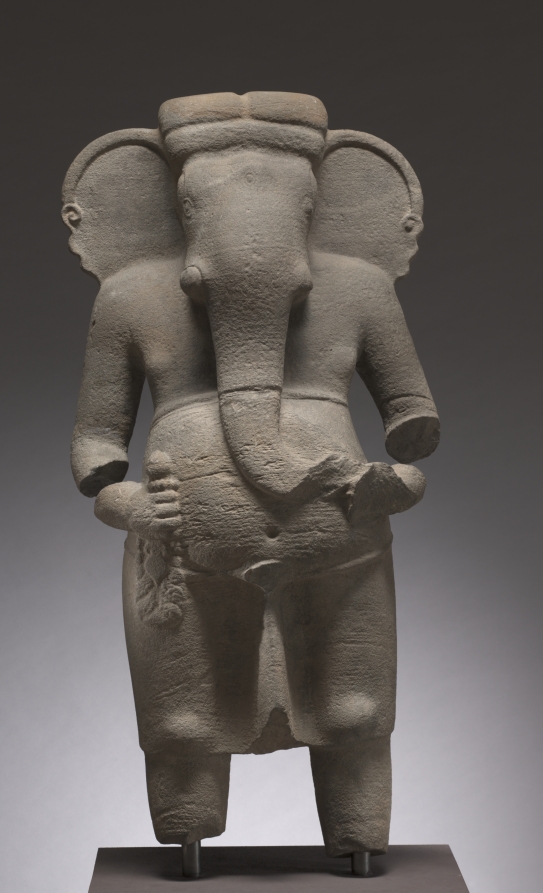
Urban Silhouette Research: Ganesha — Structural Poetics of the Lithic and the Figure
I. The Lithic Paradigm: Negative Space as Architectural Armature
The primary subject presents a fundamental proposition for the 2026 executive wardrobe: that mass is not volume but orchestrated absence. The scholar's rock — Lingbi stone in its canonical shou, zhou, lou, tou morphology — operates not through additive bulk but through a disciplined economy of perforation. Its silhouette is defined by what it refuses to enclose. For Addison Fashion, this translates into a tailoring philosophy where the garment's authority derives from the precision of its voids: the clean armhole, the deliberate shoulder gap, the waist suppressed rather than cinched. The 2026 executive does not wear structure; she inhabits negative space.
The stone's surface — its cun texture, those geological striations recording deep time — establishes a materiality that is simultaneously raw and refined. This is the central tension we must resolve in fabric. The urban equivalent is a compact wool with a dry, chalked hand: dense enough to hold an architectural line, matte enough to absorb rather than reflect light. No sheen. No softness that compromises the edge. The rock's cavities function as a light theater, and so must the garment's seams — each opening a calculated aperture through which the city's luminance passes.
II. The Figure Paradigm: Drape as Geological Strata
The secondary subject — the seated luohan with attendant — offers the countervailing discipline: the poetics of the fold. The robe's cascading pleats are read not as cloth but as sedimentary accumulation, each layer a compressed epoch. The attendant's dynamic counterpoint to the seated figure's stillness establishes the dialectic that governs our 2026 silhouette: static core, kinetic periphery. The executive jacket must anchor the torso with monastic composure while the sleeve, the hem, the scarf-line release into controlled motion.
The mineral pigments on silk — their permanence against time — instruct our color discipline. Onyx as the foundational tone: not black, but the deep carbonaceous grey-black of compressed stone, a color that reads as absolute without being flat. Against it, the ivory of the attendant's garment provides the single permitted contrast — a bone-white that functions as the painting's liubai, the reserved emptiness that gives the composition breath. In the wardrobe, this is the one ivory shell beneath the onyx tailoring: restraint as luxury.
III. Geometric Integrity: The 2026 Executive Silhouette Defined
The synthesis of these two paradigms yields a silhouette of asymmetric axiality. The rock's vertical thrust — irregular, leaning, never symmetrical — liberates us from the bilateral tailoring that has dominated executive dress for a decade. The 2026 line is off-axis by design: a shoulder seam displaced two centimeters, a lapel that narrows asymmetrically, a hem that falls fractionally longer at one side. This is not decoration; it is the geometric integrity of the natural form, which achieves balance through dynamic compensation rather than mirroring.
The luohan's seated mass provides the counterweight: a defined waist, a grounded hip, a hem that breaks with geological weight. The tension between the rock's verticality and the figure's horizontality produces the collection's governing proportion — a 1:1.618 vertical-to-horizontal ratio applied to jacket length against shoulder breadth. The result is a silhouette that reads as simultaneously monumental and mobile.
IV. Urban Materiality: The City as Lithic Surface
The final register is material. The rock's tou — its perforations — find urban corollary in the city's own negative spaces: the gap between towers, the light well, the plaza void. Our fabrics must carry this architectural memory. We specify a double-faced cashmere bonded to a technical membrane: the exterior matte and mineral, the interior smooth as polished stone. Seams are pressed open and topstitched in a single tonal thread — no contrast, no hardware, no intervention that breaks the lithic continuum. Buttons are concealed or eliminated entirely; closure is achieved through internal magnetic architecture, invisible as the rock's internal fractures.
The palette remains rigorously constrained: Onyx as the structural ground, Slate for secondary layers, Ivory as the single release. Silver appears only as a trace element — a hairline edge-paint on a collar, the interior lining of a cuff — never as ornament. This is the discipline of the scholar's stone: the object's value is not in what is added but in what is rigorously withheld.
V. Conclusion: The Metaphysical Garment
The Addison Fashion 2026 executive silhouette is, finally, a portable landscape. It carries the rock's abstract rhythm and the figure's composed stillness into the urban field. It refuses utility as its justification — it is not merely professional armor — and instead claims the uselessness of the scholar's stone: the garment as a metaphysical medium, a surface upon which the wearer's interiority is projected and protected. In the tension between mineral mass and human motion, between void and fold, the collection achieves the object-heart correspondence that Eastern aesthetics has always demanded. The executive does not wear a suit. She wears a microcosm.