Urban Form: Christ Carrying the Cross with Saints Simon and Veronica
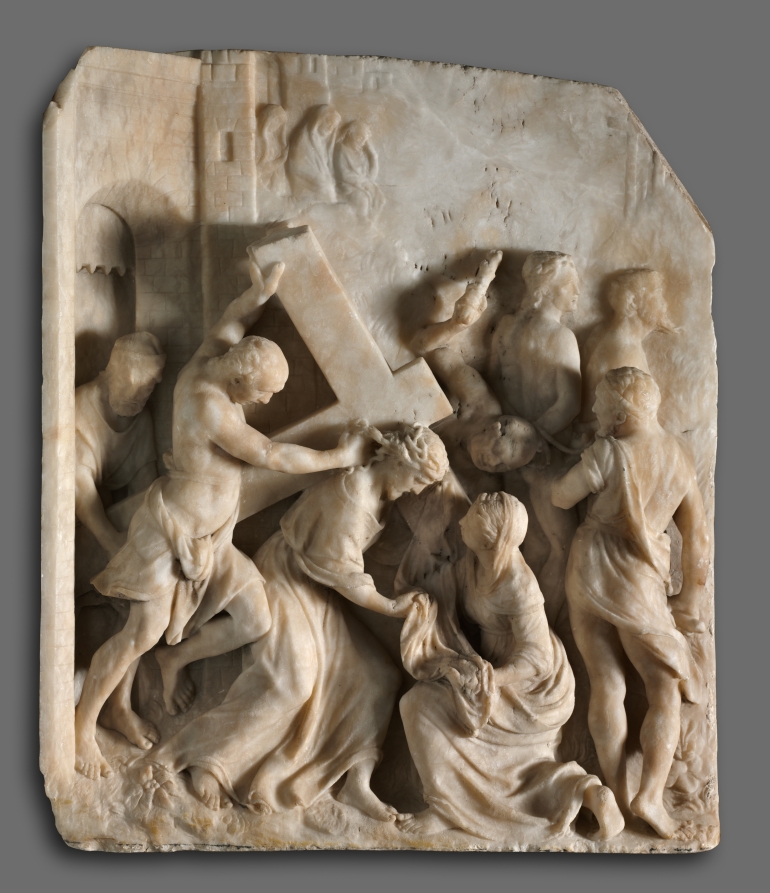
Urban Silhouette Research: Christ Carrying the Cross with Saints Simon and Veronica — Structural Poetics of the Interrupted Line
I. The Diagonal as Executive Architecture
The composition is governed by a single, relentless diagonal: the axis of the Cross, borne across the picture plane at an angle that refuses both the vertical authority of the column and the horizontal repose of the horizon. This is not a neutral geometry. It is a load-bearing line — a structural member under compression — and it dictates the entire choreography of bodies beneath it. For the 2026 executive silhouette, this diagonal is the operative principle: the garment must read as a single continuous member in tension, not as an assembly of parts. The shoulder line descends; the hem counterweights; the spine of the coat traces the same unbroken vector. Where the Cross cuts the frame, the silhouette must cut the urban field — decisively, without apology, and with the cold clarity of a structural calculation.
II. Veronica's Veil: The Principle of the Interrupted Plane
The veil held toward the face is the painting's most sophisticated formal device. It is a plane within a plane — a soft, absorbent surface inserted into a composition of hard stone, timber, and armored flesh. It interrupts the diagonal without breaking it; it absorbs the gesture without dissolving the tension. This is the precise logic of the Addison outer layer for 2026: a minimalist membrane — a veil-weight wool, a matte technical silk — laid over the architectural shell, registering the body's movement while refusing to soften the underlying structure. The veil does not console the composition. It records it. Materiality here is documentary: the surface must carry the imprint of pressure, of contact, of the city's friction, and remain uncreased in its formal integrity.
III. Simon of Cyrene: The Counter-Force and the Tailored Seam
Simon's intervention — the hand steadying the beam from behind — is the composition's counter-force, the hidden structural support that makes the visible load possible. In tailoring terms, this is the internal seam: the canvassed chest, the taped shoulder, the weighted hem that no observer sees and every observer feels. The 2026 executive silhouette cannot be understood from its exterior alone. Its authority derives from concealed engineering — the invisible armature that permits the outer line to remain severe while the body beneath it moves freely. Simon is the tailor's conscience: the acknowledgment that structure is a collaborative act between the visible and the hidden.
IV. The Crowd as Urban Field: Density Without Noise
The surrounding figures — soldiers, onlookers, the compressed heads at the frame's edge — constitute the urban field: dense, stratified, and deliberately unresolved. They are not narrative decoration; they are contextual mass. The painting refuses to isolate its subject against a void. It embeds the diagonal within a crowd, and the crowd's density is what gives the diagonal its meaning. This is the governing lesson for urban materiality in 2026: the executive garment is worn within the city, not above it. Its minimalism must be earned against density — a slate-toned shell that holds its edge in a crowd of signals, screens, and competing silhouettes. Restraint is not withdrawal. It is the discipline of remaining legible under compression.
V. The Fragment Logic: Completion Through Interruption
The painting's frame crops the narrative — the procession continues beyond the edge, the destination is withheld. This is the aesthetic of the fragment: the work achieves its power precisely where it is cut. The 2026 silhouette adopts this logic without sentiment. A hem that stops short. A sleeve that terminates at the wrist's precise articulation. A closure that resolves asymmetrically. Each interruption is a calculated incompletion — the garment refuses to over-explain itself, and in that refusal it gains authority. The executive wardrobe of the coming season is not a finished statement. It is a structurally resolved fragment: complete in its engineering, open in its reading.
VI. Conclusion: The Cold Poetics of the Load-Bearing Line
The definitive Addison silhouette for 2026 is derived from this painting's central proposition: that structure is carried, not displayed. The diagonal must be borne; the veil must record; the counter-force must remain hidden; the crowd must remain dense. In slate-toned minimalist tailoring, the result is a silhouette of severe economy — a single uninterrupted line, an interrupted plane, an invisible armature — worn against the city as the Cross is worn against the crowd: as a load, deliberately, with composure. This is the urban poetics of the executive form: not ornament, not gesture, but the cold and exacting beauty of a line that holds.