Urban Form: Silver Wine Jug, Ham, and Fruit
Urban Silhouette Research: The Udumbara Protocol — Form, Void, and the Silver Vessel
I. Subject Framing: The Still Life as Silhouette Archive
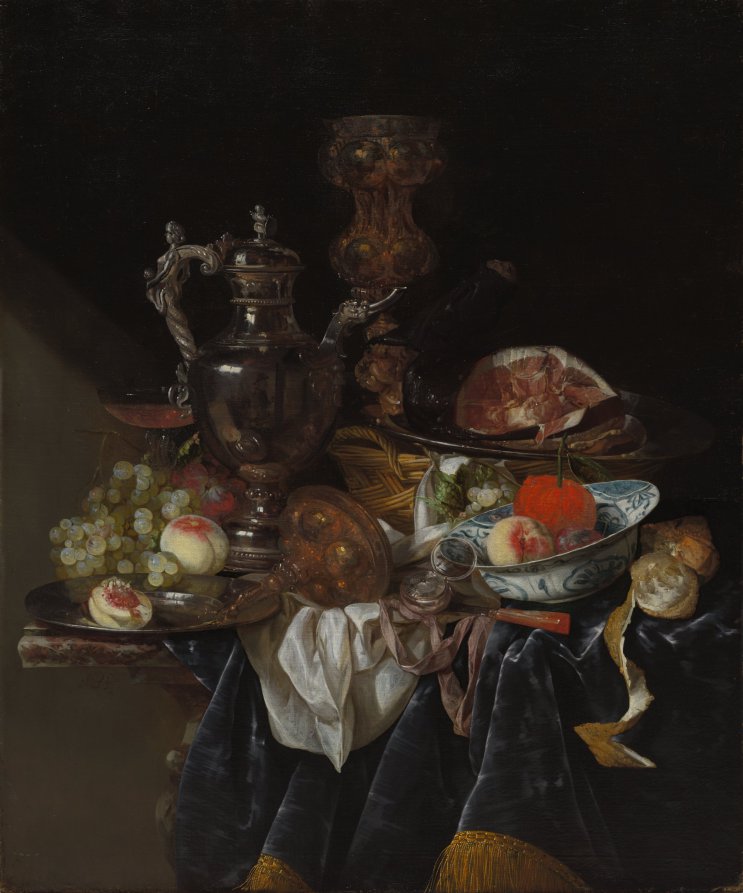
The subject under analysis—Silver Wine Jug, Ham, and Fruit—is not a still life to be read as domestic abundance, but a compositional instrument. In the Addison research lexicon, we treat the Dutch-Flemish still life not as genre painting but as a silhouette archive: a controlled field in which mass, void, and reflectivity are calibrated against one another. The silver jug functions as the anchor object—a high-luster, rotationally symmetrical volume that establishes the vertical axis and the specular register. The ham introduces organic mass with irregular contour and matte density. The fruit supplies chromatic punctuation and spherical repetition. Together they form a triad of volume, mass, and accent—the same triad that governs the executive wardrobe's structural logic for 2026.
The DNA source—the Udumbara Flowers temple plaque and the Chest for Storing Garments—supplies the philosophical substrate. The plaque's principle of de-imaging (the flower rendered as name, not form; absence as presence) and the chest's principle of receptacle aesthetics (the container as inhabited interval) converge on a single proposition: the object must hold meaning through restraint of surface and discipline of void. This is the operative thesis for the 2026 collection.
II. Formal Deconstruction: Mass, Void, and the Specular Axis
The silver jug's silhouette is defined by a continuous convex curve interrupted only at the neck and handle—a closed, self-referential form. In tailoring terms, this translates to the unbroken shoulder-to-hem line: no waist suppression, no dart interruption, a single fluid contour that reads as volume rather than shape. The jug's reflectivity is critical. Silver, as a color and a material property, does not absorb light; it redistributes it. Applied to fabric, this mandates low-sheen technical surfaces—bonded wool, matte cupro, brushed silk—that catch and return ambient light without gloss. The result is a garment that reads as present without being loud: the executive silhouette as specular object.
The ham's irregular mass provides the counter-principle: organic asymmetry. In the wardrobe, this manifests as the single-side drape—a bias-cut panel, an asymmetric closure, a hem that falls one centimeter lower on the left. The asymmetry is not decorative; it is structural relief against the jug's symmetry, preventing the silhouette from collapsing into monotony. The fruit's spherical repetition supplies the accent rhythm: cuff, collar, and closure hardware as discrete, repeated volumes—each a small sphere of attention against the field of the garment.
The void—the negative space between jug, ham, and fruit—is the most consequential element. In the plaque's logic, the unpainted surface is where meaning resides. In the wardrobe, the void is the interval between body and cloth: the engineered ease that allows movement without billow. For 2026, this interval is calibrated at 4–6 cm at the chest, 8–10 cm at the hem—sufficient for layering, insufficient for volume drift. The garment must contain the void, not surrender to it.
III. Color Logic: Silver as Chromatic Discipline
Silver is not a neutral; it is a conditional—a color that exists only in relation to its environment. The jug's silver reads warm against the ham's ochre and cool against the fruit's vermilion. In the executive wardrobe, silver functions as the chromatic hinge: it mediates between the wearer's skin tone and the urban field (concrete, glass, steel). The 2026 palette therefore deploys silver as ground, not accent—a silver-grey wool suiting, a silver-sand silk shirting, a silver-onyx knit. The accent register is reserved for the fruit logic: a single vermilion or ochre point—a lining, a stitch, a button—that operates as chromatic punctuation against the silver field.
This is the Udumbara principle applied to color: the flower is named, not shown; the accent is implied, not saturated. The executive wardrobe of 2026 does not announce its color; it withholds it, releasing it only in the interval of movement.
IV. Wardrobe Translation: The 2026 Executive Silhouette
The resulting garment architecture is a three-tier system. Tier one—the jug: a closed, continuous outer layer (long coat, unstructured blazer) in silver-grey bonded wool, shoulder line extended 2 cm beyond the natural joint, hem falling at mid-calf. Tier two—the ham: an asymmetric mid-layer (bias-cut tunic, draped shell) in matte cupro, hem offset by 1.5 cm, closure concealed. Tier three—the fruit: discrete accents (cuff, collar, hardware) in brushed silver or single-point ochre. The void is engineered at the chest and hem; the specular axis is maintained through low-sheen surfaces; the asymmetry provides structural relief.
The philosophical闭环 is complete: the plaque's de-imaging becomes the wardrobe's restraint of surface; the chest's receptacle logic becomes the garment's containment of void. The silver jug is not a still life—it is a silhouette protocol. The 2026 executive does not wear color; she inhabits it, as the plaque inhabits its cracks and the chest inhabits its flowers. Form holds the void; the void holds the meaning. This is the Addison position.