Urban Form: Sleeping Christ Child
Urban Silhouette Research: The Sleeping Christ Child — Structural Poetics of the Involuted Form
I. Geometric Integrity: The Closed Curve as Executive Armature
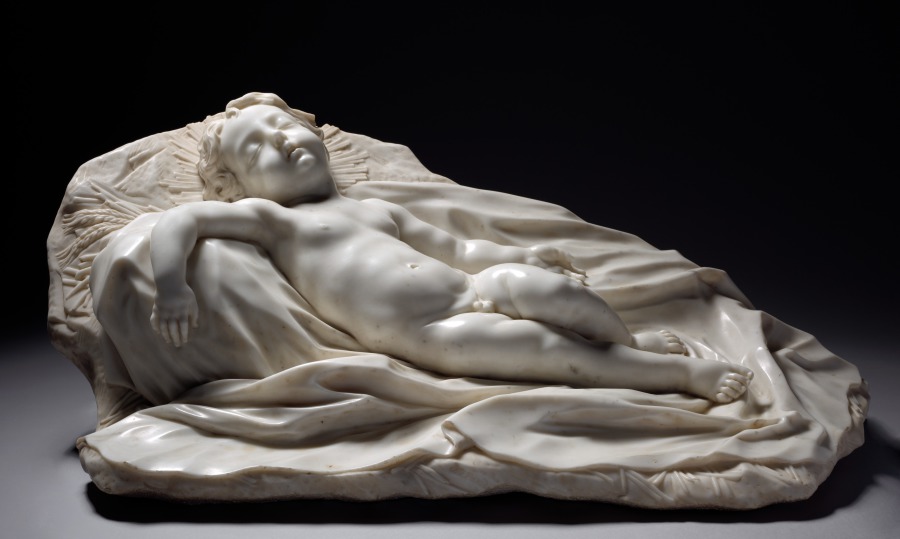
The Sleeping Christ Child presents a compositional geometry defined not by extension but by involution — the deliberate folding of mass into a self-referential contour. The infant’s body describes a near-perfect ovoid, its circumference interrupted only by the slight protrusion of the bent knee and the countervailing recession of the shoulder. This is not the geometry of the heroic diagonal, nor of the monumental vertical; it is the geometry of the enclosed volume, a form that refuses outward projection and instead consolidates its energy at the core. For the 2026 executive silhouette, this principle translates into a garment architecture that prioritizes containment over display: the shoulder is rounded and dropped, the waist suppressed, the hem weighted to fall in a continuous arc from the nape. The result is a silhouette that reads as a single, unbroken gesture — a sealed form that communicates authority through restraint rather than through the aggressive tailoring of the previous decade.
The drapery surrounding the child — the folds of the Virgin’s mantle, the swaddling cloth — operates as a secondary geometry, a system of parallel arcs that echo and amplify the primary ovoid. These are not chaotic creases but regulated undulations, each fold calibrated to reinforce the central mass. In material terms, this suggests a fabrication logic for 2026: bonded wool crepe and double-faced cashmere that hold a curve without collapsing, that permit the garment to maintain its architectural integrity while yielding to the body’s movement. The urban environment demands this duality — a silhouette that is structurally legible from a distance yet tactically responsive at close range.
II. Structural Poetics: The Rhetoric of the Recumbent Axis
The painting’s dominant axis is horizontal, but it is a horizontality that resists passivity. The child lies, but the body is tensed into a curve, the head tilted back, the limbs drawn inward. This is the poetics of latent force — a form at rest that nonetheless implies potential energy. For the executive wardrobe, this translates into garments that appear composed and static while concealing an internal dynamism: the cocoon coat with its curved raglan sleeve, the column dress cut on a subtle bias so that the fabric spirals rather than hangs, the kimono-sleeve blazer whose volume is controlled by a single, almost invisible seam at the back. The silhouette does not announce movement; it withholds it, releasing energy only through the wearer’s gait.
The negative space surrounding the figure — the dark, undifferentiated ground — is equally significant. It is not emptiness but compression, a visual pressure that forces the eye back onto the form. In urban terms, this corresponds to the monochrome palette and tonal restraint that will define the 2026 executive wardrobe: slate greys, onyx blacks, ivory whites, each garment a closed system of color that gains its power from the absence of contrast. The silhouette emerges not through juxtaposition but through modulation — the subtle shift from matte to sheen, from felted to bonded, within a single tonal field.
III. Urban Materiality: The Tactile Register of Authority
The painting’s surface — its craquelure, its aged varnish, its cumulative patina — speaks to a materiality that is layered and temporal. The 2026 executive does not wear newness; they wear accumulation. Fabrics must register time: washed silk with a faint irregularity of hand, compressed felt that holds the memory of pressure, bonded leather whose edges are left raw and unsealed. The silhouette is not pristine; it is resolved, the product of a material logic that values density over decoration and weight over transparency.
The child’s flesh — rendered with a cool, almost marble-like pallor — introduces a counterpoint of smoothness against the surrounding texture. This duality suggests a two-material system for the 2026 silhouette: a dense, matte shell (wool, felt, bonded cotton) enclosing a fluid, second-skin layer (silk jersey, fine-gauge knit) that is visible only at the cuff, the collar, the hem. The executive form is thus stratified, its authority derived from the controlled revelation of what lies beneath the architectural surface.
IV. Conclusion: The Silhouette as Secular Reliquary
The Sleeping Christ Child is, finally, a vessel — a form designed to contain and protect something precious, something that cannot be displayed without being diminished. The 2026 executive silhouette, as derived from this artwork, must function in the same register: it is not a garment that announces the wearer but one that houses them, that provides a structural envelope within which authority is not performed but preserved. The geometry is involutional, the poetics are those of latent force, and the materiality is one of accumulated density. In the urban landscape — a field of horizontal pressures and vertical demands — this silhouette stands as a quiet, closed curve, a form that resists the noise of the street and returns the executive body to its most essential function: the occupation of space with intention.