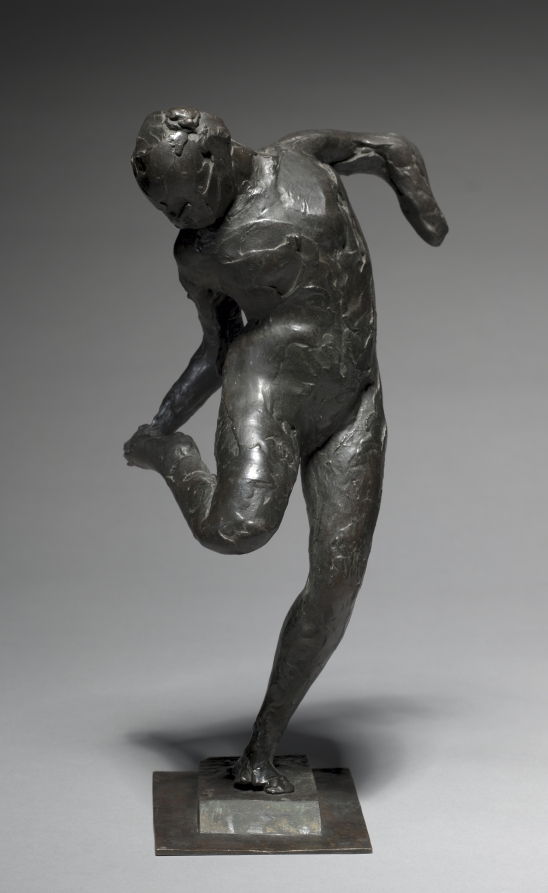
Urban Form: Dancer Looking at the Sole of her Right Foot
Urban Silhouette Research: Geometric Integrity and the 2026 Executive Form
Preliminary Structural Reading
The subject—a dancer arrested in the act of inspecting the sole of her right foot—presents a closed kinetic system of exceptional formal discipline. The body is not merely posed; it is engineered. Every limb resolves into a load-bearing axis, and the resulting composition reads less as a portrait than as a study in compressive and tensile forces held in precarious equilibrium. For Addison Fashion, this is the governing document of the 2026 executive silhouette: a garment must behave as the body behaves here—deliberate, self-referential, and structurally honest.
The Folded Geometry: A Closed Polygon of Intent
Observe the primary gesture. The torso inclines forward; the right leg folds sharply at the knee, drawing the foot upward toward the eyeline; the supporting leg anchors the entire mass. The silhouette thus describes an irregular polygon—a taut, angular envelope in which negative space is as rigorously governed as positive mass. There is no decorative spill. The line of the spine, the shelf of the shoulder, the acute angle of the raised thigh: each reads as a cut edge rather than an organic curve. This is the architectural logic we translate into tailoring. The 2026 executive jacket will abandon the soft shoulder in favor of a defined, almost planar yoke; the trouser will follow the folded knee's geometry, tapering to a precise break that mirrors the foot's upward address. The body becomes a constructed volume, and the cloth must respect its facets.
Compression and Release: The Poetics of Load
The dancer's pose is defined by compression at the hip and release at the extremity. The folded leg gathers fabric and flesh into a dense, high-tension node; the extended foot and inspecting gaze release that tension outward into space. This dialectic—gathered mass against projected line—is the structural poetry of the collection. We propose a tailoring system of variable density: dense, bonded wool at the waist and hip, where the body compresses; fluid, lighter-weight panels at the sleeve and hem, where the body extends. The garment should register the body's load paths the way the dancer's musculature registers hers—visibly, but with restraint. Nothing is padded into oblivion; everything is resolved.
Urban Materiality: Surfaces That Hold Their Edge
The image is rendered in a cool, slate-toned register—a palette of shadow and matte surface that refuses ornament. This is the material brief. For 2026, Addison Fashion specifies dry-handed, matte-finish textiles: high-twist worsteds, bonded double-face wool, and technical gabardines with sufficient body to hold a crease without pressing. The surface must read as architectural concrete reads—flat, confident, and slightly austere. Sheen is permitted only at points of articulation, where movement demands a subtle shift in light. The dancer's skin and the floor share a tonal sobriety; so too must the executive wardrobe. Slate is not a color here but a structural condition.
The Gaze as Tailoring Criterion
Critically, the subject looks down—at the sole, at the point of contact, at the foundation of her own stance. This downward, self-inspecting gaze is the collection's conceptual anchor. The 2026 executive does not perform outward authority; she audits her own structure. Tailoring must therefore be legible from within: clean internal finishing, exposed seam architecture where appropriate, a hem that reveals its own construction. The garment is not a facade but a load-bearing system the wearer can inspect and trust. This is minimalism as engineering, not as absence.
Silhouette Specification
The resulting 2026 silhouette is columnar with a folded interruption—a long, vertical line broken at the hip or knee by a deliberate angular gesture. Shoulders are squared but not exaggerated; the waist is defined by compression rather than cinching; the hem falls with the weight of the fabric, not against it. Proportions favor a high, narrow torso over a grounded, tapered leg—a direct quotation of the dancer's folded stance. The overall read is closed, exacting, and quietly monumental: a body that has measured itself and found its geometry sound.
Conclusion
The dancer inspecting her sole is, in essence, a structural audit made visible. Addison Fashion's 2026 executive silhouette derives from this principle: garments as resolved force diagrams, surfaces as matte and deliberate as slate, and a minimalism that is not the absence of form but the rigorous proof of it. The collection will not decorate the body. It will corroborate it.