Urban Form: Two Angels and Cherubs Bearing an Icon of Christ
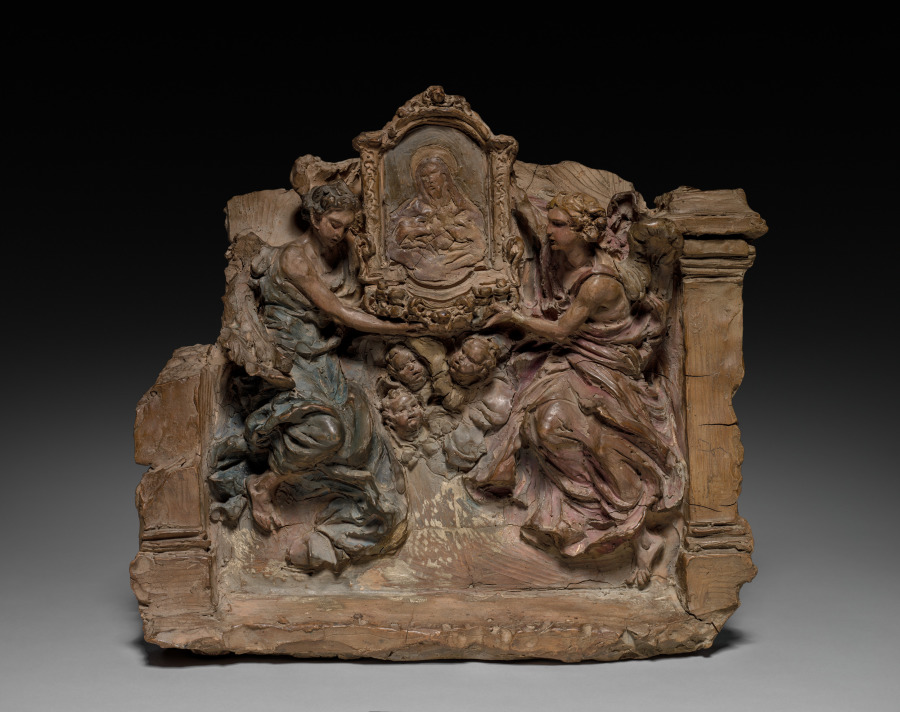
Urban Silhouette Research: Two Angels and Cherubs Bearing an Icon of Christ
Preliminary Structural Reading
The composition under examination—a devotional panel depicting two angels and cherubs bearing an icon of Christ—operates less as narrative illustration than as an exercise in load-bearing geometry. The Addison eye does not read wings, drapery, or halos as ornament; it reads them as vectors of force. The central icon functions as the gravitational core of the frame, a rectangular mass suspended within an otherwise fluid field of ascending and descending bodies. This is the first principle of the 2026 executive silhouette: a single, immovable axis of authority, surrounded by subordinate forms that articulate motion without disturbing equilibrium. The angels are not decoration; they are structural brackets. The cherubs are not sentiment; they are counterweights.
Geometric Integrity: The Icon as Keystone
The icon of Christ is presented frontally, its edges parallel to the picture plane, establishing a rigid orthogonal grid against which every other form is measured. This is the architectural discipline Addison requires of the coming season. The executive silhouette of 2026 will not be defined by volume for its own sake, but by the presence of a central, unbroken vertical—a spine of intention. In the panel, the icon’s frame is the only true rectangle; all else curves, tapers, and folds. The lesson is precise: minimalism is not the absence of structure, but the concentration of it into a single, legible plane. The wearer becomes the icon—frontal, composed, irreducible—while the surrounding garment performs the work of the angels: lifting, bearing, and stabilizing without visible strain.
The Angelic Diagonal and the Poetics of Ascent
The two angels are arranged on opposing diagonals, their bodies angled inward toward the icon yet oriented upward, as if the composition itself were being hoisted. This diagonal tension is the structural signature of the Addison 2026 tailored line. Shoulders are set on a subtle incline; lapels and seams follow the same upward thrust. The result is a silhouette that appears to rise from the floor rather than rest upon it—an urban poetics of verticality. The angels’ drapery, rendered in long, unbroken folds, anticipates the fluid tailoring that will define the season’s outerwear: fabric that falls in continuous planes, interrupted only where the body demands articulation. The cherubs, clustered at the lower register, provide the compressed mass that anchors the ascent—a reminder that elevation without ballast is merely instability.
Materiality: The Weight of Light
The panel’s surface is aged, its pigments muted into a register of slate, ivory, and tarnished silver. This is the palette of urban materiality—concrete, brushed metal, winter wool. The Addison interpretation is not decorative but tactile: fabrics that hold a matte finish, that absorb rather than reflect, that register the hand of the wearer as a patina rather than a shine. The icon’s gold ground, now dimmed, suggests that luxury in 2026 will be legible through density, not brilliance. A coat must feel like it has been carried, not purchased. The angels’ wings, feathered in close, repetitive strokes, propose a textural language for the season: surfaces that reward proximity, that reveal their construction only at close range. This is minimalism as material honesty, not as erasure.
The Executive Silhouette: A Final Specification
From this panel, Addison derives a definitive silhouette for the 2026 executive: a narrow, vertical core—the icon—framed by two opposing arcs of movement—the angels—and grounded by a compressed lower mass—the cherubs. Translated to the body, this yields a tailored column of slate wool or ivory cashmere, cut close through the torso, with sleeves and hem that curve outward in controlled, deliberate arcs. The shoulder is inclined, not squared. The closure is frontal and unbroken. The proportion is elongated, but the weight is distributed low, ensuring that authority is carried rather than displayed. The cherubs become the pockets, the belt, the hidden structure that keeps the ascent credible. The icon becomes the wearer: still, frontal, and entirely sufficient.
This is the Addison position. The artwork is not a source of motifs; it is a diagram of composure. The 2026 silhouette will be built on the same principle—a single, unwavering axis, surrounded by forms that lift without clamor. In the urban field, where noise is constant, the executive figure must be the quietest and most structurally resolved element in the frame. The angels bear the icon. The garment bears the wearer. The geometry holds.