Urban Form: Eighteen Views of Rome: The Piazza Farnese (recto)
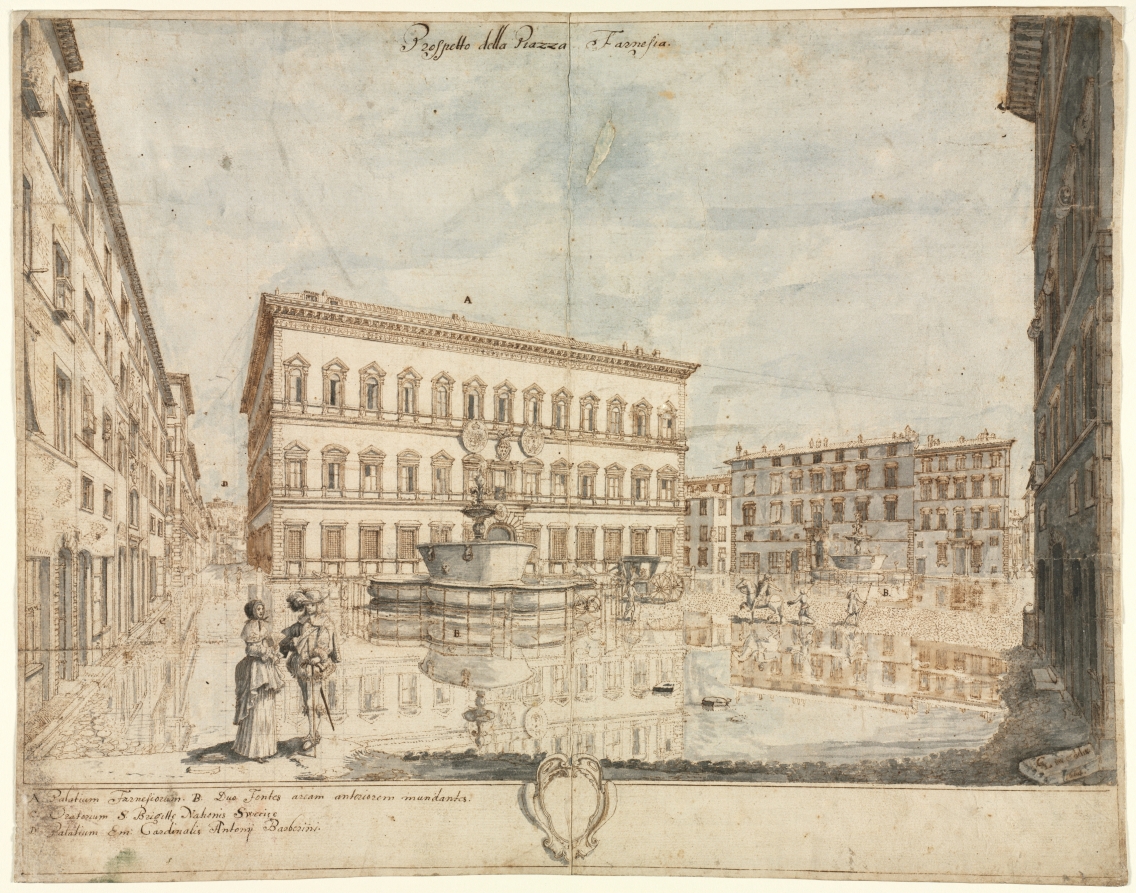
Urban Silhouette Research: Eighteen Views of Rome — The Piazza Farnese (recto)
I. Geometric Integrity: The Container as Architecture
The Piazza Farnese drawing presents a compositional logic that is fundamentally container-based. The piazza is not depicted as open ground but as a vessel — bounded by the vertical discipline of the Palazzo Farnese façade, the lateral compression of flanking structures, and the recessive depth of the central axis. This is the same geometric grammar as the Jar (Hu): a swelling body, a constricted aperture, a stable base. The drawing's perspective lines converge with the cold precision of a structural section, and the void at the center of the piazza — the empty space that defines the composition — operates precisely as the interior of the Hu operates: emptiness as function, not absence. For the 2026 executive silhouette, this is the governing principle. The garment must be read as a container: a defined interior volume that holds the body without narrating it. The shoulder line is the palazzo cornice — horizontal, uninflected, absolute. The waist is the piazza's central void — present only as the negative space between two architectural masses. The hem is the drawing's foreground plane — grounded, weighted, refusing flight.
II. The Farnese Loggia and the Problem of the Aperture
Examine the loggia of the Palazzo Farnese as rendered in the recto: a rhythmic sequence of arched openings, each one a controlled perforation in an otherwise monolithic wall. This is the aperture as discipline — not decoration, not transparency for its own sake, but a measured interruption that allows the interior to breathe without surrendering its opacity. The 2026 executive silhouette adopts this logic at the seam and the closure. A single, precisely placed opening — a vent at the shoulder blade, a slit at the cuff, a released seam at the side body — functions as the loggia functions: it admits air and light while preserving the integrity of the whole. The error of contemporary tailoring is the multiplication of apertures: the unnecessary dart, the decorative zip, the visible topstitch. The Piazza Farnese teaches restraint. One opening, correctly placed, is architecture. Three are noise.
III. Materiality: Travertine, Shadow, and the Weight of Slate
The drawing's tonal range is narrow and deliberate: the pale travertine of the palazzo, the deeper grey of shadowed recesses, the near-black of the drawn line itself. This is a materiality of compressed value — no color, no ornament, only the registration of light against mass. Translated to cloth, this demands a fabric that holds a crease like stone holds a shadow: a dense wool crepe, a bonded cotton with a dry hand, a double-faced cashmere whose two surfaces are indistinguishable in weight. The color directive is Slate — the precise mid-grey of the drawing's shadowed wall, neither warm nor cool, a color that absorbs light rather than reflecting it. Slate is the color of institutional permanence. It does not flatter. It does not date. It is the chromatic equivalent of the palazzo's ashlar: a surface that records time without displaying it.
IV. Structural Poetics: The Piazza as Garment, the Garment as Piazza
The deepest lesson of the Piazza Farnese recto is its hierarchy of enclosure. The piazza encloses the citizen; the palazzo encloses the piazza; the loggia encloses the threshold; the drawing encloses the whole in a frame of paper. Each level is complete, each level is necessary, and no level attempts to explain the one above it. The 2026 executive silhouette must operate identically. The inner layer — a fine-gauge knit or a silk shell — is the citizen: private, unobserved, functional. The middle layer — the tailored jacket — is the palazzo: public, structural, declarative. The outer layer — the coat — is the drawing's frame: the final enclosure that presents the whole as a single, resolved object. The error is to collapse these levels into one garment that tries to be all three. The Piazza Farnese does not collapse. It layers, and each layer holds its own edge.
V. Urban Materiality: The Drawing as Wearable Contract
Finally, consider the recto's status as a record of a specific place at a specific moment — an eighteenth-century view of a Roman piazza, drawn with the cold exactitude of an architectural survey. This is the contract the 2026 executive garment must honor: it is not a fantasy, not a costume, not a narrative. It is a survey of the body in space, executed with sufficient precision that the wearer disappears into the structure. The Piazza Farnese does not tell us who walks across it. It tells us only that the ground is level, the walls are true, and the void at the center is sufficient. The Addison executive silhouette of 2026 asks for nothing more: a level shoulder, a true seam, and an interior volume sufficient to hold a life without comment.
The piazza is empty. The garment is complete. The structure holds.