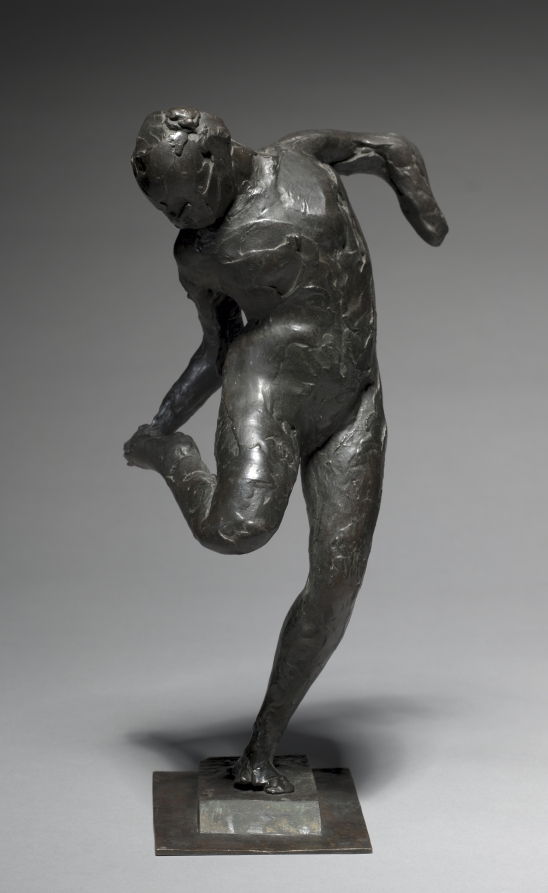
Urban Form: Dancer Looking at the Sole of her Right Foot
Urban Silhouette Research: Form and Color in the Dancer's Asymmetry
I. Chromatic Foundation: The Dialectic of Warmth and Cold
The subject—a dancer arrested in the act of inspecting the sole of her right foot—presents a chromatic problem of considerable sophistication. The DNA source establishes a fundamental tension between the warm, amber-toned gold of the Pilgrim Sudhana and the cold, patinated bronze of the Ceremonial Blade. This is not merely a palette; it is a philosophical opposition rendered visible. For the 2026 executive wardrobe, we translate this dialectic into a controlled material narrative: the body's warm interiority (skin, breath, the pulse beneath fabric) set against the cold exteriority of structured tailoring.
The dancer's form, bent inward, creates a self-referential color field. The sole of the foot—pale, vulnerable, the least "designed" surface of the body—becomes the visual anchor. In textile terms, this suggests a Slate-dominant palette interrupted by strategic zones of warmth: an ivory underlayer at the cuff, a sand-toned lining that flashes only in motion. The oxidation green of the Sudhana, that "mottled verdigris of accumulated time," finds its urban equivalent in the desaturated teal-grey of weathered concrete—a color we deploy as a secondary accent in knitwear, never as a primary.
II. Structural Analysis: The Spiral and the Axis
The dancer's posture is a study in controlled asymmetry. The standing leg—vertical, load-bearing, rational—corresponds to the geometric precision of the Ceremonial Blade: a central axis, bilateral symmetry, the "golden-section placement of the three perforations" translated into the strategic placement of seams and darts. The raised leg, bent at the knee, the foot rotated inward for inspection, introduces a spiral dynamic—the "three-curve" (三曲式) of the Sudhana, the "spiral ascent" of drapery that "flows like water."
For the executive silhouette, this demands a garment that is structurally bifurcated: a tailored shoulder and lapel (the blade's geometry) married to a fluid, spiraling drape at the waist and hem (the Sudhana's curve). The result is a Minimalist column that is not rigid but torsionally responsive—a coat that holds its line when still, but reveals a helical seam when the wearer turns. The dancer's inspection of her sole—a gesture of introspective attention—informs the interior construction: bound seams, a clean finish, a garment that rewards the wearer who looks inside.
III. The Sole as Signifier: Grounding the Abstract
The sole of the foot is the point of contact with the earth—the "three holes" of the blade as "heaven, earth, and humanity" find their corporeal analogue in the tripod of the standing foot, the inspecting hand, and the lifted knee. In the 2026 wardrobe, this translates to a deliberate weighting of the hem: a Slate wool crepe with sufficient density to "ground" the silhouette, preventing the Minimalist column from floating into abstraction. The dancer's foot, pale and unadorned, suggests a raw-edge finish at the cuff—a controlled imperfection that signals material honesty over ornament.
The color logic follows: the sole is Ivory, the standing leg Slate, the lifted knee Onyx (the shadow of the bent form). This triadic distribution—light at the point of vulnerability, mid-tone at the point of support, dark at the point of tension—is the chromatic grammar of the collection. It is a Minimalist system, but one that derives its restraint from anatomical observation, not from abstraction.
IV. The 2026 Executive Wardrobe: A Technical Translation
The dancer's form yields three actionable specifications for the Addison Fashion NYC atelier:
1. The Torsional Coat: A Slate double-faced wool, cut on a spiral bias at the back panel, with a geometric shoulder and a three-hole button stance (the blade's perforations as functional closure). The coat holds a vertical axis when stationary; in motion, the bias panel releases a controlled flare—the Sudhana's "spiral ascent" rendered in cloth.
2. The Introspective Trouser: A high-twist wool in Onyx, with a clean, flat front and a tapered ankle that exposes the Ivory of a silk-cotton sock—the "sole" of the outfit, the point of ground contact. The waistband is bound, not fused, a reference to the "inner contemplation" of the Sudhana: the garment's interior is as considered as its exterior.
3. The Ceremonial Blouse: A Sand-toned silk crepe de chine, with a mandarin collar (the blade's "ritual order") and a single asymmetric seam that spirals from the left shoulder to the right hip—the dancer's rotated foot as a seam-line. The blouse is unlined, the seams French-finished, the hem weighted with a narrow tape to maintain the "grounded" silhouette.
V. Conclusion: The Executive as Dancer
The dancer looking at the sole of her right foot is not a figure of vulnerability but of technical self-awareness. She inspects the point of contact—the interface between body and world—with the same rigor that the executive inspects a balance sheet or a contract. The 2026 Addison wardrobe, derived from this posture, is a Minimalist system of grounded asymmetry: Slate as the dominant field, Onyx as the structural shadow, Ivory as the point of honest exposure. The forms are torsional, not static; the colors are dialectical, not decorative. The executive who wears this collection does not merely dress—she inspects, adjusts, and grounds herself in a garment that understands the spiral and the axis as the twin poles of urban movement.