Urban Form: Composition with Red, Yellow, and Blue
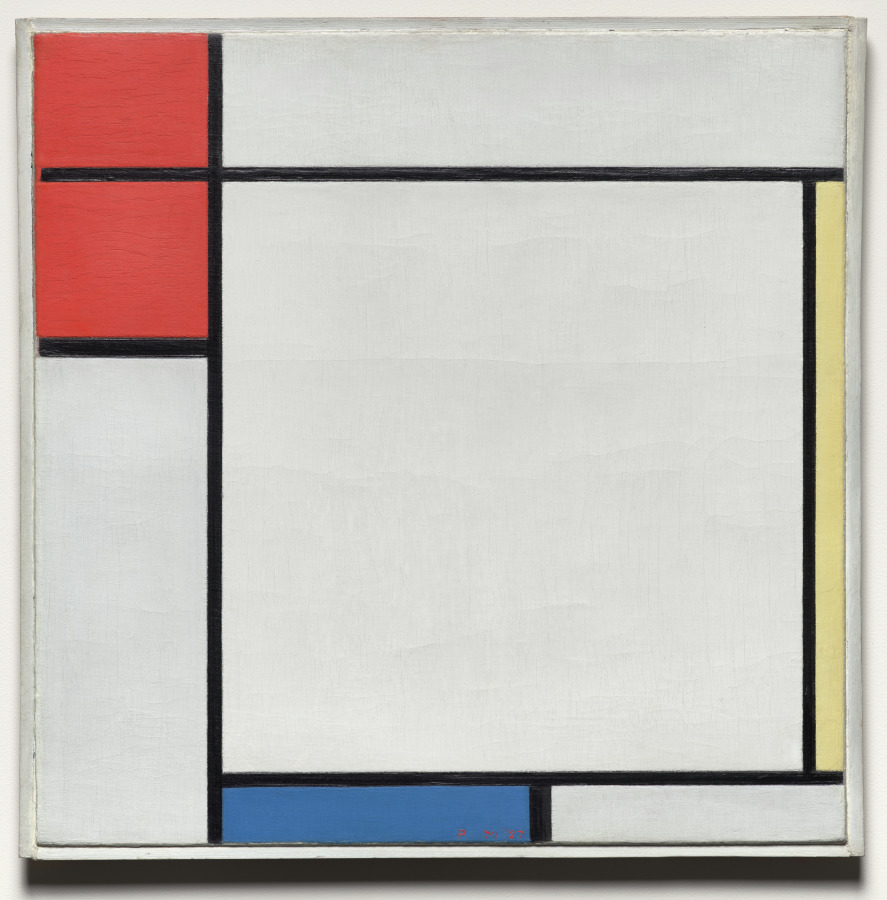
Urban Silhouette Research: Composition with Red, Yellow, and Blue
I. Geometric Integrity as Structural Doctrine
The composition under examination operates through a rigorous economy of means: orthogonal fields, primary chromatic weights, and a black grid that functions less as border than as load-bearing architecture. For Addison Fashion, the analytical value lies not in the painting's historical position but in its structural poetics—the manner in which flat planes are made to carry gravitational tension. The black lines are not decorative; they are seams. They articulate where mass meets void, where weight is transferred, where the garment—or the canvas—must hold its shape without collapse.
This is the grammar of the 2026 executive silhouette. The grid establishes a proportional system in which each chromatic block occupies a precise ratio of the whole. Translated to tailoring, this becomes a discipline of panel division: a shoulder seam that reads as a horizontal rule, a lapel that functions as a vertical axis, a hem that closes the composition with the finality of a baseline. The integrity is geometric, not organic. Nothing drapes without first being measured.
II. Chromatic Weight and the Discipline of Restraint
The red, yellow, and blue are deployed as mass, not ornament. Each field is saturated to the point of opacity, refusing transparency and refusing blend. In material terms, this corresponds to the Addison approach to surface: wool crepe that absorbs light rather than reflecting it, bonded jersey with a matte hand, leather finished to a chalky density. The palette is resolved against an onyx ground—the black grid functioning as the structural constant against which chromatic incident is permitted.
For the executive wardrobe, this yields a principle of controlled chromatic punctuation: a single field of color isolated within a black architectural frame. A vermilion underlayer visible only at the cuff. A cadmium yellow lining that flashes at the vent. The color is never ambient; it is quarantined, deliberate, and structurally contained. This is minimalism as discipline rather than absence—the refusal of excess in order to amplify the precision of what remains.
III. Urban Materiality and the Tactile Grid
The painting's surface—its slight weave, its refusal of gloss—insists on the physicality of the plane. This is urban materiality in its most exacting form: surfaces that register the city's abrasion without surrendering their structure. Addison's 2026 fabrication research proceeds from this premise. Double-faced cashmere bonded to a technical membrane. Compact cotton with a resin finish that holds a crease like a scored line. The grid becomes literal in the garment's internal construction: taped seams, bonded edges, interfacings that behave as structural ribs rather than hidden scaffolding.
The silhouette that emerges is columnar and self-supporting. Shoulders are squared but not padded into caricature; the line descends without interruption to a hem that sits precisely at the knee or the ankle, never between. There is no waist suppression for its own sake—the body is acknowledged as volume, not as curve. The garment stands away from the figure by a calculated margin, creating the negative space that the painting achieves between its chromatic fields. This is the architecture of the modern executive: present, legible, and resistant to the softness of mere fashion.
IV. The Binary Structure: Motion and Stasis
The internal DNA of this research—the dialectic between the musician fragment and the Taurus mortuary figure—resolves within the composition as a tension between rhythm and stillness. The vertical and horizontal lines establish stasis; the chromatic fields introduce pulse. In the 2026 silhouette, this duality manifests as garments that are static in their architecture yet alive in their articulation: a coat whose back panel is cut on a single unbroken line, but whose sleeve is engineered with a two-piece rotation that permits the arm its full range. The body moves; the structure does not yield.
This is the final proposition of the research. The executive silhouette of 2026 is not softened, not relaxed, not dissolved into comfort. It is constructed as a container for presence—a grid of seams and planes within which the wearer operates with the authority of a figure who has been measured, and found exact. The composition does not decorate the wall. It holds it. The garment does not decorate the body. It holds the room.