Urban Form: Memorial head (nsodie)
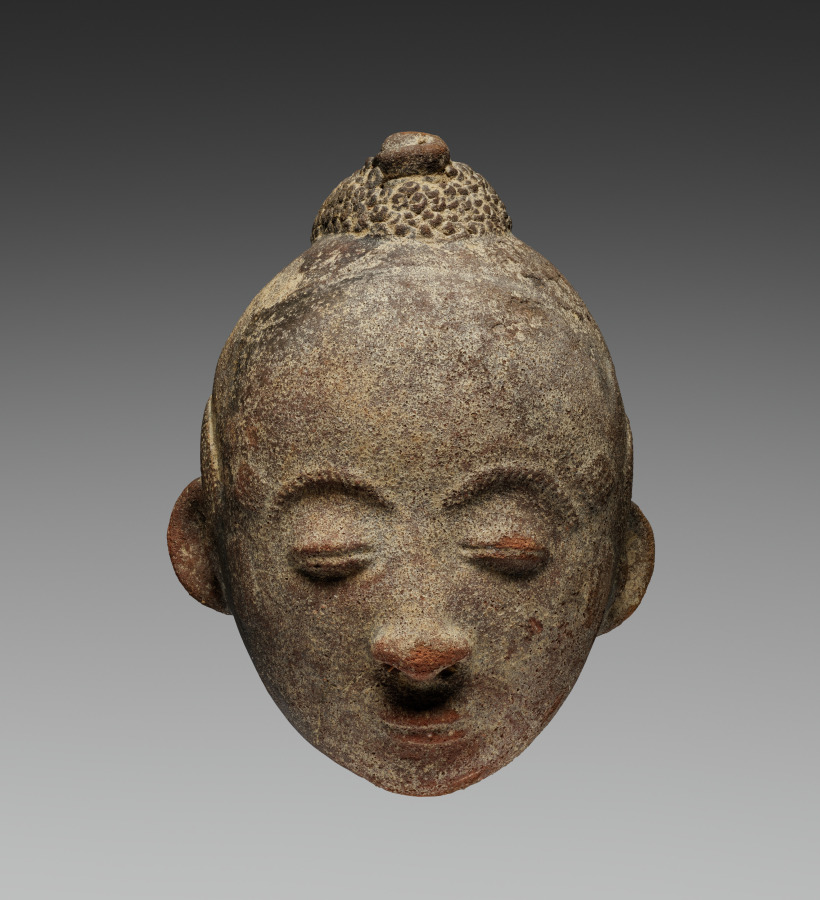
Urban Silhouette Research: Memorial Head (Nsodie) — Geometric Integrity and the 2026 Executive Silhouette
I. The Object as Structural Premise
The memorial head, or nsodie, presents a closed geometric system. Its mass is concentrated in a columnar neck and a flattened, planar face whose features are reduced to shallow relief. The silhouette is not descriptive but architectural: a vertical axis, a compressed horizontal crown, and a frontal plane that refuses depth. This is the first principle of the 2026 executive silhouette — the body as a load-bearing structure, not an expressive surface. The nsodie does not gesture. It stands. It holds. It occupies space with the authority of a monolith, and in that refusal of movement it achieves a stillness that reads as power.
II. Geometric Integrity: The Frontal Plane and the Closed Volume
Analyze the head's geometry and three operations emerge. First, frontal compression: the face is a shallow plane, its features incised rather than modeled. There is no chiaroscuro, no recession into shadow. The plane is flat, and that flatness is deliberate — it converts the head into a facade. Second, axial symmetry: the vertical centerline governs every element, from the brow to the chin. Symmetry here is not decorative but structural; it distributes weight evenly and produces a silhouette that reads identically from either side. Third, closed volume: the head is a sealed mass, without apertures or interruptions. The neck is a column, the crown a cap, the face a panel. Nothing leaks. Nothing escapes.
Translated into tailoring, these operations define the 2026 executive silhouette as a closed, frontal, axially governed volume. The shoulder line is horizontal and unbroken. The torso is a plane, not a curve. The garment does not follow the body; it replaces it with a geometry of its own. This is the nsodie principle: the wearer disappears into the structure, and the structure becomes the statement.
III. Structural Poetics: The Tension Between Mass and Void
The nsodie is heavy — stone, wood, or terracotta — yet its poetics lie in what it withholds. The face is a void of expression, a surface without psychology. This is the central tension of the 2026 silhouette: mass without weight, presence without personality. The executive garment must carry the authority of the monolith while remaining fluid enough to move through the urban field. The solution is a layered architecture: an outer shell of rigid geometry — the coat, the structured shoulder, the planar lapel — over an inner layer of fluid minimalism. The shell provides the frontal plane; the inner layer provides the void. The wearer moves, and the geometry holds.
This is the poetics of the nsodie translated into cloth: the silhouette is a monument that walks. It does not cling. It does not drape. It stands, and in standing it commands the urban corridor as the memorial head commands the ancestral space — through silence, symmetry, and the refusal to explain itself.
IV. Urban Materiality: Onyx, Slate, and the Surface of Authority
The nsodie's surface is its argument. Whether weathered wood or polished stone, the material is matte, dense, and non-reflective. It absorbs light rather than throwing it back. This is the material logic of the 2026 executive wardrobe: Onyx as the governing color — a black that is not flat but deep, a black that holds shadow within itself. Paired with Slate for secondary planes and Ivory for the occasional interruption, the palette is a study in tonal compression: no contrast, no ornament, only the slow gradient of dark to darker.
The fabrics must follow. Dense wool crepe for the frontal plane, bonded cotton for the structural shoulder, matte silk for the inner void. No sheen. No texture that calls attention to itself. The surface must read as carved, not woven — the garment as a single block of material, shaped by subtraction rather than addition. This is the urban materiality of the nsodie: the city is a quarry, and the executive silhouette is cut from it.
V. The 2026 Executive Silhouette: A Definitive Statement
The nsodie resolves the central problem of the executive wardrobe: how to project authority without ornament, presence without performance. Its geometry — frontal, symmetrical, closed — defines a silhouette that is architectural in its integrity and poetic in its restraint. The 2026 executive does not dress to be seen. The executive dresses to occupy — to stand in the urban field as the memorial head stands in the ancestral grove: a closed volume, a frontal plane, a silent mass. The geometry holds. The city passes. The silhouette remains.