Urban Form: Saint George and the Dragon
Urban Silhouette Research: The Saint George Paradigm — Structural Poetics of the Liminal Moment
I. Geometric Integrity: The Armature of Heroic Form
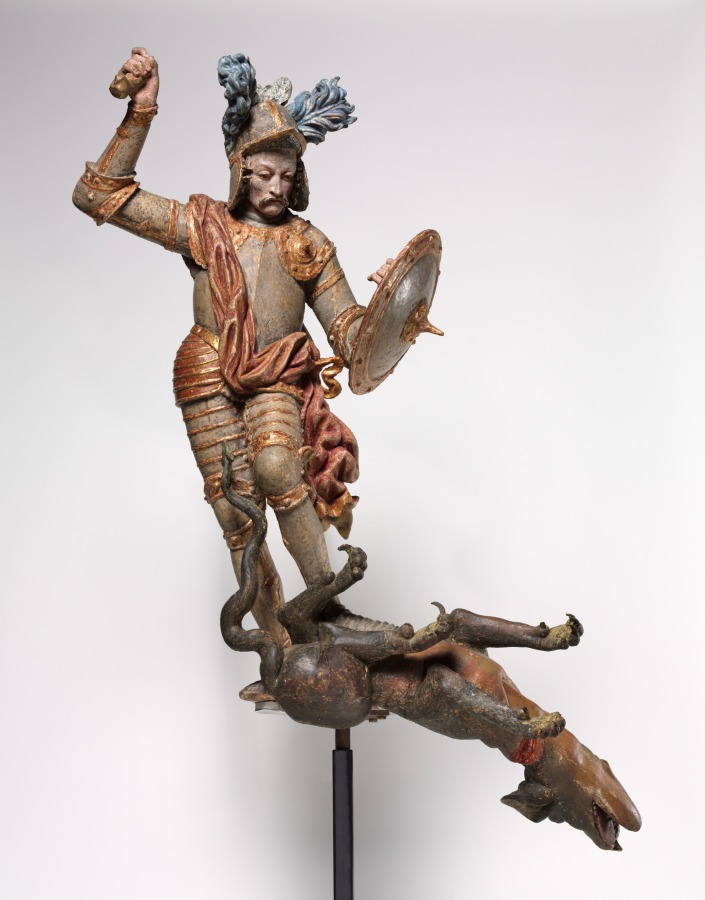
The Saint George and the Dragon composition presents a masterclass in compressed architectural tension. The mounted saint and the prone dragon form a closed circuit of opposing vectors — the vertical ascension of the rider's torso against the horizontal sprawl of the beast. This is not merely narrative; it is structural syntax. The lance, held at a precise diagonal, functions as the compositional spine, bisecting the frame into zones of dominance and submission. For Addison Fashion's 2026 executive silhouette, this geometry translates into a tailored shoulder line that rises with deliberate authority, paired with a lower body that anchors rather than follows. The garment must embody the lance: a single, unbroken line of intentionality from collar to hem.
The horse's arched neck and the saint's forward lean create a cantilevered posture — weight distributed forward, yet held in suspension. This is the essence of urban poetics: motion arrested at the apex of decision. The 2026 silhouette will reject the passive drape in favor of engineered tension, where fabric behaves as structural membrane rather than decorative sheath.
II. Materiality: Stone, Mineral, and the Urban Surface
The artwork's surface — whether read as carved stone or mineral-pigmented panel — speaks to a materiality of permanence. The dragon's scales are rendered as tessellated planes, each a discrete unit of armor. The saint's mail is a grid of interlocking cells. This is urban materiality at its most literal: the city as a lattice of repeated modules, each joint a point of load transfer. For 2026, Addison Fashion will employ bonded technical wools and matte-finish cupro that mimic the mineral flatness of the source — surfaces that absorb light rather than reflect it, achieving the slate-toned gravitas of weathered basalt.
The absence of ornamental flourish in the dragon's wing — reduced to a single, ribbed membrane — signals the minimalist imperative: every element must justify its structural role. The 2026 executive wardrobe will follow this logic. No seam without purpose. No closure without function. The garment becomes a load-bearing system, not a surface decoration.
III. The Liminal Moment: Death, Transfiguration, and the Executive Uniform
The subject matter — the instant before the dragon's death — is a liminal threshold, the precise point where one state collapses into another. This is the philosophical core of the 2026 silhouette: the executive as a figure who operates at the threshold of decision, where action and consequence converge. The saint's raised arm is not a gesture of triumph but of calibrated release — the lance has already found its mark; the body merely follows through. In tailoring terms, this translates to a shoulder that is set, not padded; a sleeve that follows the arm's trajectory without excess volume; a hem that terminates with the finality of a struck blow.
The dragon's prone form — a low, horizontal counterweight — provides the necessary ballast. In the 2026 silhouette, this manifests as a deliberately weighted hemline, achieved through internal facing and dense weave, ensuring that the garment's verticality is earned rather than assumed. The executive does not float; they stand with geological certainty.
IV. Color and Tonality: The Slate Register
The artwork's palette is restrained to a narrow band of mineral neutrals — the grey-green of oxidized bronze, the bone-white of exposed stone, the deep umber of shadow. Slate emerges as the dominant register: a color that is neither warm nor cool, but resolutely architectural. It is the color of the city's infrastructure — pavement, façade, sky at dusk. For 2026, Addison Fashion will deploy slate as a monolithic base, interrupted only by the ivory of a shirt collar or the silver of a hardware element. The effect is one of controlled austerity: the wearer is legible at a distance, yet impenetrable at close range.
V. Conclusion: The Silhouette as Ethical Statement
Saint George and the Dragon is not a narrative of violence but a diagram of resolve. The 2026 executive silhouette, derived from this source, must embody the same cold clarity: a garment that does not decorate the body but articulates its intention. The geometric integrity of the artwork — its closed vectors, its mineral surfaces, its liminal tension — provides the blueprint. Addison Fashion's task is to translate stone into cloth, and cloth into a wearable argument for precision. The dragon is not slain by force; it is resolved by geometry. The silhouette, likewise, is not worn; it is enacted.