Urban Form: Seated Male Figure
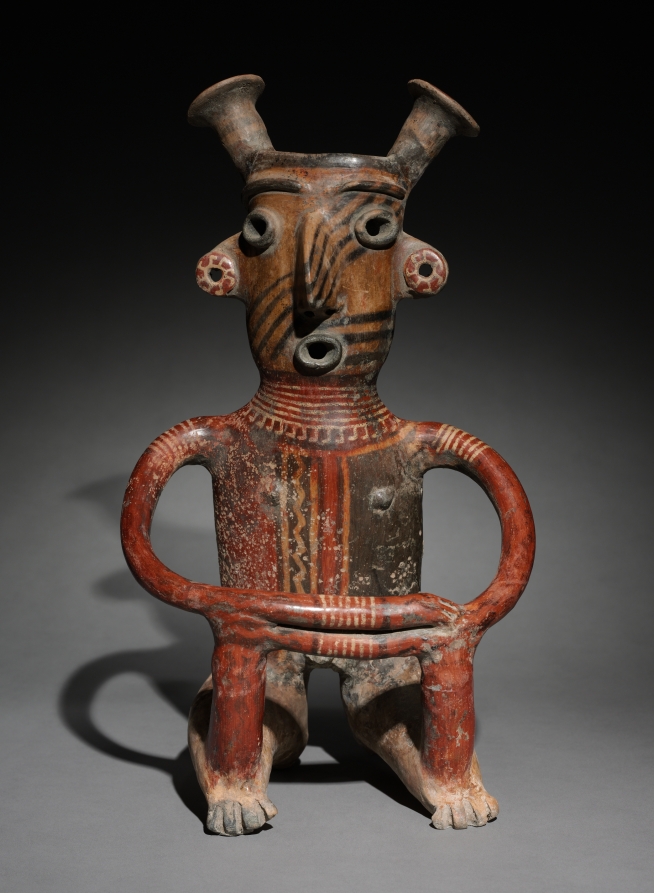
Urban Silhouette Research: Linear Economy and the Seated Male Form
I. Thesis: The Aesthetic of the Continuous Line
The seated male figure, as a problem in tailoring, is fundamentally a problem of line management under compression. When the body folds at the hip, the vertical authority of the standing silhouette collapses into a series of horizontal and diagonal vectors—thigh, torso, forearm—that must be reconciled without loss of structural intent. Our research draws its DNA from two artifacts that share a single aesthetic principle: the yousi, or "swimming thread," a line that does not describe volume but instead captures the rhythm of a gesture at the instant of its occurrence. The Mold Fragment with Musicians and the Square Mirror with Two Phoenixes and Floral Sprays—one broken, one whole—together articulate a theory of line as the direct externalization of vital breath rather than the tracing of contour. For the 2026 executive wardrobe, this translates into a seated silhouette governed not by padding or drape, but by the disciplined continuity of a single seam.
II. The Fragment as Method: Asymmetry and Productive Absence
The Mold Fragment is instructive precisely because it is incomplete. Its musicians are rendered in hair-fine lines that do not model mass; they record a tilt of the torso, a suggestion of fingering, a posture caught mid-phrase. The missing portion of the vessel is not a defect but the site of maximum aesthetic tension—the viewer completes the melody through imagination. Translated to tailoring, this principle argues against the closed, fully resolved garment. The seated executive jacket should incorporate a deliberate zone of absence: a suppressed back panel, an unlined vent, a shoulder seam that terminates before the armhole and resumes beyond it. These interruptions function as structural "rests"—they allow the eye to complete the form, and they permit the fabric to move with the seated body rather than resisting it. In slate wool with a matte finish, such absences read as intentional negative space rather than construction failure.
III. The Mirror as Discipline: Closed Systems and Eternal Order
Where the fragment opens, the mirror closes. The Square Mirror presents a complete cosmology: phoenix and floral spray interlocked in a self-referential loop of line, each curve answering another, the whole governed by an internal logic of return. This is the counterweight to the fragment's openness—a reminder that absence is only legible against a ground of order. For the seated figure, the mirror principle manifests in the closed system of the lap: the line of the thigh, the break at the knee, the fall to the hem must form a continuous circuit, each transition resolved. The jacket's front edge, when seated, should describe a single unbroken arc from collar to hem—no puckering, no gape. This demands a reduced armhole and a forward-rotated sleeve, cut so that the seated arm hangs in a plumb line rather than pulling the chest panel into distortion.
IV. Color as Ground: Slate and the Suppression of Volume
Color in this system is not decorative but structural. Slate—a desaturated blue-grey of low chroma and medium value—performs the specific function of flattening perceived volume while retaining enough depth to register the play of line. In the fragment, the clay ground is neutral; the line carries all information. Similarly, slate wool allows seam architecture to read without the distraction of tonal contrast. We specify a monochrome slate ensemble—jacket, trouser, and knit—so that the only visual events are linear: the shoulder line, the lapel roll, the break at the wrist. Where differentiation is required, it is achieved through texture rather than hue: a dry-finished wool against a fluid viscose knit, both within the same slate register.
V. Application: The 2026 Seated Executive Silhouette
The resulting garment is a minimalist construction with maximal linear discipline. Key specifications: a soft-shouldered jacket with a continuous front edge and no darts below the waist; a two-piece sleeve rotated forward fifteen degrees to accommodate the seated forearm; a ventless back with a suppressed waist seam that releases at the hip; and a trouser with a clean, unbroken crease that survives the seated posture through a high-twist wool. The silhouette is narrow but not close—a line held at a measured distance from the body, like the swimming thread held above the clay. The wearer, seated in a boardroom or a car, presents not mass but a continuous, breathing contour: authority expressed as restraint, presence as the disciplined absence of noise.
VI. Conclusion: Line as Executive Capital
The lesson of the two artifacts is that completeness and fracture are not opposites but phases of the same line. The 2026 executive wardrobe, built on this principle, abandons the rhetoric of power dressing—shoulder pads, contrast, volume—in favor of a quieter proposition: that a man's authority is legible in the continuity of his seams and the composure of his seated line. Slate, minimalist, and linear, the collection asks the wearer to trust the thread. In the fragment, the music survives the vessel. In the mirror, the phoenix never lands. In the suit, the line holds.