Urban Form: Silver Wine Jug, Ham, and Fruit
Urban Silhouette Research: The Dialectics of Concealment and Saturation in Form and Chromatic Field
I. Preliminary Thesis: The Object as Structured Absence
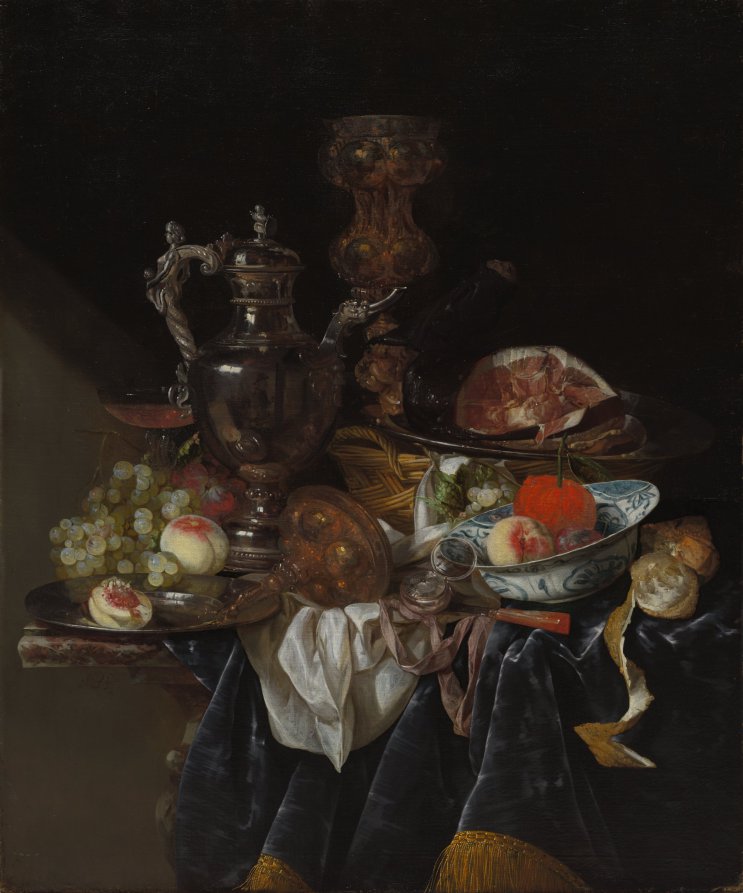
The subject under examination—a silver wine jug, ham, and fruit—presents a compositional problem of considerable theoretical interest for the Addison Fashion atelier. At first glance, the arrangement belongs to the genre of still life, a category historically consigned to the decorative periphery of art-historical discourse. Yet a rigorous formal reading reveals a more consequential proposition: the still life is not a record of objects but a negotiation between volumetric presence and chromatic reticence. It is, in the precise sense, a study in the economics of visual information. The silver jug functions as the compositional anchor, its reflective surface operating less as a color than as a chromatic void—a mirror that absorbs and redistributes ambient light rather than asserting a hue of its own. The ham and fruit, by contrast, supply organic mass and saturated warmth, establishing a dialectic between the inorganic and the perishable, the permanent and the transient.
This dialectic maps directly onto the central problem of the 2026 executive wardrobe: how to construct authority through restraint, and how to permit warmth without surrendering severity. The Addison position is unambiguous. Form must precede ornament; chromatic discipline must govern material exuberance. The silver jug is our governing metaphor.
II. Formal Deconstruction: Volume, Silhouette, and the Discipline of the Curve
The jug's silhouette is defined by a controlled convexity—a swelling body that tapers into a narrow neck before resolving into the handle's disciplined arc. This is a study in tapered volume: mass concentrated at the base, attenuated at the apex, producing a silhouette that reads as stable without appearing inert. For tailoring, the implication is structural. The 2026 Addison executive blazer will adopt a comparable logic—shoulder line precise and unexaggerated, waist suppressed by a mere two to three centimeters, hem falling with architectural cleanness. The objective is not the hourglass, which is a historical affectation, but the calibrated column: a form that acknowledges the body's volume while refusing to dramatize it.
The ham introduces a countervailing formal principle. Its mass is irregular, its surface matte, its contour resistant to idealization. In compositional terms, it performs the function of the ground against which the jug's figure is read. This figure-ground relationship is instructive for fabric selection. A wardrobe composed exclusively of reflective, high-finish surfaces—silk, polished wool, metallic hardware—produces visual fatigue and, more damagingly, a loss of hierarchy. The Addison solution is the deliberate introduction of matte textures: heavy cotton twill, brushed flannel, unpolished leather. These materials function as the ham functions—they absorb light, stabilize the composition, and permit the silver accents to register as intentional rather than indiscriminate.
The fruit, finally, supplies chromatic punctuation. Its role is not structural but rhetorical: a controlled deviation from the dominant tonal field. In wardrobe terms, this corresponds to the single-point accent—a burgundy glove, a bronze clasp, a deep oxblood belt. The rule is arithmetic: no more than one accent per ensemble, and the accent must occupy less than five percent of the visible surface area. Excess in this register converts authority into affectation.
III. Chromatic Analysis: Silver as Strategic Neutrality
The dominant chromatic field is silver—but silver of a specific character. It is not the cool, blue-shifted silver of industrial chrome but a warmer, slightly oxidized silver that registers as grey with a latent luminosity. This distinction is critical. Pure metallic silver reads as futuristic and, in the executive context, slightly adversarial. Oxidized silver reads as inherited authority: patrician, understated, and temporally grounded.
The Addison 2026 palette will therefore treat silver as a foundational neutral rather than an accent. The proposed chromatic architecture is tripartite. First, a base field of silver-grey and slate—these constitute approximately seventy percent of the wardrobe and establish the tonal ground. Second, a mid-field of ivory and bone—these supply contrast without rupture and occupy twenty percent. Third, the accent field of bronze, oxblood, and deep olive—confined to ten percent and deployed with the discipline of the fruit in the composition: present, deliberate, and strictly bounded.
The ham's warm umber and the fruit's russet operate in the source image as chromatic counterweights to the jug's cool neutrality. Without them, the composition would read as sterile; with them in excess, it would collapse into sentimentality. The executive wardrobe confronts an identical risk. A wardrobe of unrelieved grey and silver communicates competence but not judgment; judgment requires the visible exercise of discrimination, which is to say, the controlled admission of warmth. The Addison position is that warmth must be earned through proportion, not asserted through saturation.
IV. Material Logic and the Question of Surface
The jug's surface is the composition's most sophisticated element. It is reflective but not transparent; it receives light and returns it in modified form. This is the material analogue of the executive's public persona—responsive to context, never merely transparent. The 2026 Addison fabric program will privilege semi-lustrous finishes: wool-silk blends, cashmere with a low-twist finish, leather with a hand-burnished patina. These surfaces register light without glare, communicate quality without ostentation, and age with dignity rather than deterioration.
The ham's matte surface and the fruit's slight bloom provide the necessary textural counterpoint. The principle is textural stratification: no ensemble should present a single surface quality. The executive who appears entirely in high-sheen fabrics reads as theatrical; the executive who appears entirely in matte fabrics reads as inert. The Addison standard is a minimum of two surface qualities per ensemble, with the lustrous element subordinate to the matte.
V. Conclusion: The Wardrobe as Resolved Composition
The silver wine jug, ham, and fruit constitute a compositional argument that the Addison atelier takes as directive rather than decorative. The argument is this: authority is produced not by the accumulation of signifiers but by their disciplined arrangement. The jug's silver is meaningful precisely because the ham's umber and the fruit's russet are present to define it. Form achieves eloquence only when it is bounded by restraint. The 2026 NYC executive wardrobe, as conceived by Addison Fashion, will operationalize this principle across silhouette, palette, and surface—delivering garments that are structurally precise, chromatically governed, and materially stratified. The result is not minimalism as absence but minimalism as resolution: every element present, every element necessary, nothing in excess.