Urban Form: Sculptural Element from a Reliquary Ensemble (mbulu ngulu)
Urban Silhouette Research: The Reliquary Geometry as Executive Armature
I. Object Analysis: The Mbulu Ngulu as Structural Proposition
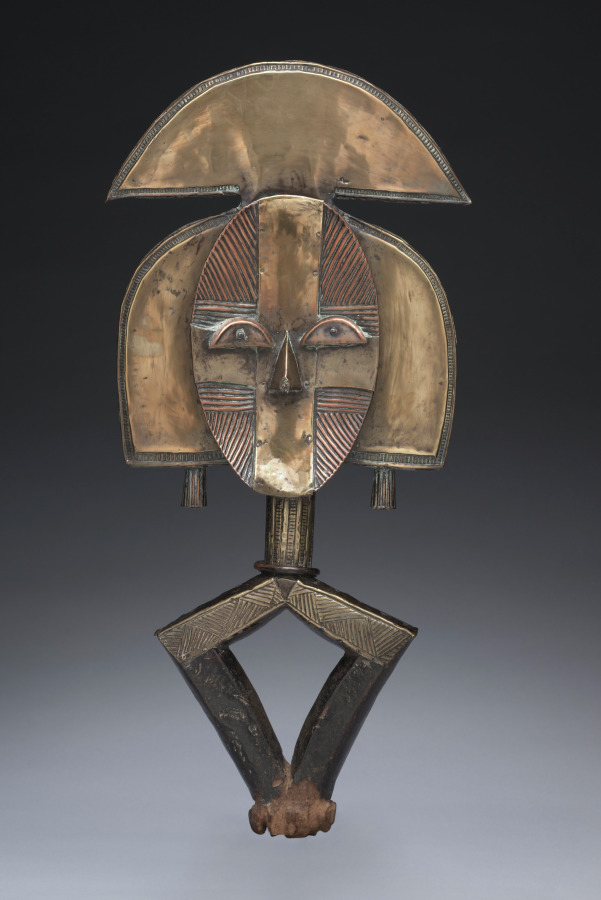
The mbulu ngulu—the sculptural element from a Kota reliquary ensemble—operates not as ornament but as load-bearing abstraction. Its formal logic is relentless: a planar face, often sheathed in brass or copper, is bound to a wooden armature and surmounted by a crest of openwork geometry. The figure is not mimetic; it is a diagram of authority. Every plane is legible, every edge intentional. The object refuses the softness of the organic and instead proposes a body built from interlocking planes: the oval of the face, the lateral wings of the coiffure, the vertical spine of the crest. It is, in the strictest sense, an exoskeleton of meaning.
For Addison Fashion, this is the operative precedent. The 2026 executive silhouette must be read as an armature first, a garment second. The mbulu ngulu demonstrates that authority is achieved through reduction to essential geometry—a lesson in how a single planar gesture can command a room without volume, without excess, without apology.
II. Geometric Integrity: Planar Discipline and the Symmetrical Contract
The object's integrity rests on a symmetrical contract: bilateral balance across a central axis, with the crest introducing a controlled asymmetry of depth. This is not decorative symmetry; it is structural symmetry, the kind that distributes visual weight so that the form reads as inevitable. The face plane is slightly convex, catching light along a single meridian; the wings flare outward at a fixed angle, creating a shoulder line that is both protective and declarative. The openwork crest functions as negative space made active—aeration as architecture.
Translated to the 2026 executive silhouette, this demands planar tailoring: a shoulder that is built, not padded; a lapel that is a folded plane, not a soft roll; a waist that is suppressed through geometric convergence rather than cinching. The silhouette must read as a single continuous argument from collar to hem, with each seam acting as a structural rib. The mbulu ngulu does not drape; it stands. So too must the executive coat, the column dress, the architectural blazer—each a freestanding volume that holds its own edge against the body and the room.
III. Structural Poetics: The Crest as Gesture, the Face as Facade
The poetics of the object lie in its hierarchy of planes. The face is the facade—calm, frontal, impenetrable. The crest is the gesture—radiating, open, almost heraldic. This duality is the core of the 2026 executive proposition: a composed front and a declarative back. Consider the tailored coat with a sculpted back yoke that flares into a standing collar; the column dress with a knife-pleated spine that opens at the shoulder blade. The garment must perform the same front/back dialectic—stillness in the presence, motion in the departure.
Materiality is equally prescribed. The mbulu ngulu binds wood to metal—organic warmth to cold reflectivity—and the tension is the point. For Addison Fashion, this suggests Onyx as the governing color: a deep, light-absorbing black that reads as mineral rather than textile. Pair it with brushed silver hardware—a clasp, a spine of buttons, a single metallic seam—to replicate the object's metal-sheathed plane. The fabric itself must carry body: a double-faced wool, a bonded crepe, a matte silk faille that holds a crease like folded brass. Urban materiality here means cloth that behaves like sheet metal with a memory.
IV. The 2026 Executive Silhouette: A Reliquary for the Body
The definitive 2026 silhouette, derived from this analysis, is a reliquary for the body: a garment that encloses, protects, and elevates the wearer into a symbol. It is Minimalist in category because every element is load-bearing; nothing is applied that does not hold the structure. The shoulder is a fixed plane. The waist is a convergence point. The hem is a terminal edge, not a fade. The color is Onyx, because the object teaches that darkness is a surface for light—the metallic crest, the polished plane, the single reflective gesture against a matte field.
This is the Addison Fashion position: the executive does not dress to blend into the urban field but to stand within it as a legible form. The mbulu ngulu was never a portrait; it was a proposition of presence. The 2026 silhouette must be the same—a geometric argument for authority, worn on the body, cold, exact, and complete.