Urban Form: Transenna Post
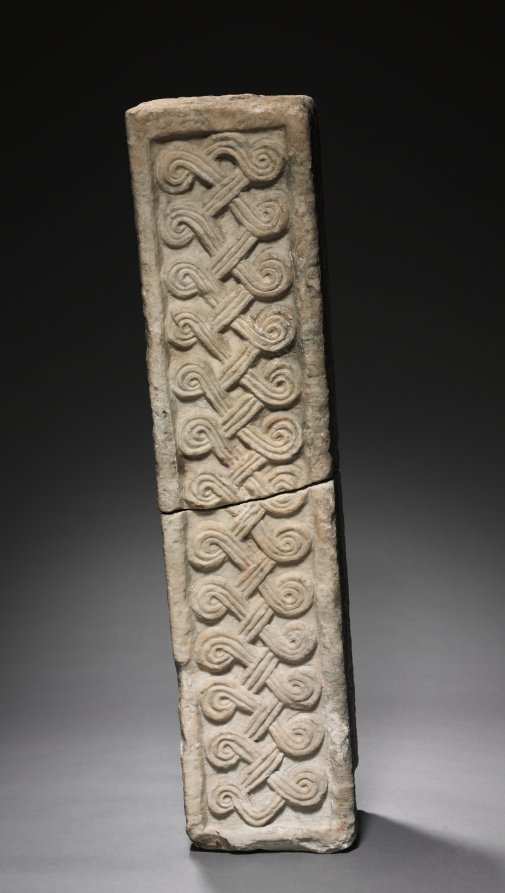
Urban Silhouette Research: Transenna Post — Structural Poetics of the Layered Void
I. Preliminary Taxonomy: The Artifact as Architectural Proposition
The Transenna Post is not, strictly speaking, an object of adornment. It is a load-bearing thesis — a screen-element whose internal logic derives from the same civilizational grammar that governs the Damascus Room and the pedestal of the Daoist immortal He Xiangu. Where the Damascus interior achieves density through stratified cladding — wood, marble, stucco, tile, gilded calligraphy — and where the He Xiangu base achieves ascent through tiered cloud, lotus, and stone, the Transenna Post operates as the vertical seam between these two conditions: the wall that divides and the plinth that elevates. For Addison Fashion's 2026 executive wardrobe, this artifact supplies the governing silhouette: a minimalist armature of interrupted planes, in which structure is legible precisely because void is permitted to remain void.
II. Geometric Integrity: The Perforated Orthogonal
The post's geometry is deceptively severe. Its primary mass resolves into a rectilinear column, yet the column is punctured — transenna, after all, denotes a screen or lattice — and it is this systematic perforation that establishes the artifact's structural poetics. The apertures are not decorative accidents; they are calibrated intervals, repeating at a rhythm that recalls the muqarnas corbelling of the Damascus ceiling and the stacked lotus registers of the He Xiangu base. Three geometric operations define the integrity:
First, the vertical datum. A single unbroken edge runs the full height of the post, functioning as the silhouette's spine. In tailoring terms, this is the shoulder-to-hem line — the uninterrupted seam that gives a coat its authority. The 2026 executive jacket will be cut so that this datum remains visible even when the garment is closed: a continuous front edge, unbroken by lapel roll or pocket flap, asserting verticality over volume.
Second, the negative register. The perforations are proportioned according to a repeating module — roughly square, slightly taller than wide — whose intervals tighten toward the base and loosen toward the crown. This is the same logic of compression and release found in the He Xiangu pedestal, where dense cloud-scroll at the bottom gives way to open sky above. Translated to the body, the 2026 silhouette will be weighted at the hem and lightened at the shoulder: a dense, structured lower register (wool crepe, bonded seams) resolving into a pared-back upper register (unlined shoulder, single-layer facing). The eye is drawn upward, as the devotee's gaze is drawn from pedestal to immortal.
Third, the interrupted plane. The post never presents a solid face. Every surface is broken by aperture, and this is the artifact's most consequential contribution to the executive silhouette. The 2026 wardrobe will reject the monolithic torso in favor of planes that are visibly segmented: a front panel that floats slightly from the body, a side panel that recedes, a back panel that drops cleanly. The garment reads as a screen, not a shell — layered, ventilated, and deliberately incomplete.
III. Urban Materiality: Slate, Shadow, and the Ethics of Restraint
The Transenna Post's material logic is urban in the coldest sense: stone, metal, and shadow. Its surface is matte and non-reflective, absorbing light rather than broadcasting it — the antithesis of the gilded excess that lines the Damascus walls. This restraint is not poverty; it is discipline. The artifact demonstrates that density of meaning can be achieved without density of ornament, provided the intervals are exact. For Addison Fashion, this translates into a material palette of slate-toned wool, brushed silver hardware, and onyx-dyed leather — surfaces that hold shadow, that reward proximity, that refuse to glitter.
The post's weathering — its edges softened by contact, its recesses darkened by accumulation — introduces a temporal dimension that the executive wardrobe must also accommodate. The 2026 silhouette is not pristine; it is inhabited. Seams are pressed open and left visible. Hem allowances are exposed as deliberate bands of contrast. The garment records its own construction, as the post records its own carving.
IV. The Executive Silhouette: A Screen for the Body
The synthesis is unambiguous. The Transenna Post defines a 2026 executive silhouette that is minimalist in surface, structural in cut, and poetic in its handling of void. The coat is a screen: vertical datum, weighted hem, interrupted plane. The suit is a lattice: modular proportion, compression at the base, release at the shoulder. The palette is slate and shadow. The decoration — such as it exists — is the interval itself, the measured gap between solid and absence. This is the lesson of the Damascus Room and the He Xiangu base, distilled to its coldest and most wearable form: density of thought, not density of thread. The executive of 2026 does not wear armor. She wears architecture — perforated, deliberate, and open to the air.