Urban Form: Dish with Ginkgo Leaves
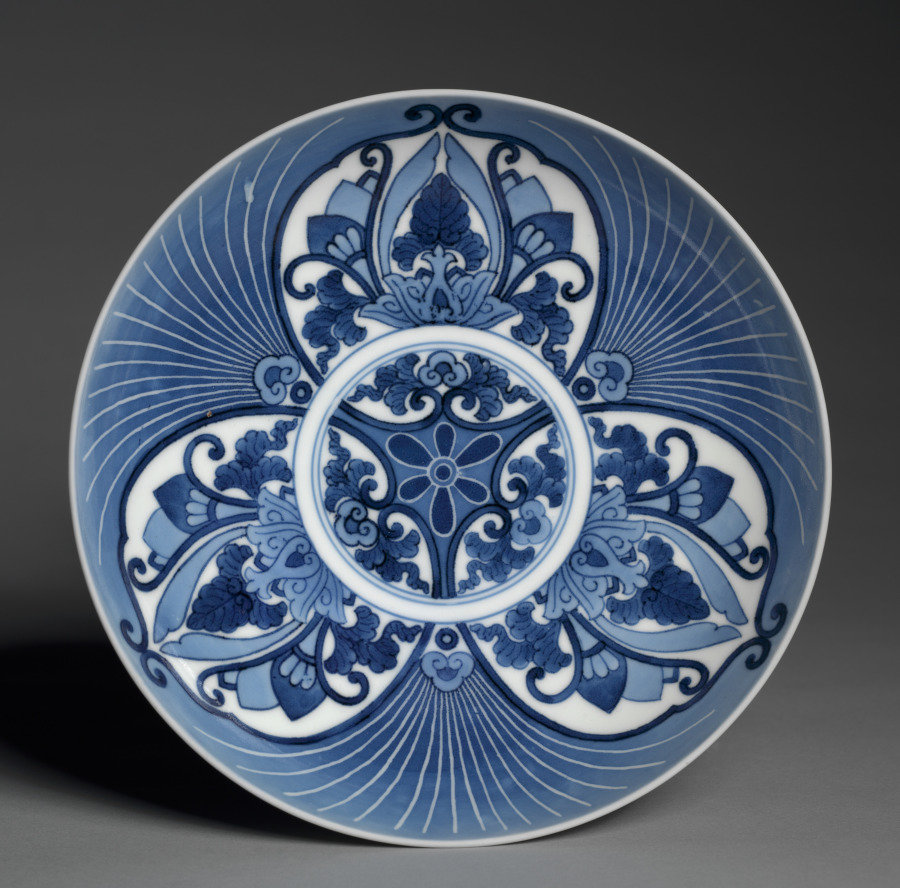
Urban Silhouette Research: Form and Color Deconstruction of the Ginkgo Leaf Dish
I. Formal Taxonomy: The Vessel as Silhouette Proposition
The subject under examination—a dish bearing ginkgo leaf motifs—presents a formal problem of considerable interest to the Addison design intelligence. At first read, the object is a shallow, open vessel: a horizontal plane bounded by a low, continuous rim. Its silhouette is centrifugal rather than centripetal, expansive rather than contained. This is the inverse of the meiping logic cited in the source DNA, where the shoulder swells and the foot contracts to produce a vertical, self-contained column. The dish, by contrast, distributes its visual weight outward across the horizontal axis, establishing a low center of gravity and a broad, stable footprint.
For the 2026 executive wardrobe, this formal distinction is not academic. The dish's geometry translates directly into the cape-and-trouser proposition: a garment whose volume is distributed laterally at the shoulder line while the lower body maintains a disciplined vertical. The ginkgo leaf—fan-shaped, bilaterally symmetrical, with a radial venation that converges at the stem—supplies the internal graphic logic. Each leaf is a self-contained formal unit that repeats across the dish's surface without hierarchical arrangement. This is pattern as democratic repetition, not ornament as decoration. The executive silhouette of 2026 will absorb this principle: tonal jacquards, laser-cut leathers, and engineered knits whose motifs repeat at consistent scale across the garment's plane, producing texture without narrative.
II. Chromatic Analysis: The Ivory Register
The dish's chromatic field operates in the low-chroma, high-value register—what the Addison atelier classifies as Ivory. This is not white in the clinical sense but a warm, mineral-adjacent neutral that carries the optical memory of celadon glaze and unbleached linen. The ginkgo motifs, rendered in a slightly deeper tonal value, function as sub-threshold contrast: visible only upon sustained inspection, invisible at conversational distance. This is the chromatic equivalent of the Song dynasty's anhua (hidden) decoration—meaning disclosed through proximity rather than proclamation.
For the executive wardrobe, the Ivory register demands material differentiation rather than color contrast. A single-garment proposition in Ivory requires the designer to generate visual interest through surface behavior: the matte absorption of wool crepe against the specular reflection of silk charmeuse, the dry hand of paper-touch cotton against the liquid drape of cupro. The 2026 executive will not wear color-blocked statements; she will wear monochromatic constructions whose complexity is legible only to those within her immediate radius. This is power dressing redefined as proximity-based authority.
III. The Void as Structural Principle
The source DNA identifies the dish's empty center as its philosophical core—the void that receives rather than the void that lacks. Formally, this manifests as a negative space bounded by the rim's continuous curve. The ginkgo leaves cluster toward the perimeter, leaving the center relatively open. This is composition by centrifugal evacuation: the eye is drawn outward, not inward.
Translated to garment architecture, this principle informs the open-front coat and the unbelted column dress—silhouettes whose centers are deliberately unresolved, whose closure is implied rather than enforced. The 2026 executive wardrobe will feature outerwear that frames the body without enclosing it: kimono-sleeve trenches, duster coats with raw-edge lapels, wrap constructions that fasten at a single point and drape open below. The void is not absence; it is strategic permeability.
IV. Surface and the Ethics of Restraint
The dish's surface treatment—likely incised or molded rather than painted—produces a tactile register that operates below the threshold of color. The ginkgo veins are relief, not pigment. This distinction matters: the decoration is structural, integral to the clay body, not applied as a subsequent layer. For Addison's 2026 output, this translates to self-fabricating surfaces: double-cloth wool whose pattern emerges from the weave structure, bonded jersey whose color variation is achieved through heat and pressure rather than dye, leather whose grain is manipulated at the tannery rather than printed in the finishing house.
The ethical dimension is explicit. In an market saturated with applied ornament—logo hardware, contrast stitching, digital print—the dish proposes a counter-ethic: decoration as construction. The executive who wears a garment whose interest is intrinsic to its making signals a refusal of the decorative gesture in favor of the engineered surface. This is minimalism not as absence but as compression: meaning held under pressure, released only upon close inspection.
V. Synthesis: The 2026 Executive Proposition
The ginkgo dish, read through the Addison formal lens, yields a coherent wardrobe directive. Silhouette: horizontal expansion at the shoulder, vertical discipline below, with open centers and unresolved closures. Color: the Ivory register, deployed monochromatically, with tonal variation achieved through material rather than pigment. Surface: structural decoration, self-fabricating textiles, relief over print. Philosophy: authority through proximity, complexity through compression, the void as strategic permeability.
The dish is not a vessel for holding. It is a proposition for seeing—and the 2026 executive wardrobe will be its wearable argument.