Urban Form: Muse with Violin Screen
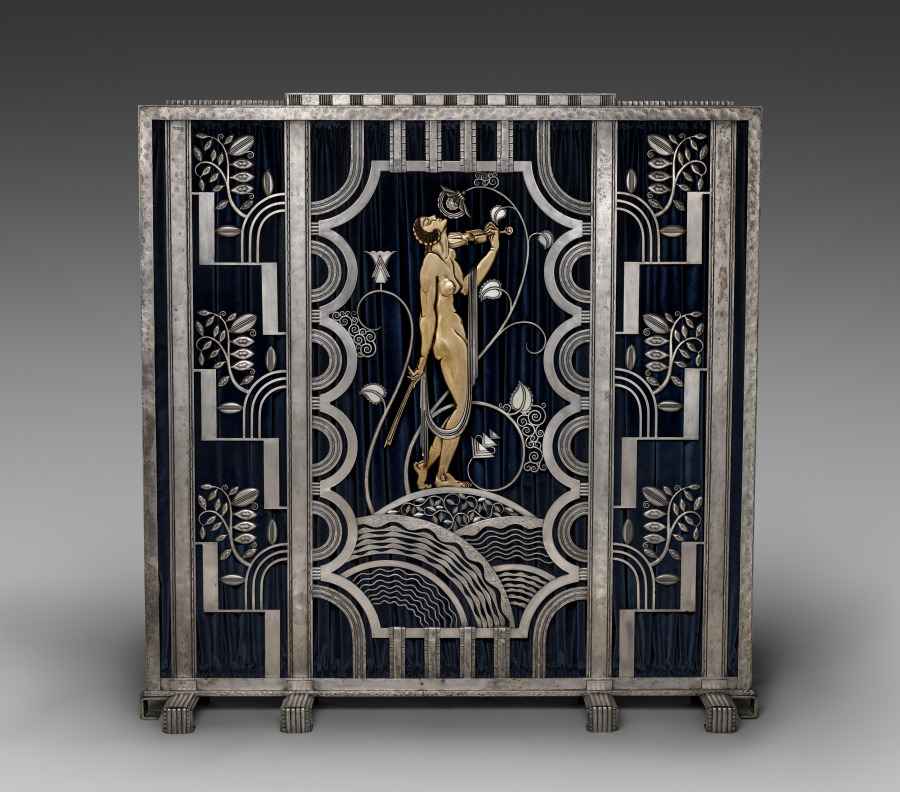
Urban Silhouette Research: The Violin Screen as Structural Artifact
I. Preliminary Observation: The Screen as Boundary Condition
The subject under examination—a muse positioned behind a violin screen—presents an immediate problem of architectural reading. The screen is not ornament; it is a load-bearing partition that divides the visual field into foreground and interior. In the Addison design language, this division is the first principle of the 2026 executive silhouette: the body must be understood as a sequence of planes, not a continuous volume. The violin screen operates as a threshold object, and its geometry—vertical slats, a curved upper register, a rectilinear base—establishes the proportional grammar we will translate into garment structure.
The screen's slats are evenly spaced, yet the intervals are not uniform in visual weight; the eye reads them as a rhythmic column. This is the same logic that governs a tailored coat's vertical seam placement: regularity that is felt rather than counted. The muse behind the screen is partially occluded, and this occlusion is the point. The 2026 silhouette does not reveal the body; it negotiates it.
II. Geometric Integrity: The Slat, the Arc, and the Void
Three geometric primitives organize the composition. First, the slat: a narrow vertical rectangle, repeated, creating a field of parallel lines. Second, the arc: the screen's crest, a shallow curve that resolves the verticals into a single gesture. Third, the void: the negative space between slats, which is as structurally significant as the material itself.
In the Addison atelier, we read the slat as the princess seam—a vertical line that shapes without cinching. The arc is the shoulder line, resolved not as a slope but as a controlled curve that sits slightly forward of the body's natural axis. The void is the ease: the deliberate interval between garment and flesh that permits movement without collapse. The geometric integrity of the artwork resides in the tension between repetition (slats) and singularity (arc). A garment that reproduces only one of these registers fails; it becomes either rigid or formless. The 2026 executive silhouette requires both: repetition for authority, curvature for intelligence.
III. Structural Poetics: The Screen as Disciplined Occlusion
The violin screen is a device of partial visibility. It does not conceal; it frames. This is the poetic core of the artwork and the central proposition for the coming season. The executive woman of 2026 does not present herself as an open surface. She presents herself as a calibrated sequence of reveals—a cuff, a collar edge, a hem that stops precisely where the eye expects continuation.
The screen's slats create a striated reading of the figure behind it. In garment terms, this translates to tonal striping through construction: a slate wool overcoat with a slightly darker slate binding at the lapel, a seam that catches light along the arm, a hem faced in a matte finish against a lustrous body. The poetics are not decorative; they are optical engineering. The eye is guided along verticals and arrested at the arc. This is the same discipline required of a single-breasted column coat in slate: the closure is a vertical, the shoulder is an arc, and the space between them is the garment's argument.
IV. Urban Materiality: Slate, Felt, and the Weight of Restraint
The artwork's material register is cool, dense, and non-reflective. The screen reads as painted wood or oxidized metal; the muse's garment reads as a matte textile with a slight nap. There is no gloss. This is the materiality of the urban executive environment: stone lobbies, brushed steel elevator doors, the flat light of a north-facing office.
For 2026, Addison specifies slate as the governing color—not as a neutral, but as a structural tone that absorbs light and returns authority. The fabrics must carry weight without stiffness: double-faced wool for the outer layer, compact felt for the screen-like panel constructions, fine-gauge knit for the interior column. The surface must be quiet. Any sheen is a distraction from the geometry. The violin screen teaches that materiality is not about texture for its own sake; it is about how a surface receives and holds shadow. A slate felt coat holds shadow in its seams and releases it along the arc of the shoulder. This is the urban materiality we pursue: shadow as a design element.
V. The 2026 Executive Silhouette: A Provisional Specification
The silhouette derived from this analysis is columnar with a controlled arc at the shoulder, executed in slate wool or felt, with vertical seam placement that echoes the screen's slats and a hem that terminates in a clean horizontal. The garment must permit occlusion: a deep side vent, a wrapped front, a collar that stands away from the neck. The body is present but edited. The screen does not hide the muse; it gives her structure. The 2026 executive silhouette does the same: it does not conceal the woman; it gives her a geometry worth reading.
The artwork's final lesson is one of restraint as authority. The screen is not elaborate. The muse is not adorned. Yet the composition holds because every element is placed with intention and left without apology. This is the standard for the coming season. The Addison executive silhouette will be minimal, slate, and structurally exact—a garment that functions as a screen: framing the wearer, disciplining the eye, and refusing the decorative.