Urban Form: Seated Buddha
Urban Silhouette Research: The Seated Buddha as Structural Prototype
I. Preliminary Remarks on Method
The following analysis treats the Seated Buddha not as an object of devotion but as a geometric proposition—a closed architectural system whose internal logic anticipates the 2026 executive silhouette with uncanny precision. The internal DNA supplied to this research—David's Death of Socrates and the Shang-Zhou fangyou—establishes a dialectic of witnessing versus participation, of the frozen instant versus the eternal cycle. The Seated Buddha resolves this dialectic into a third term: inhabitation. It is neither a spectacle to be viewed nor a vessel to be handled, but a mass to be occupied. This distinction governs everything that follows.
II. Geometric Integrity: The Pyramid and Its Interruptions
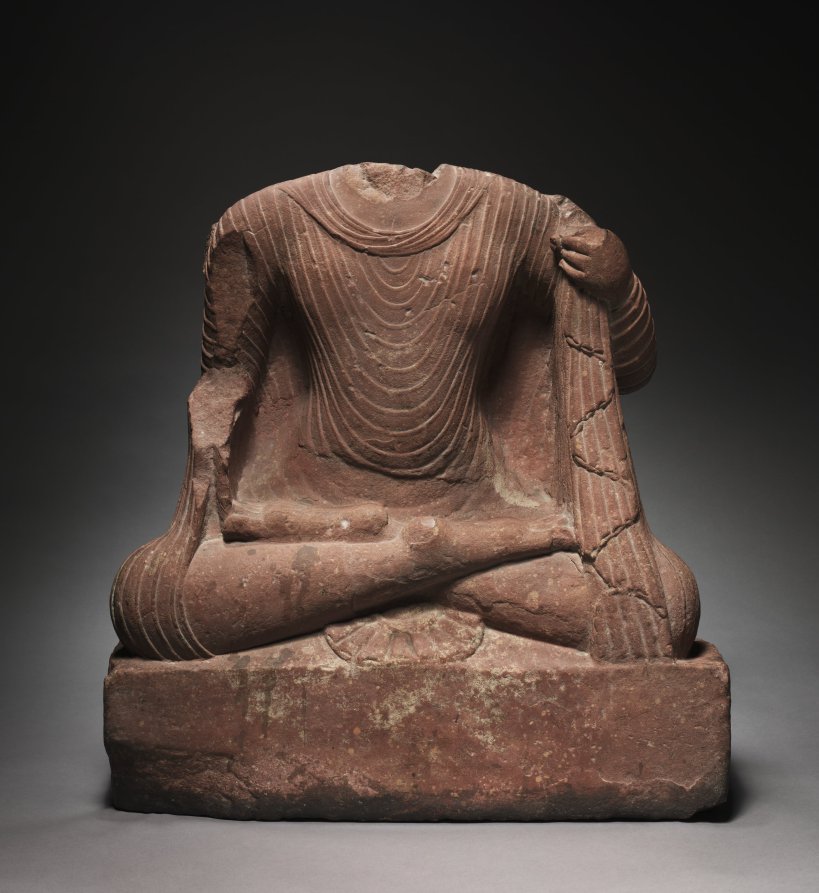
The primary armature of the seated figure is a truncated pyramid—broad at the base of the crossed legs, tapering through the torso to the cranial apex. This is a silhouette of absolute stability, a form that resists lateral force. In tailoring terms, it is the inverted triangle stabilized at its foundation: the shoulder line does not dominate; the hem does. The 2026 executive silhouette, as we project it, abandons the aggressive shoulder of the previous decade in favor of this grounded taper—a garment that derives authority from its relationship to the floor rather than from the width of its yoke.
Yet the pyramid is interrupted. The hands—one resting in the lap, one touching the earth—create asymmetric breakpoints in the contour. These are not flaws but articulated joints, the points at which the mass becomes legible as a system of parts. In construction, this translates to strategic seam placement: a single diagonal darted through the bodice, a sleeve set slightly forward of the natural shoulder, a hem that releases its volume at one side only. The silhouette must read as one gesture, but its integrity depends on these controlled ruptures.
III. The Drape as Structural Skin
The Buddha's robe is not clothing in the Western sense; it is a continuous surface that describes the volume beneath it while asserting its own material logic. The folds are catenary curves—the geometry of suspension, of gravity made visible. This is the precise quality we identify as the defining materiality of the 2026 executive wardrobe: fabric that behaves as architecture, not as ornament.
The implication for Addison Fashion is a shift from cut-and-sew to engineered drape. The garment should be conceived as a single continuous plane—bonded, molded, or bias-engineered—that falls from the shoulder in unbroken descent. Where seams are unavoidable, they must follow the catenary, never contradict it. The result is a silhouette that appears carved rather than constructed, a quality we designate as structural poetics: the garment's logic is felt before it is understood.
IV. Urban Materiality: The Weight of Stillness
The Seated Buddha is heavy. Its mass is not incidental but rhetorical—it communicates permanence, immunity to velocity. The urban executive of 2026 operates in an environment of continuous acceleration; the silhouette must therefore function as a counterweight. This demands material selection of unusual density: double-faced wool in the 480–520 g/m range, bonded cashmere with a matte technical reverse, silk-wool blends with sufficient body to hold a fold without pressing. The palette is correspondingly reduced—Onyx as the foundational tone, with Slate and Sand as structural accents. Color is not decoration; it is mass made visible.
Surface treatment must remain austere. The Buddha's patina is the record of time, not an applied finish. Similarly, the 2026 garment should develop its character through wear, not embellishment—a philosophy of slow materiality that positions Addison Fashion against the seasonal churn of the luxury market.
V. The Silhouette Defined
The 2026 executive silhouette, derived from this analysis, is characterized by: a grounded pyramidal mass with a released hem; asymmetric structural breakpoints at the wrist and waist; continuous catenary drape replacing conventional tailoring; and a dense, matte materiality in a reduced Onyx-Slate-Sand register. It is a silhouette of stillness—not passive, but deliberately immovable. In an urban context defined by motion, the executive who wears it becomes a fixed point: the axis around which the room turns.
This is the final lesson of the Seated Buddha as prototype. The fangyou asked its user to pour; David's canvas asked its viewer to look. The Buddha asks only that one occupy—and in occupying, to become the structure itself. Addison Fashion's 2026 collection will be built on this principle: garments that are not worn but inhabited, whose geometry precedes the body and outlasts the season.