Urban Form: Panel from a Triptych: St. Anthony Abbot
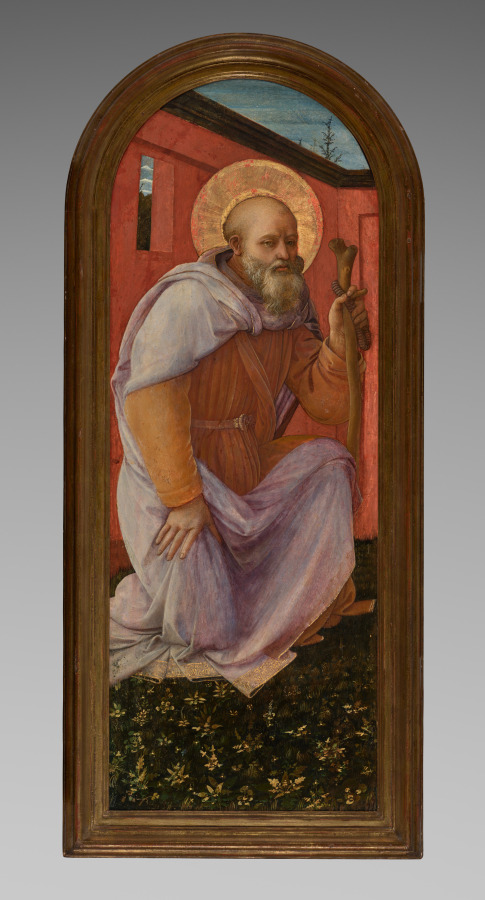
Urban Silhouette Research: Panel from a Triptych — St. Anthony Abbot
I. Geometric Integrity: The Vertical Ascetic
The panel presents a closed geometric system governed by a single dominant axis. St. Anthony Abbot is constructed as a vertical column—a narrow, unbroken plumb line from the hood’s apex to the hem’s terminal edge. This is not a silhouette of gesture but of architectural restraint. The figure’s mass is distributed with cold precision: the shoulders form a near-horizontal shelf, the sleeves descend as parallel conduits, and the robe’s hem resolves into a stable trapezoidal base. The composition reads as a load-bearing structure, where every fold is a calculated deflection of weight rather than an organic accident.
What defines the geometric integrity is the tension between the figure’s interior volume and its exterior contour. The robe does not drape; it encloses. The silhouette is sealed—no exposed limb disrupts the perimeter, no accessory breaks the line. This hermetic quality is the panel’s central structural proposition: a body rendered as a self-sufficient envelope, legible from a distance as a single, unambiguous form. For the 2026 executive silhouette, this translates into a doctrine of closed volume—garments that hold their own shape without relying on the body beneath, where the wearer inhabits the architecture rather than the architecture following the wearer.
II. Structural Poetics: The Monastic Column and the Urban Body
The poetics of this panel reside in its refusal of ornament as structural logic. The robe’s vertical folds function as load paths, channeling visual weight downward with the inevitability of a colonnade. There is no waist suppression, no tailored interruption—the form is continuous, a single-span elevation from shoulder to floor. This continuity is the poetic core: a silhouette that does not negotiate with the body’s curves but instead overrides them with a higher order of geometry.
For the 2026 executive, this suggests a silhouette that operates as urban infrastructure—a garment conceived as a building rather than a covering. The monk’s hood becomes a cowl-neck structural element, the sleeves become tubular volumes with the rigidity of poured concrete, and the hem becomes a grounding plane that anchors the figure in space. The poetics are cold, deliberate, and anti-sentimental: the silhouette does not express emotion; it declares presence. In the urban context, this is the executive as monolithic marker—a figure whose outline is immediately legible against the city’s visual noise, whose form communicates authority through geometric certainty rather than decorative excess.
III. Urban Materiality: Slate, Wool, and the Weight of Silence
The panel’s materiality is implied through its tonal restraint. The palette is Slate—a cool, mineral gray that absorbs light rather than reflecting it. This is not the gray of softness but the gray of stone, of overcast sky, of urban pavement after rain. The robe’s surface suggests a dense, matte textile—heavy wool, felted cashmere, or a bonded technical fabric with the hand of monastic cloth. The material must carry weight, both literal and visual, to sustain the silhouette’s architectural integrity.
In urban terms, this materiality translates into fabrics that hold a crease, that resist drape, that maintain a plane. The 2026 executive silhouette demands materials with structural memory—double-faced wool, compact gabardine, bonded jersey—textiles that behave like sheet metal in their ability to form and retain a shape. The surface should be non-reflective, a deliberate rejection of the glossy, the performative, the attention-seeking. This is the materiality of quiet permanence: a fabric that does not announce itself but instead endures, that gains authority through density and opacity rather than sheen.
IV. The 2026 Executive Silhouette: A Synthesis
The St. Anthony Abbot panel offers a definitive template for the 2026 executive silhouette: a closed, vertical, load-bearing form executed in dense, matte, slate-toned material. The geometry is monolithic—a single continuous volume from shoulder to hem, with no waist interruption, no exposed limb, no decorative aperture. The poetics are ascetic—authority conveyed through restraint, presence through silence, power through the refusal to negotiate with the body’s natural contours. The materiality is urban and mineral—fabrics that behave like architecture, that hold their shape with the indifference of stone.
This is not a silhouette of comfort or ease. It is a silhouette of conviction—a garment that stands as a structural statement in the urban landscape, a form that does not ask to be read but demands to be reckoned with. The monk’s column becomes the executive’s column: a vertical assertion of order in a horizontal world. The 2026 silhouette, derived from this panel, is the body as building, the garment as infrastructure, the executive as monument—cold, precise, and utterly unyielding.