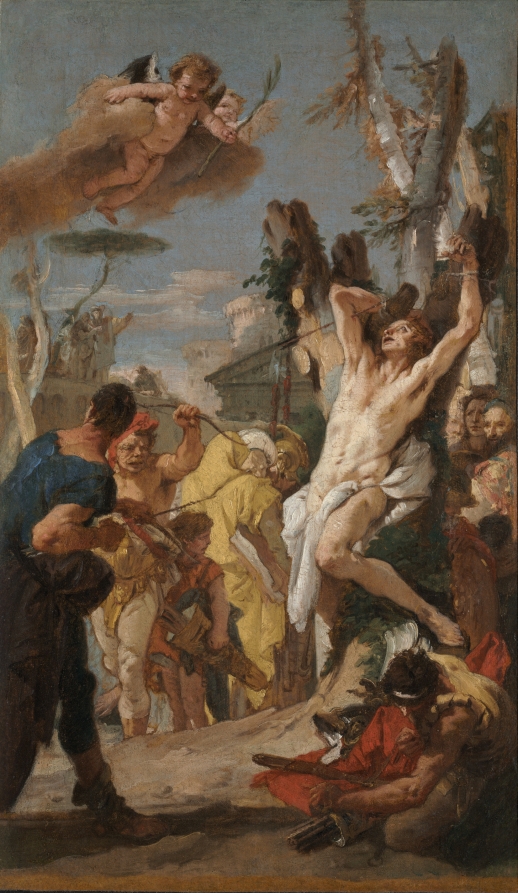
Urban Form: Study for "The Martyrdom of Saint Sebastian" (for the Augustinian monastery at Diessen, Germany)
Urban Silhouette Research: The Diessen Sebastian and the Architecture of Endurance
Preliminary Note on the Source Object
The subject under examination is a study for The Martyrdom of Saint Sebastian, executed for the Augustinian monastery at Diessen. The work is not a finished altarpiece but a structural proposition—a rehearsal of tension, torsion, and the disciplined distribution of mass. What concerns Addison Fashion is not its iconography but its geometric integrity: the manner in which the figure is organized as a system of counterweights, and the way the arrow—instrument of penetration—functions as a linear device that both violates and completes the body's architecture. The study is, in essence, a diagram of controlled collapse. This is the precise vocabulary of the 2026 executive silhouette.
The Vertical Axis and the Refusal of Softness
Observe the spine of the composition. It is not a curve but a calibrated deviation from the vertical—a plumb line deliberately displaced by a few degrees, sufficient to generate tension without forfeiting authority. The 2026 executive silhouette adopts this principle without apology. The shoulder is set, the waist is suppressed rather than cinched, and the fall of the garment is permitted to occur only along a single, uninterrupted axis. There is no accommodation for the body's informal gestures. The tailoring does not follow the torso; it negotiates with it, establishing a boundary that is at once protective and declarative.
This is the first law of the collection: the silhouette must read as a decision, not an adaptation. Where the Sebastian study fixes the figure against the diagonal thrust of the arrow, the garment fixes the wearer against the diagonal of the urban day—meetings, transit, negotiation—without permitting that diagonal to distort the line. Structure is not ornament. Structure is the argument.
Planar Severity and the Poetics of the Fold
The study's drapery is instructive. It does not flow; it fractures into planes. Each fold is a decision about light—where the surface will receive illumination and where it will withhold it. The resulting geometry is severe, almost lithic, and it is this lithic quality that the 2026 silhouette transposes into cloth. Wool crêpe, bonded cashmere, and dense technical gabardine are selected not for their hand but for their refusal to yield under pressure. A lapel is pressed to a knife edge. A seam is bound rather than finished, so that the interior construction becomes a visible discipline.
The fold, in this reading, is a unit of urban materiality. It records the body's movement without sentimentalizing it. When the executive walks, the garment should register the walk as a series of resolved planes—never as a ripple, never as a drape. The poetics here are austere: cloth as architecture, seam as syntax.
The Arrow as Fastener: Interruption as Completion
The most radical proposition of the Diessen study is that the wound is structural. The arrow does not destroy the composition; it completes it, supplying the counter-diagonal that the figure requires. The 2026 silhouette absorbs this logic into its hardware. Closures are placed on the bias. A single visible zip runs counter to the grain. A belt is anchored at an asymmetric point, introducing a deliberate interruption that resolves the garment's otherwise unrelieved verticality. These are not decorative gestures. They are load-bearing interventions, and they are calibrated to the millimeter.
The result is a silhouette that appears, at first reading, to be under assault by its own details—and then, on second reading, to be entirely dependent upon them. This is the executive condition rendered in cloth: composure produced by managed pressure.
Materiality and the Urban Surface
The study's surface is matte, absorptive, resistant to glamour. The collection follows. Slate-toned textiles are chosen for their capacity to hold shadow rather than reflect it. Finishes are sanded, brushed, or bonded to suppress sheen. Metal hardware is limited, darkened, and deployed sparingly—each piece of hardware must justify itself as a structural necessity rather than an accent. The urban environment is a machine for abrasion; the garment must meet it with a surface that records rather than resists, developing a patina of use that is legible as authority.
Conclusion: The Disciplined Figure
The Diessen study is a document of endurance—a body organized into geometry, penetrated by a line, and held in perfect equilibrium. The 2026 executive silhouette is its sartorial translation: a vertical axis, a fractured plane, a deliberate interruption, a matte surface. Nothing is softened. Nothing is narrated. The garment does not describe the wearer; it constructs the conditions under which the wearer may be read. This is the final position of Addison Fashion for the coming season: structure as ethic, silence as authority, and the silhouette as the only statement worth making.