Urban Form: Dish with Ginkgo Leaves
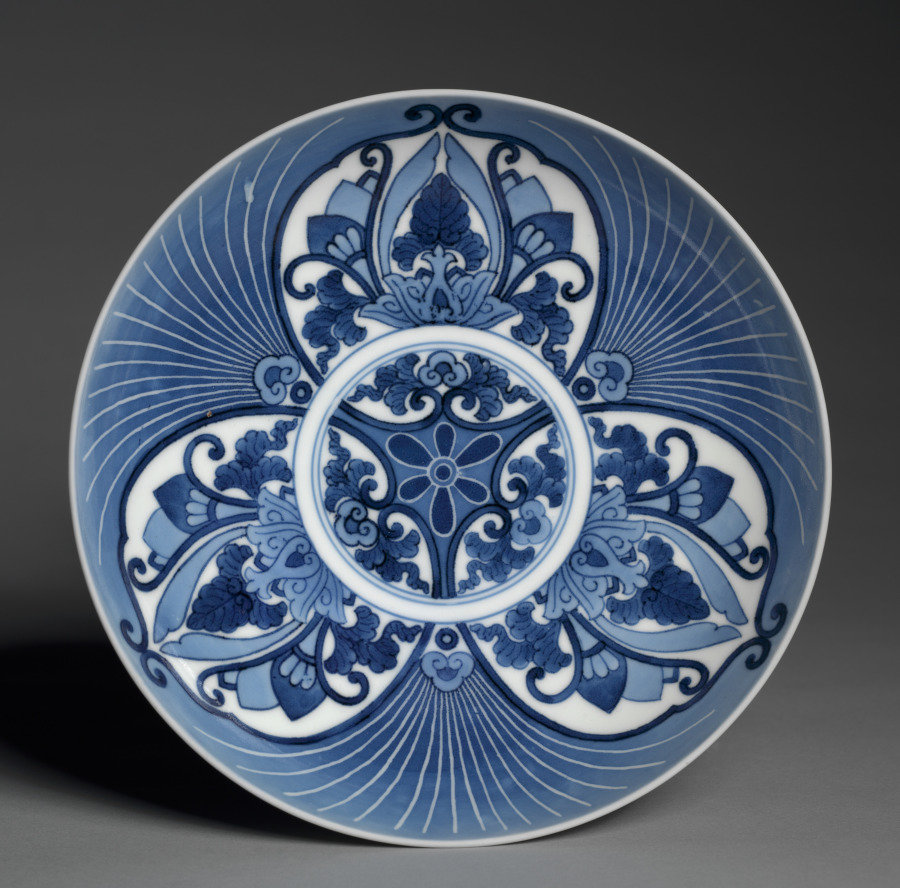
Urban Silhouette Research: The Vessel and the Void — A Technical Deconstruction of Form
I. Preliminary Thesis: The Two Registers of Form
The subject under examination — a dish bearing ginkgo leaves — presents a formal problem of considerable sophistication. It operates simultaneously in two registers: the register of the vessel (a functional object whose value resides in its interior void) and the register of the painted surface (a decorative field whose value resides in its legibility). This duality is not incidental; it is the structural DNA from which the 2026 executive silhouette must be derived. The ginkgo, with its bilobed fan and dichotomous venation, functions as the mediating motif — a botanical form that is at once ornamental and architectural, organic and geometric.
The analytical frame is borrowed from the juxtaposition of David's Death of Socrates and the Greek Jar. The former represents total presence — narrative, light, dramatic resolution. The latter represents silent containment — the self-sufficiency of the vessel, the eloquence of the void. The Addison position for 2026 is unambiguous: the executive wardrobe must migrate from the Davidian register toward the ceramic one. Not because narrative is obsolete, but because the urban environment has saturated narrative to the point of exhaustion. What remains scarce — and therefore luxurious — is containment.
II. Formal Analysis: The Dish as Silhouette Generator
The dish is a shallow concavity. Its formal signature is the low-amplitude curve — a perimeter that rises gently from center to rim, creating a contained volume without the vertical assertion of a jar or the spherical closure of a pot. Translated to garment architecture, this yields a silhouette defined by horizontal continuity and minimal vertical interruption. The shoulder line is not built; it is permitted. The waist is not cinched; it is acknowledged through the negative space of the cut rather than the positive pressure of construction.
The ginkgo leaf introduces a countervailing formal logic. Its venation is dichotomous — each vein bifurcates repeatedly, producing a fractal distribution that is dense at the margins and sparse at the base. This is a model for asymmetric detailing: the concentration of visual weight at the periphery of a garment (hem, cuff, lapel edge) while the core remains uninflected. The 2026 Addison executive jacket will therefore exhibit a deliberate peripheral density gradient — a technical term we use internally to describe the migration of seam work, topstitching, and fabric manipulation away from the torso and toward the extremities. The center front is clean. The hem carries the argument.
III. Color Logic: Slate as the Chromatic Equivalent of the Void
The color directive is Slate — not charcoal, which is too declarative; not silver, which is too reflective; not sand, which is too warm. Slate occupies the precise chromatic midpoint between the mineral and the atmospheric. It is the color of the unglazed ceramic surface after firing, the color of the shadow cast by a vessel upon a plaster wall. In the context of the dish, slate functions as the ground against which the ginkgo motif is read — and this ground-figure relationship is the operative principle for the 2026 palette.
Technically, slate is achieved through a desaturated blue-gray with a cool undertone, typically in the L* 45–55 range with a* and b* values held within ±3 of neutral. This narrow chromatic band permits the layering of multiple slate tones — a matte wool suiting at L* 48, a silk crepe at L* 52, a brushed cashmere at L* 45 — without the visual noise that arises from even minor hue shifts. The result is a monochromatic depth field in which form is read through texture and shadow rather than color contrast. This is the chromatic equivalent of the ceramic void: present, articulate, but never assertive.
IV. Application to the 2026 NYC Executive Wardrobe
The translation from dish to wardrobe proceeds through three formal operations:
1. The Contained Volume. The dish's shallow concavity informs a tailoring philosophy of permitted ease — garments that acknowledge the body without compressing it. The executive blazer for 2026 will feature a lowered armhole and a reduced shoulder pad, producing a silhouette that drapes from the acromion rather than constructing a synthetic shoulder line. The result is a form that contains the wearer as the dish contains its contents: with precision, but without grip.
2. The Peripheral Argument. The ginkgo venation model dictates that detail migrates to the margin. The 2026 Addison trouser will exhibit a clean front and a hand-finished hem with visible pick stitching — a detail that rewards proximity and punishes distance. This is the sartorial equivalent of the dish's rim: the point at which the vessel's function becomes visible as form.
3. The Silent Surface. The ceramic register demands suppression of logo, hardware, and contrast stitching. The 2026 wardrobe will be read through cloth and cut alone — a proposition of considerable commercial risk and corresponding cultural authority. The executive who wears Addison in 2026 is not signaling affiliation; she is demonstrating the confidence of the void.
V. Conclusion: The Ethics of Containment
The dish with ginkgo leaves is not a decorative object. It is a formal argument about the relationship between surface and volume, between ornament and use. The 2026 Addison wardrobe adopts this argument as its operating thesis: that the most sophisticated urban silhouette is the one that contains without constraining, that speaks through margin rather than center, and that achieves its authority through the disciplined refusal of narrative. The vessel does not explain itself. It holds. The wardrobe, likewise, will hold the executive — in slate, in silence, in form.