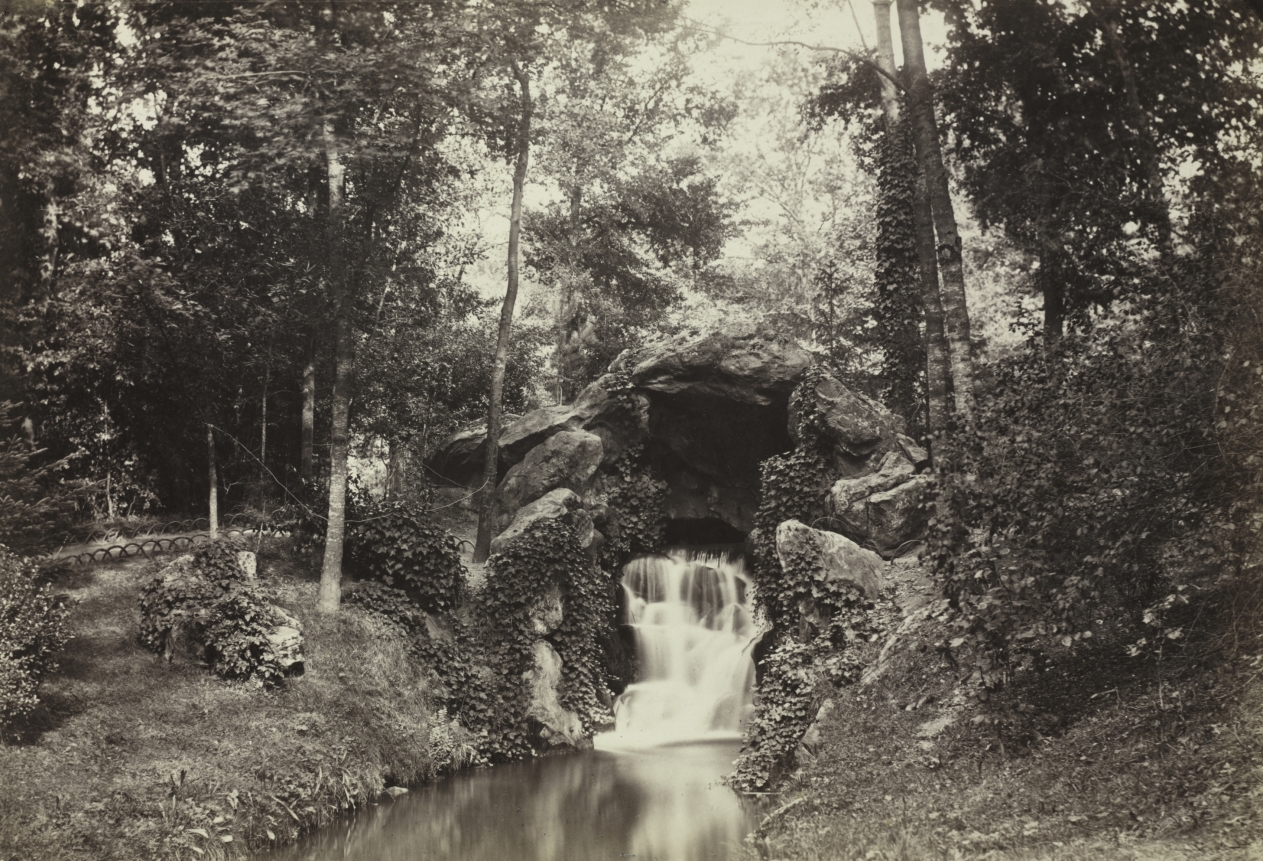
Urban Form: View of the Small Grotto toward the Deer Pond, Bois de Boulogne
Urban Silhouette Research: The Grotto as Structural Prototype
I. The Architecture of Withdrawal
The Bois de Boulogne grotto, viewed toward the deer pond, presents a proposition that is fundamentally architectural rather than picturesque. Its significance for Addison Fashion lies not in its romanticism but in its geometric integrity: a deliberate compression of space, a controlled aperture framing a measured expanse of water. The grotto operates as a threshold—stone enclosing void, mass articulating absence. This is the governing logic of the 2026 executive silhouette. The garment must function as the grotto functions: a constructed envelope that does not decorate the body but frames its interiority. The silhouette of the coming season is not expansive; it is recessed. It draws the eye inward through a disciplined aperture of proportion—shoulder, lapel, hem—toward a still center.
II. Stone, Water, and the Discipline of Contrast
The grotto's materiality is instructive. Rough-hewn stone meets the reflective plane of the pond; the mineral and the fluid are held in strict opposition. This is the dialectic that will define urban materiality in 2026. Addison's tailoring must enact the same contrast: dense, matte surfaces against controlled luminosity. Slate wool of substantial weight, its surface dry and light-absorbing, paired with the cold sheen of a silk underlayer or a brushed-metal hardware. The grotto does not soften its stone to accommodate the water; it permits the water to exist within its frame. Similarly, the executive wardrobe must not resolve the tension between structure and fluidity but stage it. A coat of architectural shoulder over a column of liquid drape. The contrast is not decorative—it is epistemological. It communicates a wearer who holds both rigor and receptivity in a single gesture.
III. The Aperture as Tailoring Principle
Consider the grotto's opening—the arch through which the pond is seen. It is not a window; it is a calibrated cut. Its edges are precise, its proportion deliberate. This is the principle of the lapel, the neckline, the vent: the aperture that determines how the interior is read. In the 2026 silhouette, apertures will narrow. Necklines will rise and close; lapels will be cut with a cleaner, more vertical line; the waist will be indicated not by cinching but by the convergence of planes. The body is not exposed but disclosed—selectively, through geometry. This is minimalism as discipline, not absence. The grotto is empty of ornament, yet its every surface is intentional. So too the executive garment: no superfluous seam, no gratuitous detail, but a total structural logic in which every line serves the aperture.
IV. The Deer Pond: Proportion and the Long View
The pond extends beyond the grotto's frame—a horizontal calm that refuses the verticality of the stone. This relationship between the contained and the continuous is the essence of urban poetics. The executive silhouette of 2026 must acknowledge that it is seen at distance and in motion. Its proportions must read across a room, across a street, across the reflective plane of a glass façade. This demands a longer line: a coat that falls below the knee, a trouser that breaks with deliberation, a shoulder that holds its architecture without aggression. The grotto's view is not a close inspection; it is a composition. The wardrobe must function as composition—legible at twenty meters, resolved at one.
V. Materiality and the Patina of Use
The grotto is weathered. Its stone carries the record of moisture, shadow, and time. This is not decay but evidence. Addison's 2026 materials must anticipate patina: wools that hold a crease with authority, leathers that darken at the fold, metals that oxidize with restraint. The urban executive does not require the pristine; she requires the durable. The grotto's surfaces are not new, yet they remain exact. This is the standard: garments that acquire character without losing their geometry, that record use without surrendering their line.
VI. Conclusion: The Silhouette as Threshold
The grotto toward the deer pond is, finally, a threshold structure—a built form that mediates between the enclosed and the open, the mineral and the fluid, the immediate and the distant. The 2026 executive silhouette must assume the same mediating function. It stands between the wearer and the urban field, framing both. It is not a costume of authority but an architecture of composure: slate-toned, precisely apertured, materially honest, and resolved in its proportions. The grotto does not announce itself; it holds. The Addison garment must do the same—hold the body, hold the gaze, hold the silence between stone and water.