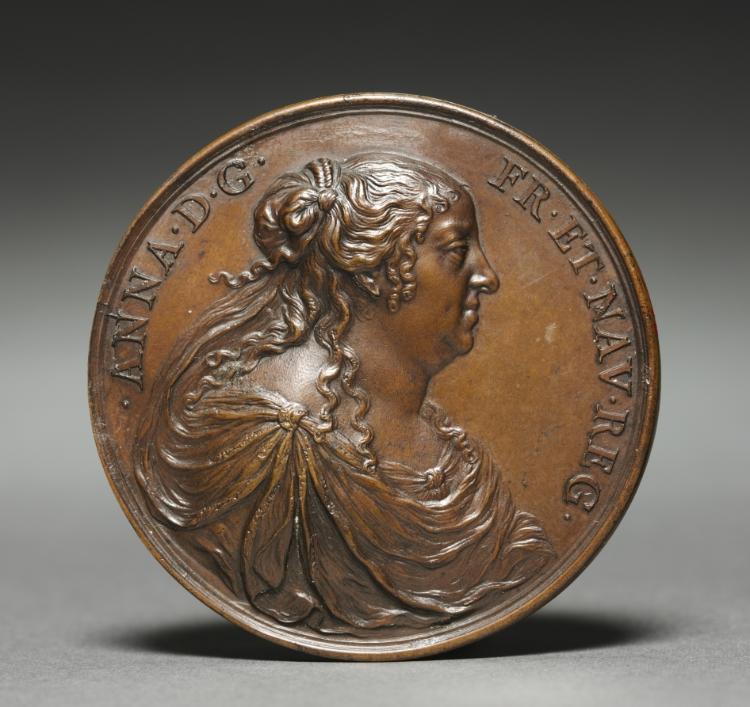
Urban Form: Medal of Anne of Austria (obverse)
Urban Silhouette Research: The Medal of Anne of Austria as Structural Prototype
I. Numismatic Geometry and the Architecture of Authority
The obverse of the Medal of Anne of Austria presents a closed compositional system of extraordinary discipline. The portrait bust is inscribed within a perfect circle—a boundary that is not merely decorative but constitutive. Every fold of drapery, every modulation of the coiffure, every contour of the regal profile submits to the gravitational logic of the circumference. This is not ornament; it is containment as ideology. The medal operates as a self-sufficient architectural unit, a microcosm in which power is rendered legible through geometric restraint.
For the 2026 executive silhouette, this numismatic circularity translates into a governing principle: the body as a bounded volume. The Addison wardrobe for the coming cycle will reject the centrifugal drift of recent seasons—the exaggerated shoulder, the ballooned sleeve, the unstructured cascade—in favor of a centripetal discipline. Garments will be conceived as closed systems, their perimeters resolved with the finality of a struck medal. The shoulder line, in particular, will assume the function of the medal's rim: a definitive edge that announces the boundary between interior and exterior, between the self and the urban field.
II. Relief, Bas-Relief, and the Poetics of Surface Tension
The medal's technical achievement lies in its bas-relief—the shallow projection of form from a planar ground. The portrait does not emerge from the field; it presses against it, creating a tension that is simultaneously optical and tactile. The drapery folds are rendered as ridges and valleys, a topography of compressed volume. This is materiality at its most economical: no excess, no superfluity, only the precise calibration of depth required to generate presence.
Translated into textile, this principle demands fabrics that hold relief without bulk. The Addison atelier will privilege double-faced wool, bonded crepe, and micro-felted cashmere—materials that possess structural memory, that can be pressed into architectural folds and retain their edge. The goal is not softness but controlled density: cloth that behaves like struck metal, that registers light along its ridges, that communicates authority through surface tension rather than volume. A jacket, in this schema, is not a covering but a relief—a shallow, deliberate projection of the wearer's presence into space.
III. The Profile as Urban Signature
The medal's obverse is, fundamentally, a profile—a lateral projection that privileges contour over façade. The face is read as a sequence of edges: the brow, the nose, the lip, the chin, the throat. This is the silhouette as linear argument, a statement made entirely through the boundary between figure and ground. In the urban context, where the executive is perpetually perceived in motion—crossing lobbies, entering vehicles, ascending stairs—the profile is the primary register of identity. The frontal view is a luxury of stillness; the profile is the operative image.
The 2026 Addison silhouette will therefore be engineered for lateral legibility. Collars will stand away from the neck with the crispness of a medal's rim. Shoulder seams will be set slightly posterior, creating a forward thrust that reads as intent. Hemlines will be resolved with the precision of an inscribed edge—no fray, no ambiguity. The garment must function as a portable architecture of profile, legible at a glance, resolved at every angle, indifferent to the softening effects of ambient light.
IV. Inscription, Restraint, and the Ethics of Ornament
Note the medal's inscription: a circumscribed legend that frames the portrait without competing with it. The text is subordinate to the image, its function to contextualize rather than to decorate. This hierarchy—image over inscription, form over ornament—is the ethical core of the Addison approach. The 2026 collection will admit no applied decoration that does not serve a structural purpose. Hardware will be functional and minimal: a single concealed closure, a precisely engineered seam, a hem weighted with intention. The urban executive does not require embellishment; she requires resolution.
The medal endures because it refuses excess. It is a closed system, a perfect circle, a profile struck with finality. The Addison silhouette for 2026 will aspire to the same condition: a garment that is not a gesture but a declaration—cold, exact, and complete.