Urban Form: Seated Buddha
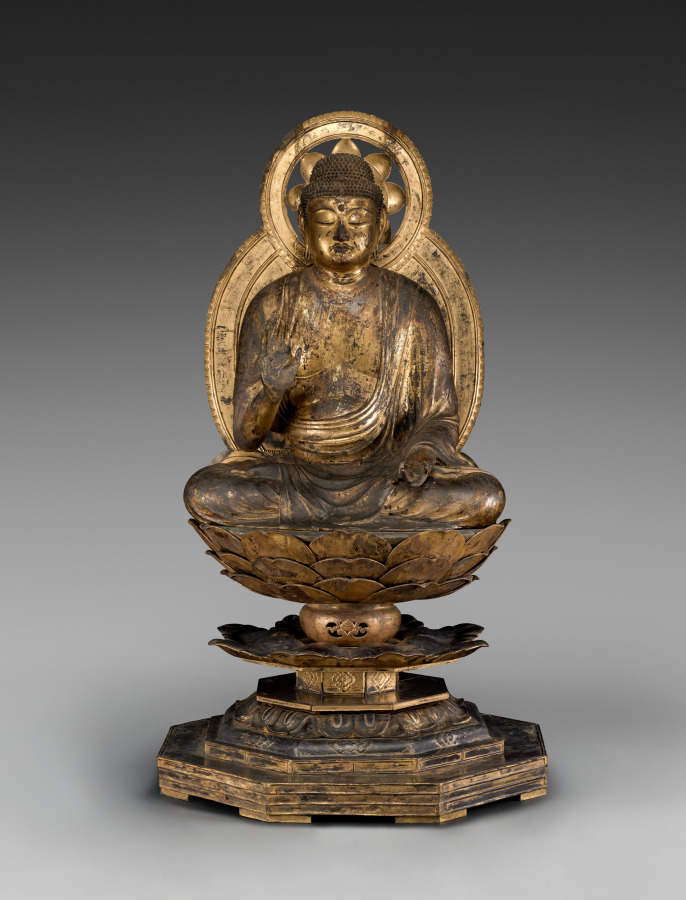
Urban Silhouette Research: The Seated Buddha as Structural Prototype for the 2026 Executive Form
I. The Geometry of Stillness: A Preliminary Reading
The seated Buddha is not a figure of repose. It is a figure of engineered equilibrium—a triangulated mass in which the base, the torso, and the cranial apex resolve into a closed system of load-bearing planes. For Addison Fashion, this is the operative insight: the 2026 executive silhouette must be read as a structure under compression, not a garment draped over a body. The Buddha's crossed legs establish a horizontal foundation of absolute stability; the rising torso forms a tapered column; the shoulders describe a shallow arc that distributes weight outward and downward. The result is a silhouette that does not decorate the body but replaces its organic uncertainty with architectural certainty.
II. Triangulation and the Collapse of the Waist
The most consequential geometric event in the seated Buddha is the suppression of the waist. The form moves from a broad, grounded base directly into an ascending torso without the intervention of a cinched midpoint. This is a deliberate refusal of the hourglass—a refusal that Addison Fashion translates directly into the 2026 executive line. The waist, in this reading, is not a point of emphasis but a zone of transition, resolved through paneled construction and a continuous front plane. The silhouette becomes a single, unbroken wedge: wide at the hem, narrowing at the shoulder, capped by the cranial dome. In urban terms, this is the geometry of the civic monument—a form that occupies space with authority and refuses to negotiate with the eye.
III. The Hand Gestures as Articulated Detail
The Buddha's hands—one resting in the lap, one touching the earth—function as articulated joints within an otherwise monolithic mass. They are the only points of asymmetry, and they are precisely calibrated. For Addison Fashion, this translates into the single point of deviation permitted within a Minimalist system: a precisely placed seam, a shifted closure, a cuff that breaks the vertical line at the wrist. The lesson is one of controlled interruption. The 2026 executive silhouette cannot be uniformly austere; it requires one deliberate gesture—a lapel that folds at an unexpected angle, a sleeve that terminates in a squared plane—to prevent the form from becoming inert. The Buddha touches the earth; the garment touches the city.
IV. Materiality: The Surface as Argument
The stone of the seated Buddha is not passive. Its surface records the tension between the carver's intention and the material's resistance—a record of negotiated hardness. Addison Fashion's 2026 material program must operate on the same principle. Slate-toned wool crepes, bonded with a micro-weave that holds a crease without stiffness; matte technical gabardines that absorb light rather than reflect it; double-faced cashmere bonded to a structural interlining that allows the garment to stand away from the body at the hem while remaining close at the shoulder. The surface must read as compressed geological time—not smooth, not rough, but resolved.
V. The Void as Structural Component
Critically, the seated Buddha is not a solid mass. The space between the crossed legs, the negative volume beneath the draped robe, the hollow of the lap—these are active voids that allow the form to breathe and to be read as architecture rather than sculpture. The 2026 executive silhouette must incorporate the same principle: the gap is the garment. A coat that stands away from the body at the hem, a trouser that breaks cleanly over the shoe without pooling, a jacket that maintains a consistent interior volume regardless of the wearer's movement—these are the urban equivalents of the Buddha's negative spaces. They are not absences; they are calculated intervals that give the silhouette its rhythm.
VI. Conclusion: The Silhouette as Civic Statement
The seated Buddha resolves the central problem of the 2026 executive wardrobe: how to project authority without ornament, stability without rigidity, and presence without excess. Its geometry is triangulated, waistless, and void-dependent—a closed system that nonetheless admits air and light. Addison Fashion's translation is direct: Slate-toned, Minimalist, structurally resolved. The silhouette does not follow the body; it completes it, the way the Buddha's form completes the stone from which it was carved. In the urban field, this is the final argument: the garment is not worn. It is occupied.