Urban Form: Gothic Bevor
Preliminary Taxonomy: The Architecture of Absence
The Gothic Bevor arrives not as a garment but as a proposition—a structural interrogation of the space between protection and exposure. In the genealogy of Eastern aesthetics, beauty manifests not through monumental declaration but through the whisper of the inconspicuous. The Udumbara flower, that void-bloom inscribed upon temple placards, never appears; its absence constitutes its entire presence. Similarly, the Chest for Storing Garments—a vessel for memory, for the sediment of time upon fabric—closes rather than reveals. Both objects share a singular aesthetic bloodline: the refusal to lay meaning upon the surface. The Gothic Bevor operates within this exact dialectic. It is armor that negates armor. It is coverage that performs as aperture.
Geometric Integrity: The Bevor as Negative Space
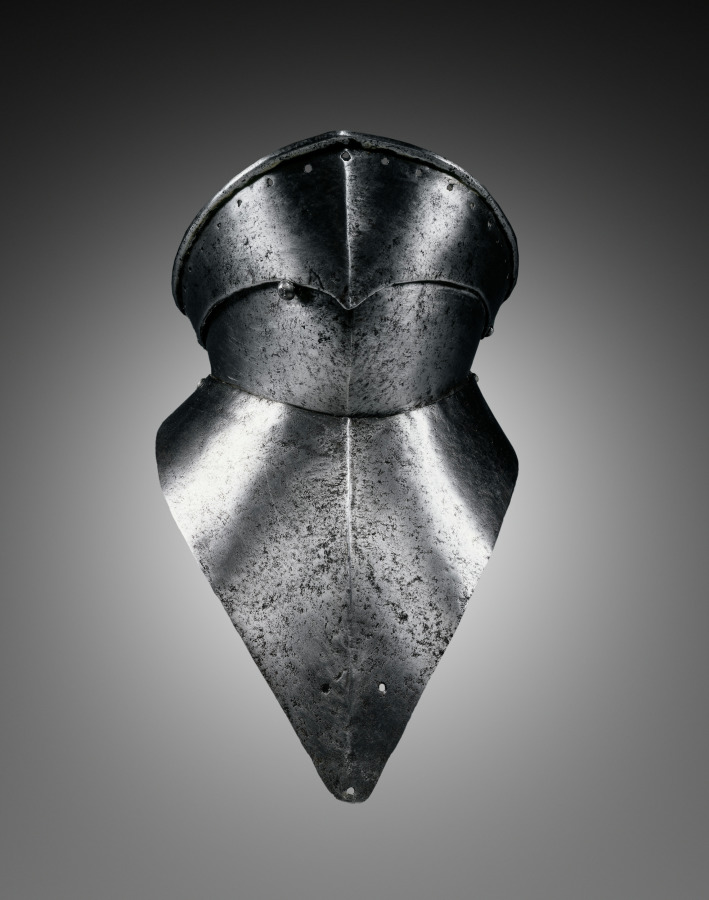
The bevor—historically a plate defense for throat and jaw—here undergoes radical abstraction. Its geometry is not additive but subtractive. The silhouette does not build outward from the body; it carves inward, creating a concave architecture around the cervical column. The neck, that most vulnerable articulation of the executive form, becomes encased in a floating plane of Onyx wool-silk, its edges laser-cut to a precision that recalls neither tailoring nor armory but architectural section drawing. The geometric integrity resides in the tension between the rigid trapezoid of the chest plate and the fluid drape of the rear cowl—a controlled asymmetry that reads as both fortification and surrender.
This is not decoration. This is structural poetics. The bevor's front panel rises to the mandible in a single unbroken plane, its surface interrupted only by a horizontal seam that functions as a horizon line—a visual equator dividing protection from exposure. Below, the garment releases into a bias-cut column that skims the torso without contact, creating a microclimate of air between skin and cloth. The executive silhouette of 2026 demands precisely this: garments that perform authority through spatial generosity rather than constriction.
Urban Materiality: Onyx as Medium and Message
The color specification—Onyx—is not chromatic choice but material argument. Onyx absorbs light. It does not reflect, does not announce. In the urban landscape, where surfaces compete for attention through gloss and glare, the Onyx Gothic Bevor operates as a visual sink, a point of gravitational density that pulls the eye inward rather than outward. The fabric specification—a bonded wool-silk with a matte cerement finish—ensures that the garment reads as monolithic at distance and micro-textured at proximity. This dual register is essential to the Addison Fashion philosophy: the executive presence must function at both the boardroom's ten-meter remove and the handshake's thirty-centimeter intimacy.
The material's urban materiality extends to its acoustic properties. The bonded construction dampens sound—the rustle of movement, the friction of fabric against itself—creating a silence of dress that mirrors the temple placard's void. In the cacophony of the metropolitan grid, the Gothic Bevor produces quiet. This is luxury as sonic restraint.
The 2026 Executive Silhouette: Armor Without Aggression
The 2026 executive silhouette, as defined by this garment, rejects both the power-shoulder aggression of the 1980s and the formless fluidity of the 2010s. It proposes instead a third geometry: the protective column. The Gothic Bevor establishes a vertical axis from mandible to hem that is unbroken, unornamented, and unapologetically severe. Yet within this severity, the rear cowl introduces a controlled collapse—a deliberate softness at the occiput that acknowledges the human necessity of movement, of breath, of the slight forward inclination that precedes speech.
This is the dialectic of 藏与显—concealment and revelation—translated into tailoring. The bevor conceals the throat, that seat of voice and vulnerability, while revealing the jaw's architecture. It conceals the chest's topography while revealing the shoulders' width through a single horizontal seam. The garment does not describe the body; it edits it. And in this editing, it performs the highest function of executive dress: it renders the wearer legible without being readable.
Coda: The Void as Signature
The Gothic Bevor, like the Udumbara flower upon its placard, signifies through absence. Its geometric integrity is the integrity of the unfilled space—the gap between armor and skin, between protection and exposure, between the garment's silence and the city's noise. In the Addison Fashion cosmology, this is not a garment for the executive who wishes to be seen. It is a garment for the executive who wishes to be sensed—as pressure, as gravity, as the quiet center of a room that does not need to announce its own authority. The bevor closes. And in its closure, it opens.