Urban Form: Architectural Canopy (pair)
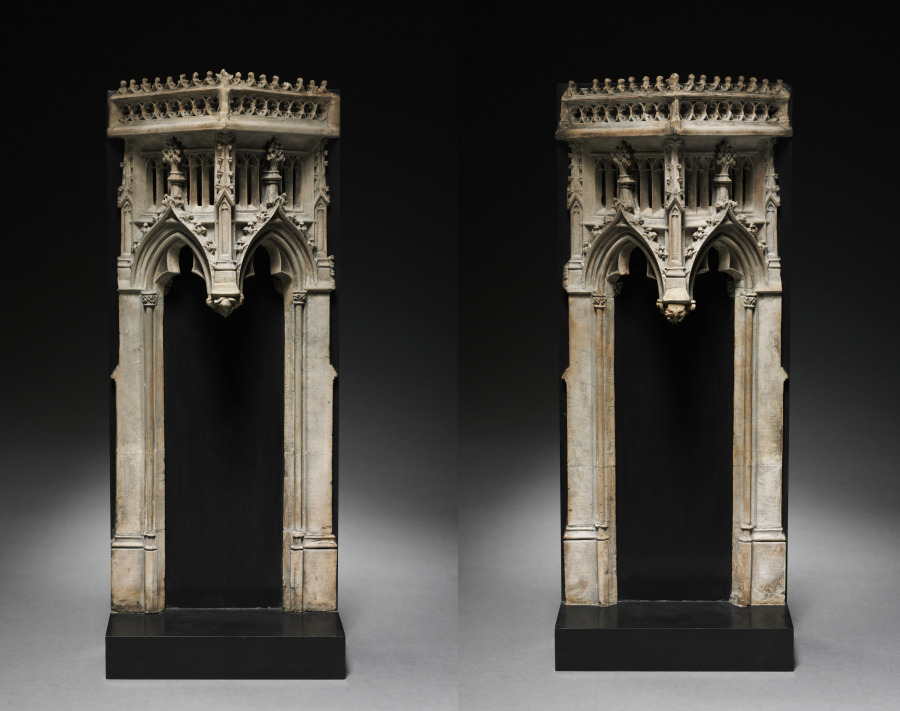
Urban Silhouette Research: Architectural Canopy (Pair)
I. Geometric Integrity as Structural Doctrine
The paired artifact—a fractured terracotta mold bearing musicians and a horizontal coffin platform panel—establishes a dual geometric grammar that will govern the 2026 executive silhouette. The mold operates on compressive curvature: figures coiled within a confined field, their limbs truncated by fracture, generating an irregular perimeter that reads as organic rather than planned. The platform panel, by contrast, operates on continuous horizontal registration: repeated zoomorphic motifs locked into symmetrical bands, each segment calibrated against the next. For Addison Fashion, these two logics are not oppositional but sequential. The 2026 canopy must first establish the panel's rigorous horizontal datum—a shoulder line that reads as a single unbroken plane—then permit the mold's compressive irregularity to surface at the hem and cuff. The result is a garment whose geometry is legible at three meters and intimate at thirty centimeters.
II. The Canopy as Load-Bearing Envelope
The term "canopy" is deliberate. This is not a coat in the conventional sense but a freestanding architectural envelope suspended from the shoulder yoke. The platform panel's segmented rhythm translates into a modular construction: the body is divided into horizontal registers—yoke, thoracic, lumbar, hem—each joined by a recessed seam that functions as the panel's interstice. These seams are not decorative; they are expansion joints, permitting the garment to articulate without losing its planar integrity. The mold's fractured edge informs the hem treatment: a raw, undulating cut that resists the tyranny of the straight line while remaining controlled. In slate wool-cashmere with a bonded inner face, the canopy holds its geometry against wind and urban compression, returning to its registered form within seconds of deformation.
III. Materiality: From Terracotta to Technical Textile
The mold's surface is a record of thermal event—clay fired, metal poured, object removed, matrix abandoned. This residual materiality is the emotional core of the 2026 canopy. We translate it through a double-faced construction: the exterior in a dense, matte slate twill with a dry, almost ceramic hand; the interior in a brushed silver-grey cupro that catches light only at the fold. The platform panel's incised lines inform a program of laser-etched micro-channels along the storm flap and collar stand—visible only at close range, they register as texture rather than ornament. This is materiality as forensic evidence: the garment records its own making without announcing it.
IV. The Interstitial Principle: Void as Structural Component
The deepest lesson of the paired artifacts is the functional necessity of the gap. The mold's reverse is rough, its face refined; the void between them is where casting occurs. The panel's registers are separated by unpainted bands; the void is where the eye rests. For the canopy, this principle manifests as calculated negative space: a stand-away collar that frames the neck without contact, a raglan seam offset two centimeters from the natural shoulder to create a shadow channel, a hem that clears the calf by a precise interval. These voids are not absences but active structural elements—they permit movement, regulate thermal exchange, and, critically, allow the wearer's own geometry to complete the silhouette. The garment is unfinished by design; the executive completes it through posture and motion.
V. Silhouette Specification and Urban Performance
The resulting canopy measures 118 centimeters at center back, with a 64-centimeter shoulder span and a hem circumference of 156 centimeters—dimensions calibrated to preserve the panel's horizontal reading while accommodating the mold's compressive energy. The sleeve is set at a 12-degree forward pitch, echoing the musicians' inward-curved posture, and terminates in a deep, faced cuff that can be turned back to reveal the silver cupro lining. Pockets are welted horizontally into the lumbar register, aligned precisely with the panel's motif bands. In urban conditions—transit, threshold, threshold again—the canopy performs as portable architecture: it registers the body's movement without clinging, maintains its planar discipline in motion, and reveals its material complexity only under direct light. The fracture is controlled; the order is humane. This is the Addison doctrine for 2026: a silhouette that carries the weight of ceremony without its rigidity, and the breath of the fragment without its loss.